

Reporting and analysis may discuss allegations and online theories. Allegations are not findings of guilt. Verify important details in the cited public record.
The Case File
For almost 16 months, police in Gwinnett County were not just chasing smashed windows. They were watching a pattern spread across parking lots, driveways, work vans, stolen vehicles, and eventually an alleged safe house in East Point. By the time prosecutors announced the indictment, the number attached to the case was no longer small enough to treat like random theft.
492 vehicles.
7 defendants.
1 alleged RICO conspiracy.
The Gwinnett County District Attorney’s Office accused Javaris Cardell Gamble, Myles David Cameron, Kylija Devion Yates, Randy D. Martinez, Emmanuel Carvarria-Ornelas, Giovanni Louis Bell, and Kejuan Miliam of participating in a large entering-auto operation between Nov. 24, 2022, and Mar. 28, 2024. Prosecutors say the group targeted nearly 500 vehicles, stole guns, cash, tools, and other items, used stolen cars to move between crime scenes, and returned stolen property to a safe house in the East Point area of Fulton County.
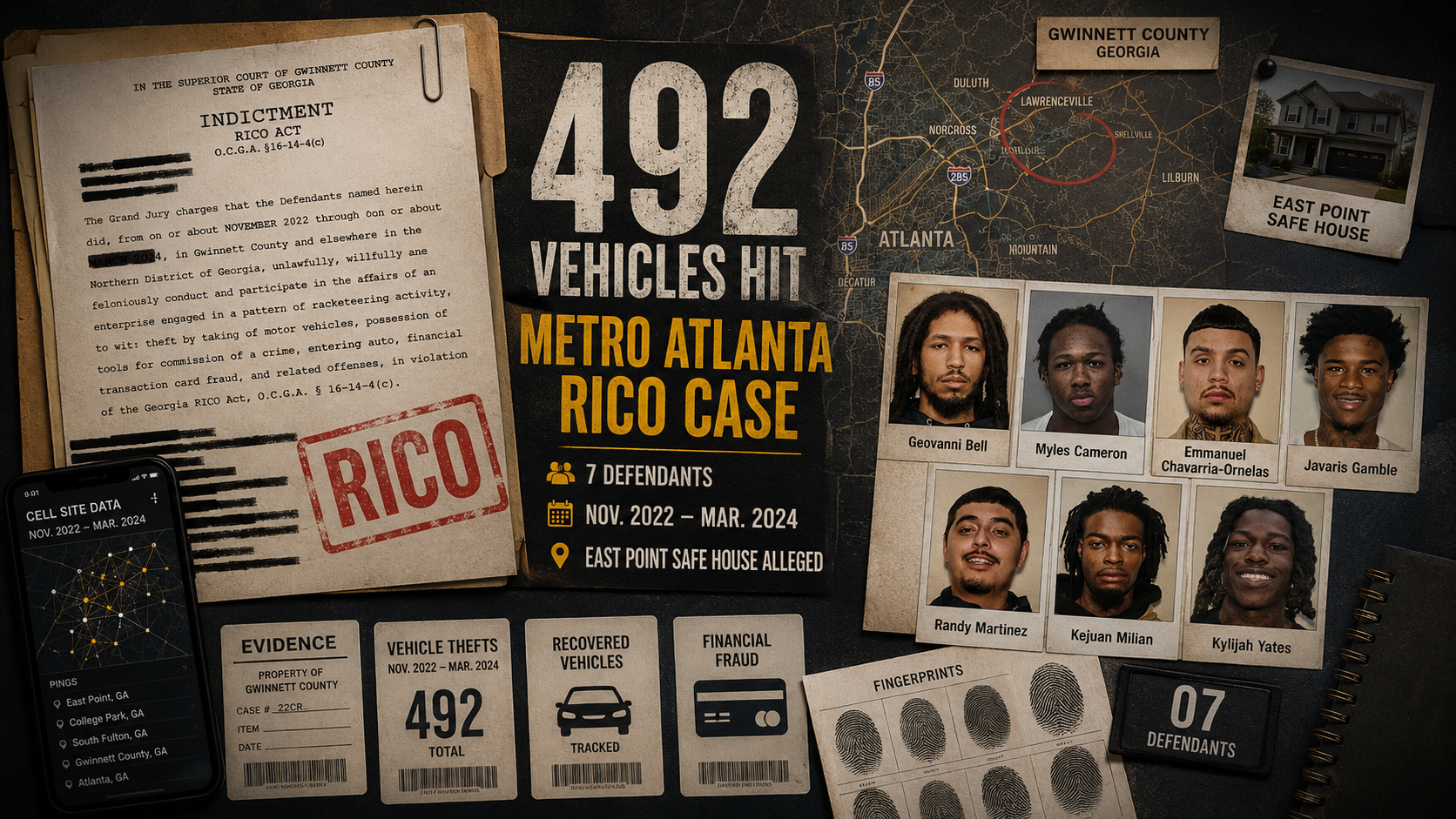
This case stands out because of the way it moved from a local theft investigation into a racketeering indictment. A normal car break-in case usually lives and dies with one scene, one victim, and whatever evidence officers can pull from a damaged vehicle. This file became something larger because investigators say the same pattern kept repeating across multiple locations. Work vans were hit at night. High-end painting equipment disappeared. Stolen vehicles were allegedly used to reach new scenes, then discarded after the crimes. Surveillance footage, fingerprints, DNA, phone data, and recovered vehicles started giving detectives pieces of a much bigger structure.
Then came Traymore Drive.
According to officials, on July 19, 2023, a homeowner discovered members of the alleged crew breaking into a vehicle in Norcross. Police say someone armed with a gun opened fire. The homeowner was not hit, but that allegation changed the entire weight of the case. Prosecutors were no longer describing only stolen property. They were describing a crew accused of breaking into cars, stealing firearms and cash, and allegedly being willing to shoot when confronted.
An indictment is not a conviction. Every defendant is presumed innocent unless proven guilty in court. But the official record makes one thing clear: Gwinnett investigators believed they were not looking at isolated break-ins. They believed they were looking at an organized operation.
The Charges

The seven defendants were charged with violating Georgia’s Racketeer Influenced and Corrupt Organizations Act. The indictment also included charges connected to aggravated assault, entering an automobile or other motor vehicle with intent to commit theft or felony, entering an automobile, theft by taking, and misdemeanor criminal trespass.
The RICO charge is the center of the case because it allows prosecutors to argue that the alleged crimes were not separate accidents, separate break-ins, or unrelated thefts. The state’s theory is that the defendants were connected through a larger pattern of activity. That is why the case is more serious than the headline makes it sound. The number of vehicles matters, but the structure behind the number matters more.
Prosecutors say the break-ins happened between Nov. 24, 2022, and Mar. 28, 2024. Over that stretch, investigators accused the group of targeting 492 vehicles. The alleged items stolen included guns, cash, tools, and other property. Police also said the group stole multiple cars from Gwinnett County, then used those stolen cars to commit more entering-auto crimes in neighboring counties.
If convicted on the RICO charges, each defendant could face up to 20 years in prison.
The Defendants Named In The File
The official Gwinnett County release named 7 defendants.
Javaris Cardell Gamble, 23, was listed as one of the men charged in the RICO case. Atlanta News First reported that Gamble was arrested in August 2023 for his alleged involvement and was accused of being the group’s ringleader.
Myles David Cameron, 22, was also named in the indictment. According to reporting, Cameron had been arrested in February 2023 on multiple entering-auto counts connected to the investigation. Police said that arrest did not end the case because investigators believed more people were involved.
Kylija Devion Yates, 23, was named as another defendant charged in the RICO case. Some local reporting spelled the first name as Kylijah, but the official Gwinnett County release listed the name as Kylija Devion Yates.
Randy D. Martinez, 24, was charged in the case and, according to the official release, had been arrested in Florida by the time Gwinnett County announced the indictment. At the time of that announcement, officials said Martinez was awaiting extradition to Gwinnett County.
Emmanuel Carvarria-Ornelas, 24, was listed in the official Gwinnett County release as a defendant. Some news reports spelled the name as Chavarria-Ornelas, but the official county release used Carvarria-Ornelas in the defendant list and Chavarria-Ornelas later in the custody update.
Giovanni Louis Bell, 27, was named in the indictment. At the time Gwinnett County announced the case on June 6, 2024, officials said Bell remained at large.
Kejuan Miliam, 24, was also named in the RICO indictment. At the time of the public announcement, officials said Miliam had not been captured.
The custody status in this file reflects the public announcement from June 6, 2024. Any later arrest, bond, plea, dismissal, or court movement would need to be confirmed through current court records before being presented as updated fact.
How The Pattern Started
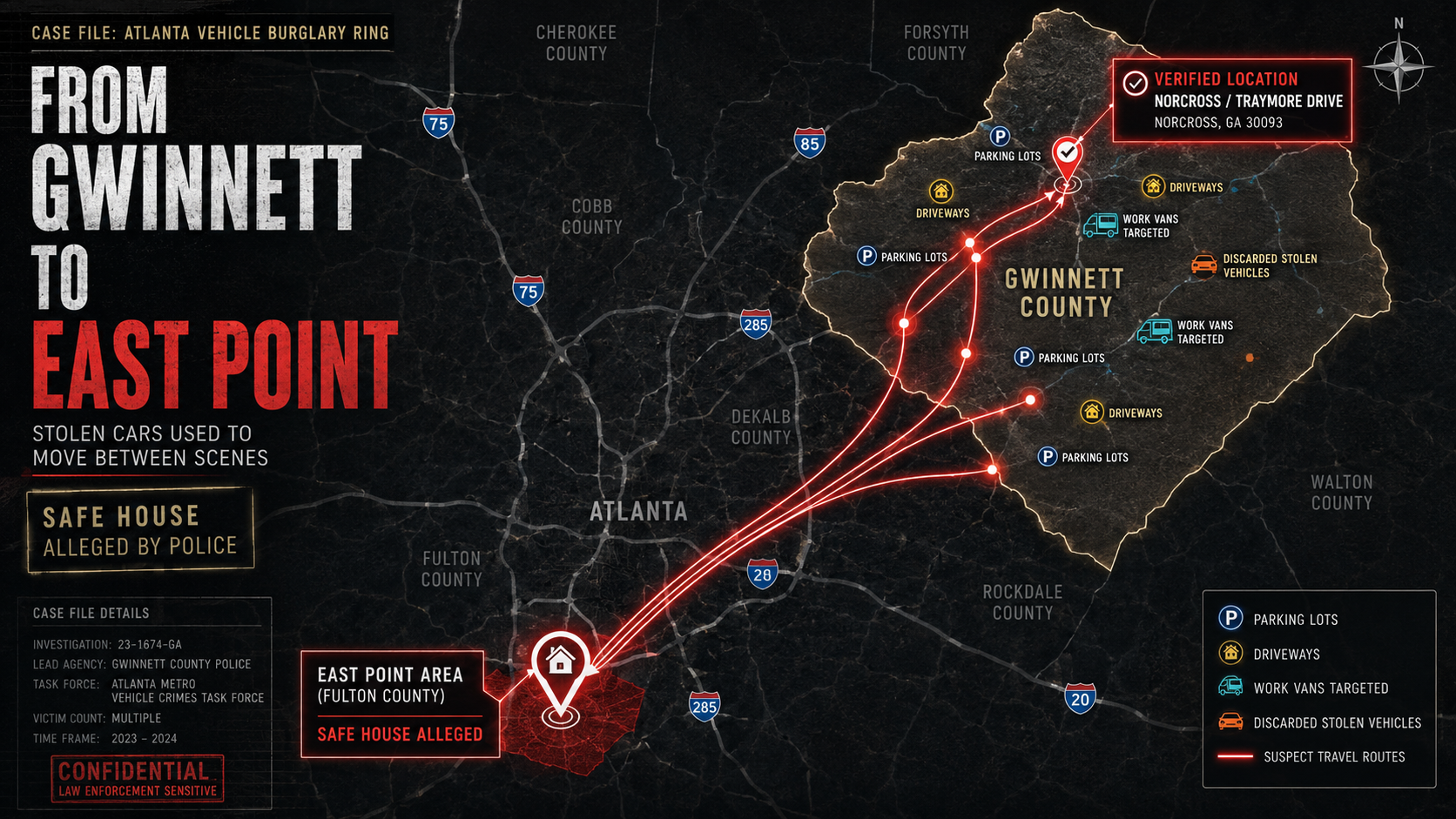
The case began with a pattern that looked specific enough for detectives to notice. Gwinnett County Police said investigators started seeing work vans being broken into at night. The items being taken were not random loose change or phone chargers. Police said high-end painting equipment and tools were being stolen.
That detail matters because work vans are not the same as ordinary passenger cars. They often carry expensive equipment, trade tools, and materials that can be sold, traded, or moved quickly. Once detectives saw the same type of target being hit repeatedly, the investigation shifted from simple theft reports into pattern recognition.
According to reporting, Myles Cameron was arrested in February 2023 on multiple entering-auto counts connected to the cases. But investigators did not believe Cameron explained the entire wave. The break-ins continued, and police kept seeing signs that more people were involved.
By June 2023, the pattern returned with more force. Police described a multi-night entering-auto and vehicle-theft spree across Gwinnett County. The suspects allegedly used stolen vehicles to move between crime scenes, which made the investigation harder. A stolen car gives a crew distance from their own identity. It can be used to arrive, commit the break-ins, leave quickly, and then disappear once the vehicle is dumped.
Police said detectives were able to recover many of those stolen vehicles after they were used and discarded. Once the vehicles were collected, detectives and crime scene specialists processed them for evidence. That is where a break-in wave can start turning into a larger case. Every recovered vehicle can potentially carry prints, DNA, surveillance links, property, phone-location clues, or connections to other scenes.
The Method Prosecutors Described
Police described the alleged method as fast and organized. The group would allegedly pull into parking lots and break into several vehicles quickly. They also allegedly targeted homes and driveways, running up to vehicles outside residences and getting out before police or owners could intervene.
The official release said stolen cars were used during the crimes to hide identities and move from one crime scene to another. That detail shows why investigators treated the case as more than a group of people breaking windows. The alleged use of stolen cars created a moving operation. A stolen vehicle could be connected to one scene, abandoned after another, then replaced by a different stolen car as the spree continued.
The evidence trail would not come from one scene alone. It had to be built through repetition. A vehicle recovered after being dumped. A fingerprint recovered from a crime scene. DNA collected by crime scene specialists. Surveillance footage showing movement in a parking lot or residential area. Cell-phone data placing people near certain locations. Each piece would be limited by itself, but together, prosecutors say those pieces formed the backbone of a RICO case.
The public record does not provide a full list of all 492 vehicle break-ins. It does not name every victim, every parking lot, every driveway, or every item taken. What the official record does provide is the alleged structure: vehicles entered, property stolen, stolen cars used for movement, evidence recovered, and a safe house allegedly used to store the proceeds.
Traymore Drive
On July 19, 2023, the case crossed into a more dangerous category.
Police said the organized group was breaking into vehicles on Traymore Drive in Norcross when a homeowner confronted them. According to officials, one suspect responded by shooting at the homeowner. The homeowner was not struck.
That allegation gives the case its sharpest turning point. Before Traymore Drive, the known pattern was theft, damage, stolen tools, stolen guns, stolen cash, and stolen vehicles. After Traymore Drive, investigators were looking at an alleged break-in crew connected to a shooting.
The shooting allegation also explains why police publicly described the suspects as dangerous. FOX 5 reported that Sgt. Collin Flynn said the suspects were believed to be extremely dangerous and pointed to the homeowner incident as proof of the risk. The logic from law enforcement was direct: if someone is willing to fire a gun after being caught breaking into a car, then the danger extends beyond property loss.
No injury was reported in the Traymore Drive shooting. But the absence of a gunshot wound did not make the allegation minor. It became part of the charges and part of the state’s argument that this case was not just a theft spree.
The East Point Safe House

The East Point safe house allegation is the detail that makes this case feel organized.
Police said the defendants operated from a safe house in the East Point area of Fulton County, where they returned with stolen items. Atlanta News First reported that the safe house was allegedly used to store stolen guns, cash, and other items. FOX 5 reported that investigators said stolen guns, victim identification, and other stolen property were found connected to that location.
That detail gives the case a center point outside the break-in scenes. Without the safe house allegation, the file is mostly a moving pattern across Gwinnett County and surrounding areas. With it, prosecutors can argue that the stolen property had a destination. A parking lot gets hit. A driveway gets hit. A work van gets hit. The stolen items do not just disappear into the air. According to investigators, they moved back toward East Point.
That matters for a RICO case because prosecutors are not only trying to prove that individual defendants committed individual acts. They are trying to show organization. A safe house, if proven, helps support the idea of coordination, shared purpose, storage, and repeated criminal activity.
The public record does not give a full inventory from the alleged safe house. It does not provide a search warrant, photographs of every recovered item, or a room-by-room breakdown. The confirmed public claim is narrower: police said stolen guns, cash, identification, and other stolen items were connected to the East Point location.
The Evidence
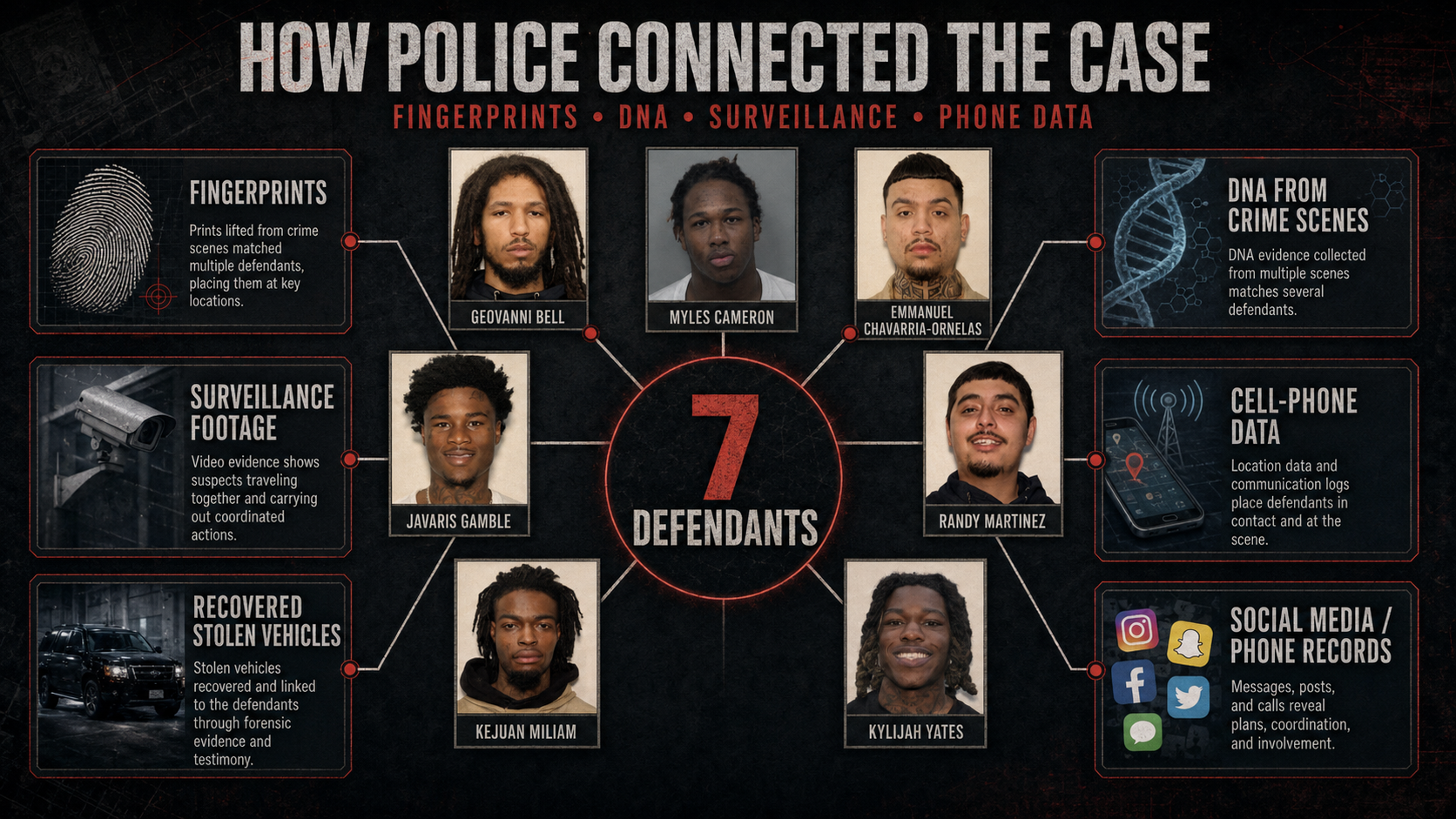
The official Gwinnett County release said investigators identified the group using fingerprint analysis, DNA recovered from crime scenes, surveillance footage, and cell-phone data.
That evidence list is important because it shows the case did not depend on one witness or one arrest. It appears to have been built across multiple layers. Fingerprints can place a person on a surface connected to a scene or vehicle. DNA can connect a person to physical evidence when collected and tested properly. Surveillance footage can show movement, vehicles, clothing, timing, or repeated methods. Cell-phone data can help investigators compare alleged suspects against locations, time frames, and one another.
WYFF’s reposted police details said detectives sorted through phone records, social media, surveillance, recovered stolen vehicles, and crime-scene evidence. That gives the investigation a broader digital and forensic shape. It suggests detectives were not just waiting for arrests. They were comparing scenes, processing vehicles, reviewing video, and building a timeline that could hold multiple defendants inside one case.
The public record does not provide the underlying forensic reports. It does not say which defendant was tied to which specific fingerprint, DNA sample, camera clip, or phone record. Those details would be inside the deeper discovery, warrants, lab reports, or indictment paperwork if publicly available. For this free case file, the accurate way to state the evidence is that police say those categories helped identify the group, while the exact defendant-by-defendant evidence remains limited in the public reporting.
The Timeline
The earliest date attached to the alleged conspiracy is Nov. 24, 2022. Prosecutors say the 492 entering-auto incidents occurred between that date and Mar. 28, 2024. Around the beginning of the investigation, Gwinnett County Police noticed a pattern involving work vans being hit at night and expensive painting equipment and tools being stolen.
In February 2023, Myles Cameron was arrested on multiple entering-auto counts connected to the investigation. Police said they believed more suspects were involved, and the case continued after Cameron’s arrest.
In June 2023, investigators noticed another wave of entering-auto incidents and vehicle thefts in Gwinnett County. Police said the break-ins often happened across multiple nights and involved numerous vehicles. During this phase, stolen cars were allegedly used to move between scenes and were later recovered after being discarded.
On July 19, 2023, the Traymore Drive confrontation happened in Norcross. Police said a homeowner caught the alleged crew breaking into vehicles and that one suspect fired at the homeowner. The homeowner was not injured, but prosecutors later charged aggravated assault in connection with that incident.
On Aug. 31, 2023, investigators arrested Javaris Gamble for his alleged involvement. Atlanta News First reported that Gamble was accused of being the group’s ringleader. Police said the break-ins continued after Gamble’s arrest, which is one reason the case remained active into 2024.
From late 2023 into Mar. 28, 2024, detectives continued working through phone records, social media, surveillance footage, recovered vehicles, fingerprint analysis, DNA, and other evidence. After months of investigation, authorities obtained warrants and the Gwinnett County District Attorney’s Office indicted all 7 defendants under Georgia’s RICO Act.
On June 6, 2024, Gwinnett County announced the racketeering case publicly. At that time, Yates, Cameron, Gamble, and Chavarria-Ornelas were in the Gwinnett County Jail. Martinez had been arrested in Florida and was awaiting extradition. Bell and Miliam were listed as at large.
Why RICO Was Used
RICO is what separates this case from a standard string of car break-ins.
A single entering-auto charge is about one vehicle, one scene, and one act. A RICO case is built around the claim that multiple acts are connected through a larger criminal enterprise or pattern. Prosecutors are not simply saying 492 vehicles were damaged or entered. They are saying those break-ins were part of a connected operation involving multiple defendants, stolen vehicles, stolen property, an alleged safe house, and repeated activity across a long time period.
The state’s theory appears to depend on the pattern: the same kind of targets, the same kind of stolen items, the alleged use of stolen vehicles, the alleged storage point in East Point, and evidence that investigators say connected the defendants to the spree.
That is why the East Point safe house is so important. It gives prosecutors something more concrete than a list of damaged vehicles. It gives the alleged operation a base. Police say stolen guns, cash, identification, and other items were connected to that location. If prosecutors can prove that property from multiple break-ins flowed back there, the safe house becomes one of the strongest organizing points in the case.
Official Facts Versus Allegations
The official facts are limited but important. The Gwinnett County District Attorney’s Office announced a RICO indictment involving 7 named defendants. The alleged conspiracy period ran from Nov. 24, 2022, to Mar. 28, 2024. The case involved 492 vehicles. The charges included RICO, aggravated assault, entering-auto offenses, theft by taking, and misdemeanor criminal trespass. Gwinnett County officials also confirmed that the investigation involved fingerprint analysis, DNA, surveillance footage, and cell-phone data.
The allegations go further. Prosecutors allege the defendants broke into nearly 500 vehicles to steal guns, cash, and other items. Police allege the group used stolen cars to move between crime scenes and then discarded those vehicles. Authorities allege the defendants operated from an East Point safe house where stolen items were stored. Police also allege that a member of the group fired at a homeowner on Traymore Drive after being caught during a break-in.
None of those allegations are convictions. The defendants are presumed innocent unless proven guilty in court. The public file available through news reports and the county release does not include the full indictment, complete evidence list, court transcripts, plea information, or trial outcome. Those records would be needed to determine what evidence prosecutors can prove against each individual defendant.
What The Public Record Does Not Show
The public record does not show all 492 locations. It does not provide a full map of the break-ins, a complete victim list, or a breakdown of how many incidents happened in Gwinnett County compared to neighboring counties. Police said the group was likely connected to crimes outside Gwinnett, but the public release does not provide a full multi-county incident chart.
The public record also does not explain exactly how the alleged safe house was discovered. It does not say whether police used a search warrant, surveillance, statements, recovered property, phone data, or another investigative step to identify the East Point location. Reports confirm the allegation that stolen items were stored there, but the deeper mechanics remain outside the public reporting.
There is also no public defendant-by-defendant evidence table in the available reports. We do not know which defendant was tied to which scene through fingerprint evidence, which one was allegedly connected through DNA, which phone records placed which person at which location, or which surveillance clips investigators believe show specific defendants. Those details matter because a RICO case can name multiple people, but the evidence against each person is not always equal.
The strongest available public version of the case is the broad structure. The deeper case would require the indictment, warrants, forensic reports, discovery filings, and court docket updates.
The Bigger Atlanta Pattern
This case also speaks to a larger metro Atlanta problem: entering-auto crews targeting vehicles for guns, tools, cash, IDs, and anything that can be resold or used in another crime. The Gwinnett case is not just about property loss. Police said stolen guns were part of what the group was after, and FOX 5 reported that stolen guns were found connected to the safe-house allegation.
That detail matters because stolen firearms can move far beyond the original break-in. A gun taken from a truck, van, or parked car can become evidence in another shooting, robbery, or trafficking case. A stolen ID can turn into fraud. Stolen tools can be resold quickly. Stolen vehicles can be used to hit more locations before being dumped.
That is the hidden damage inside a case like this. The first victim sees a broken window and missing property. Investigators see a chain. Vehicle to stolen item. Stolen item to safe house. Safe house to more suspects. Stolen car to another scene. Another scene to another victim.
By the time prosecutors put 492 vehicles inside one indictment, the case was no longer about one parking lot or one neighborhood. It was about an alleged system that kept moving until detectives believed they had enough evidence to bring racketeering charges.
Final Breakdown
Metro Atlanta’s 492-car break-in RICO case is strongest as a free case file because the public record gives enough to build a powerful investigation, but not enough yet to justify locking it behind a premium wall. The case has scale, danger, and structure: nearly 500 vehicles, an alleged East Point safe house, stolen guns and cash, a Traymore Drive shooting allegation, and a RICO indictment tying 7 men to a long-running spree.
What makes the case valuable is not just the number. It is how investigators say the number was built. Work vans were targeted first. A suspect was arrested, but the break-ins continued. Stolen vehicles allegedly helped the crew move between crime scenes. Detectives recovered dumped cars and processed them for evidence. Surveillance, DNA, fingerprints, phone data, and social media helped investigators identify the group. Then prosecutors turned the entire pattern into a racketeering case.
The file still has unanswered questions. The full indictment is not included in the public reporting. The evidence is not broken down by defendant. The safe house inventory is not fully public. The 492 incidents are not individually mapped. The final court outcomes are not confirmed in the public material used for this case file.
But the official record already reveals enough to understand why Gwinnett County treated this differently. Prosecutors were not only looking at broken windows. They were looking at an alleged operation that moved across counties, used stolen cars, stored stolen property, and escalated when a homeowner tried to stop it.
That is why this case belongs in the Atlanta file.
Not because it was the most violent case in the city.
Because 492 vehicles turned a break-in spree into a RICO indictment.


