
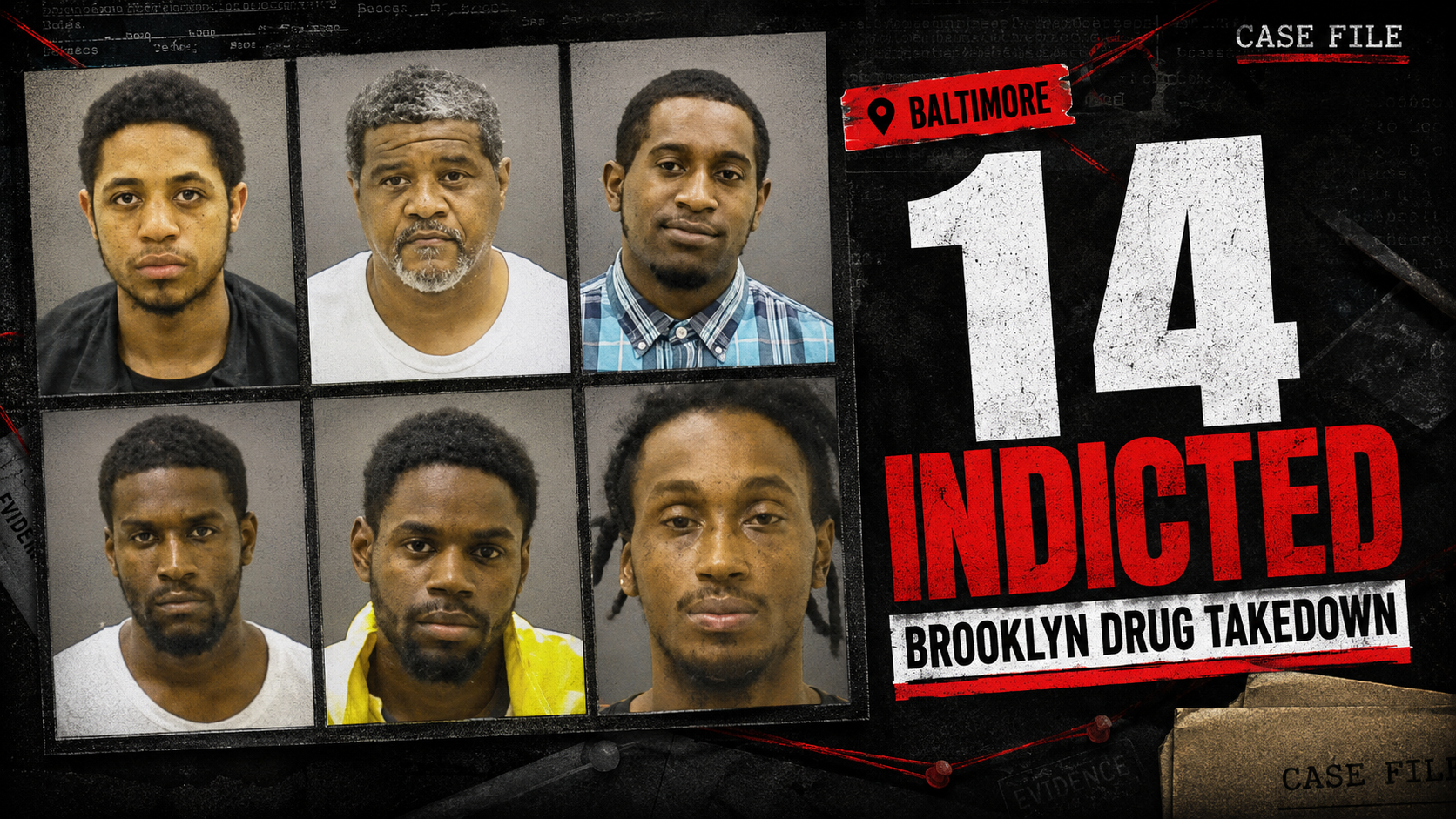
Reporting and analysis may discuss allegations and online theories. Allegations are not findings of guilt. Verify important details in the cited public record.
The Twenty-Block Crime Zone
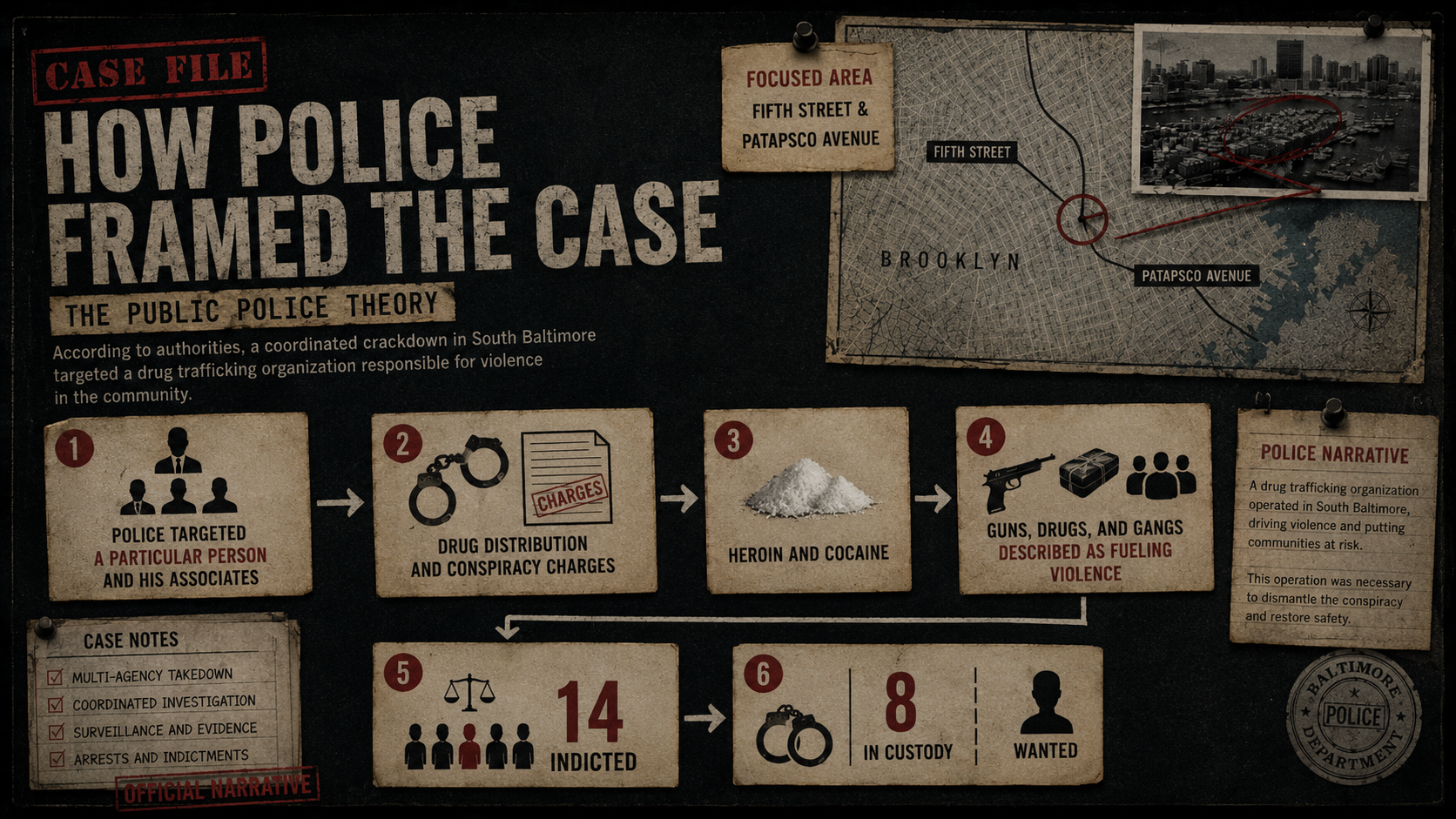
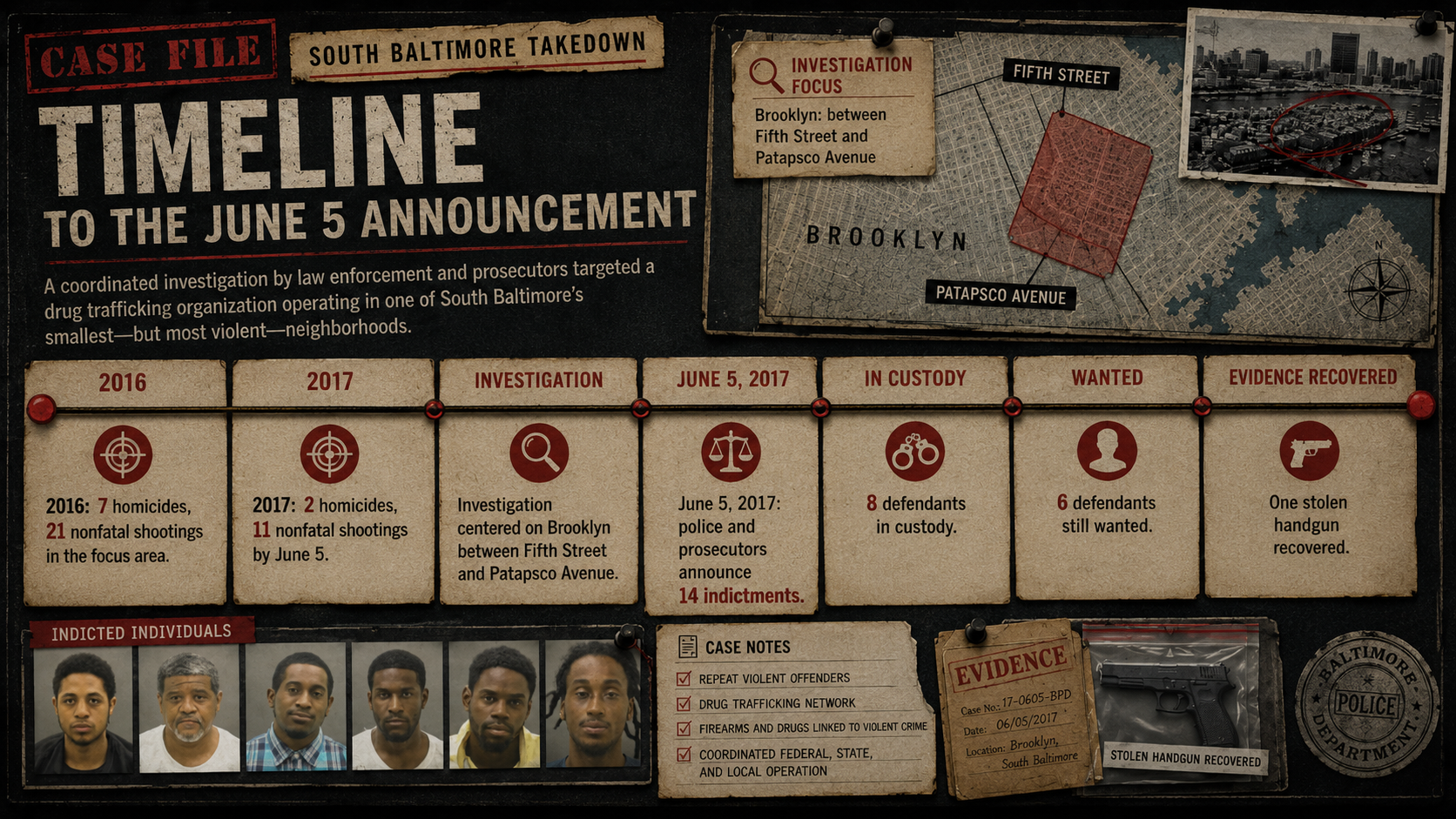
The investigation did not begin with a sprawling organization stretched across Baltimore. Police focused on a section of Brooklyn so small that officials described it as fewer than twenty city blocks, centered around Fifth Street and Patapsco Avenue in South Baltimore.
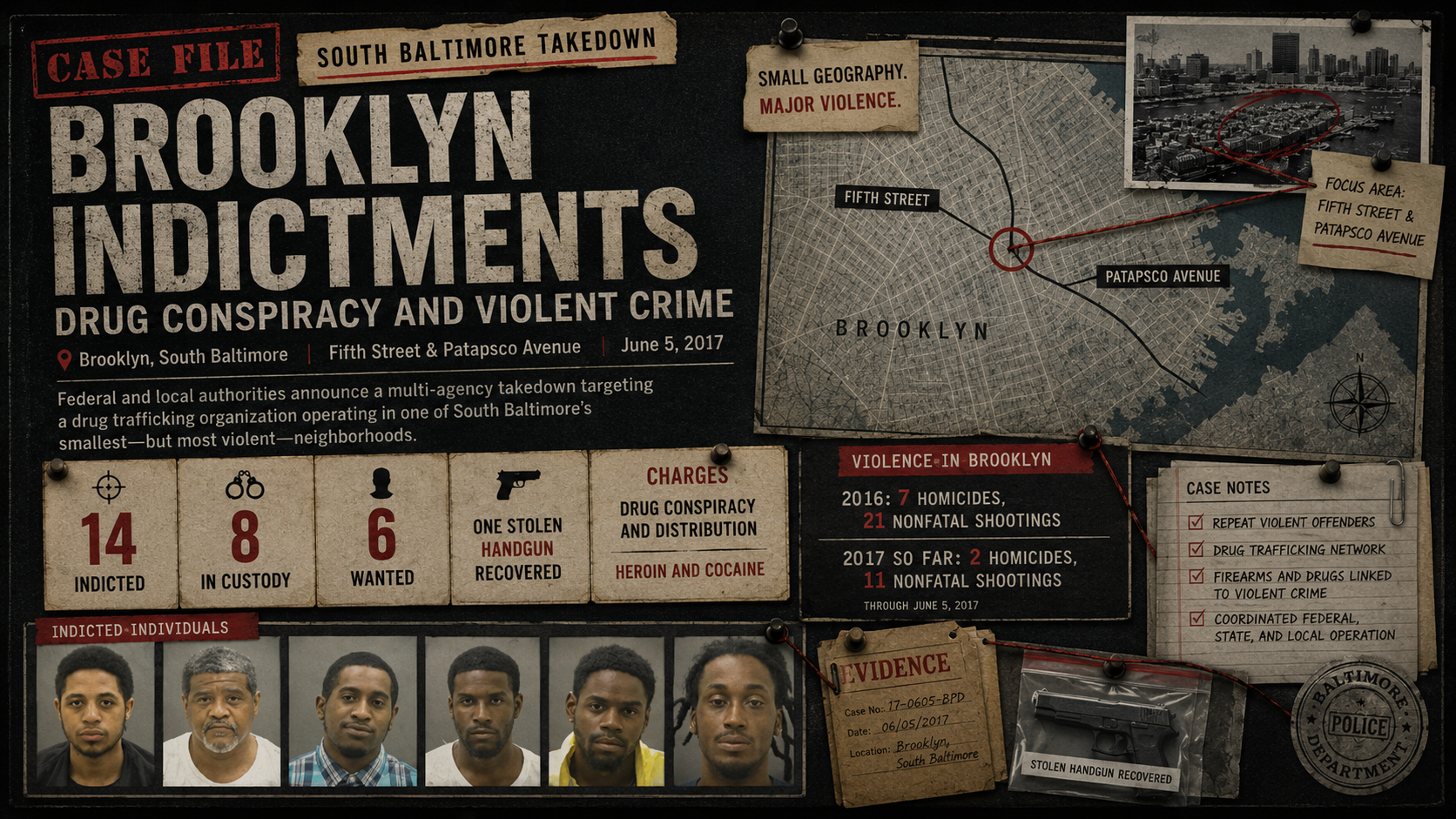
Inside that narrow area, the numbers had become impossible for investigators to ignore. During the previous year, police recorded seven homicides and twenty-one nonfatal shootings. By June 2017, Commissioner Kevin Davis was publicly describing Brooklyn as one of the neighborhoods driving Baltimore’s violence.
Detectives believed the shootings were not occurring in isolation from the drug trade operating around them. According to police and prosecutors, cocaine and heroin distribution, repeat offenders, firearms, and alleged gang activity had become intertwined inside the same limited territory.
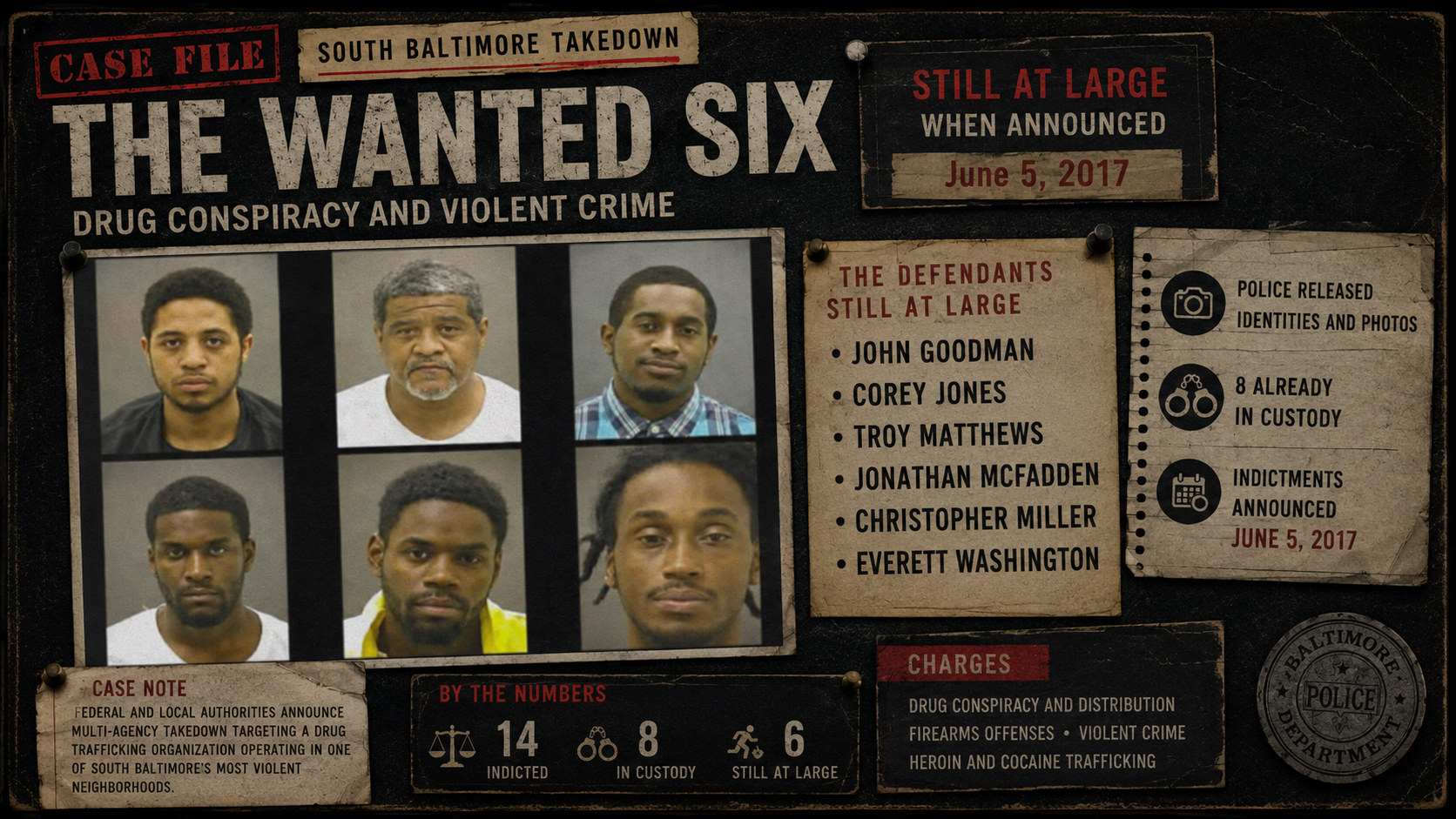
The response was a coordinated investigation that produced indictments against fourteen people. Eight were in custody when the case was announced. Six remained wanted.
The formal charges centered on drug conspiracy and distribution. The larger police theory was that dismantling the alleged drug network could interrupt the violence surrounding the market.
Brooklyn Before the Takedown
Brooklyn sits at Baltimore’s southern edge, close to Curtis Bay and the Anne Arundel County line. The investigation was not presented as an operation against every person or every block in the neighborhood. Its center was the corridor between Fifth Street and Patapsco Avenue.
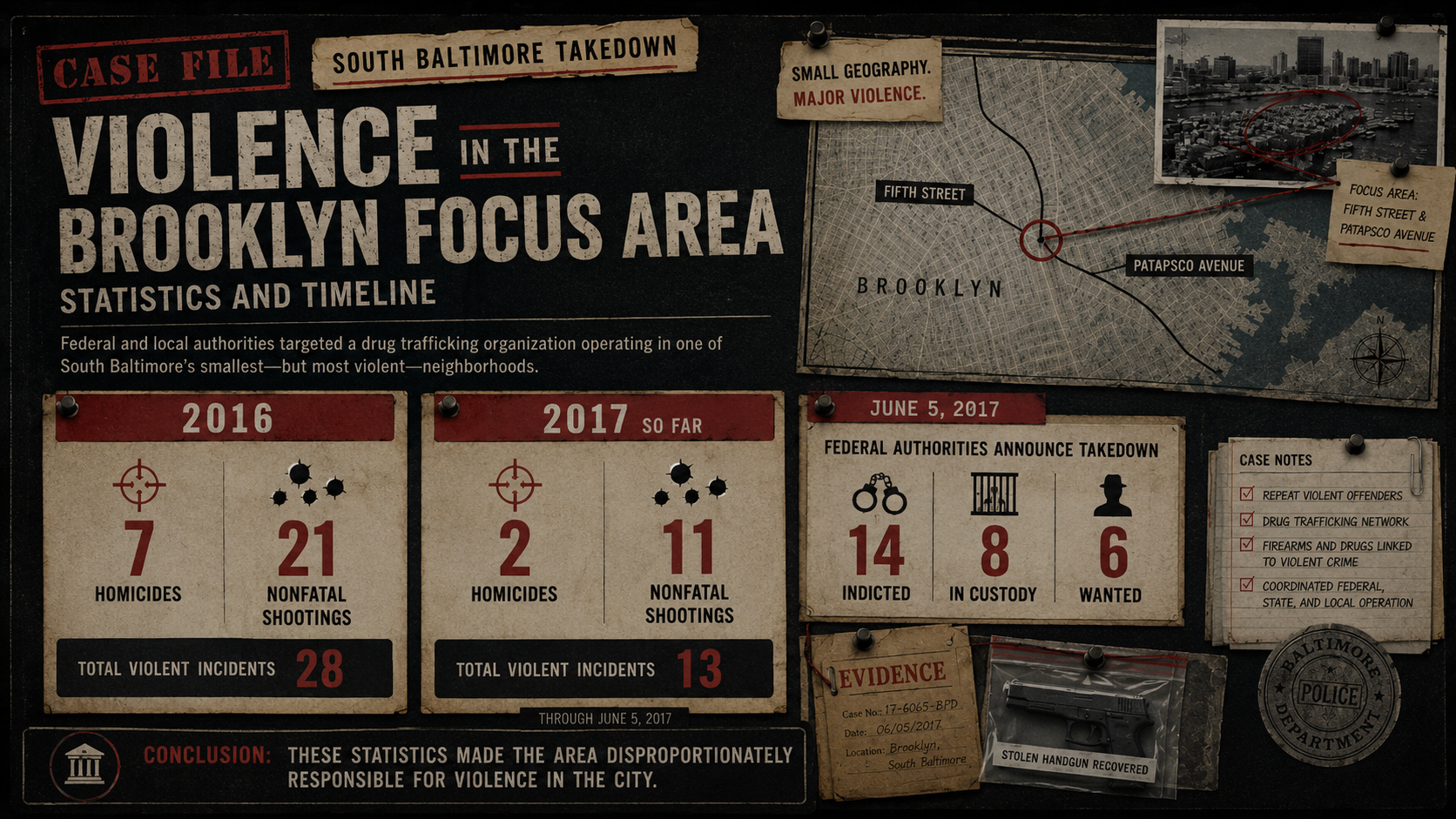
Police said that compact section had become a major contributor to Baltimore’s violent-crime statistics during the preceding two years. Seven killings and twenty-one nonfatal shootings within one year meant the area had experienced twenty-eight separate incidents in which someone was struck by gunfire or killed.
Those figures created the foundation for the investigation, but they did not mean prosecutors accused the fourteen defendants of committing all twenty-eight shootings. The publicly reported indictments involved heroin and cocaine trafficking, drug distribution, and conspiracy. Authorities used the neighborhood’s violence to explain why the alleged drug organization had become an enforcement priority.
The distinction is important. Police believed the drug market was helping sustain the conditions in which violence continued. The available public record does not show that each homicide or shooting was formally charged as an act committed by the defendants.
What investigators claimed to see was a pattern: the same small territory repeatedly appearing in drug activity, gun violence, and the movements of people already known to law enforcement.
The Investigation
Baltimore Police described the case as a comprehensive investigation designed to disrupt a specific pattern of violence in Brooklyn. The public announcement did not identify the exact date detectives began working the case or disclose how long the operation remained active before the indictments were returned.
It also did not reveal the investigative methods used to establish the alleged conspiracy. No public breakdown identified controlled drug purchases, confidential informants, wiretaps, intercepted telephone calls, surveillance teams, search warrants, undercover officers, or cooperating defendants.
Those missing details would determine how investigators moved from observing open-air drug activity to accusing fourteen people of participating in a trafficking network.
A street-level drug case might begin with individual purchases and arrests. A conspiracy case requires something broader. Prosecutors must show an agreement to commit an illegal act and connect each defendant to that agreement through conduct, communications, transactions, or other evidence.
The announcement established that police believed the defendants were involved in the same heroin-and-cocaine market. It did not expose the structure detectives claimed existed beneath that market.
There was no publicly released organizational chart identifying leaders, suppliers, sellers, stash-house operators, enforcers, transporters, or people responsible for storing money and narcotics. The fourteen names entered the public record together, but the roles prosecutors allegedly assigned to them remained inside the charging documents.
Fourteen People Enter the Case
Eight defendants had already been arrested when Baltimore Police and the State’s Attorney’s Office announced the indictments on June 5, 2017.
Those taken into custody were Dequan Cheatham, Dayquan Givens, Carl Griffin, Antione Lucas, Horace Montgomery, Lance Parker, Crystal Whye, and Adrian Worrell. The group ranged widely in age. Givens was twenty-one. Montgomery was forty-nine. That spread suggested the investigation was not limited to a single cluster of young defendants from one age group.
Six additional defendants had not yet been captured: John Goodman, Corey Jones, Troy Matthews, Jonathan McFadden, Christopher Miller, and Everett Washington.
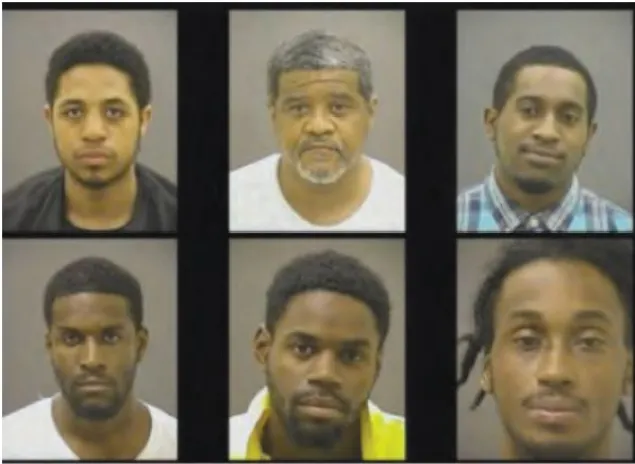
Police released their identities and photographs while asking for help locating them. The wanted defendants ranged from twenty-five to forty-seven years old. By making those names public, investigators moved the final phase of the operation out of sealed court filings and into the streets.
The fourteen defendants were accused of participating in heroin and cocaine distribution. Police also characterized them as violent repeat offenders, but the public reports did not identify the criminal history of each person or specify which prior offenses supported that description.
Likewise, contemporary coverage repeatedly used language describing the defendants as alleged gang members or participants in gang-related activity, yet no confirmed organization name appeared in the available reports. There was no publicly identified gang, clique, or crew attached to the indictment.
Any attempt to supply one would go beyond the available evidence.
The Drug Charges
The formal case involved allegations of cocaine and heroin trafficking.
Baltimore prosecutors charged the defendants with drug conspiracy and distribution offenses. The reports did not provide the quantity of cocaine or heroin attributed to the organization, the estimated value of the operation, or the length of time prosecutors believed it had been active.
No brand names for packaged heroin were reported. No drug-processing location was identified. No stash house, supply vehicle, or alleged source of narcotics was publicly named. The absence of those details prevents the public from measuring the scale of the trafficking operation. Fourteen defendants could represent a large coordinated organization, several smaller groups prosecuted together, or a network of sellers connected through shared suppliers and territory.
The charging documents would ordinarily clarify whether prosecutors alleged one continuing conspiracy or multiple overlapping agreements. They would also identify the dates of the alleged conspiracy, the controlled substances involved in each count, and the specific conduct attributed to individual defendants. The news coverage supplied the accusation but not the complete architecture of the case.
Drugs, Guns, and the Violence Theory
Commissioner Davis placed the indictments inside a broader explanation of Baltimore’s homicide crisis. Guns, drugs, and gangs, he said, continued to fuel the city’s violence.
That statement was the central theory behind the takedown.
Police were not claiming that cocaine or heroin automatically caused every shooting in Brooklyn. Their position was that an active drug market could create repeated points of conflict: control of sales territory, unpaid debts, robberies, retaliation, competition, and the presence of armed repeat offenders.
The public announcement did not identify which of those conditions investigators believed were operating around Fifth Street and Patapsco Avenue. No specific dispute was described, and no homicide was reconstructed as an act committed in furtherance of the alleged conspiracy.
Authorities nevertheless treated the drug network and the shooting pattern as parts of the same neighborhood problem. Removing suspected sellers was presented as a violence-reduction strategy, not simply a narcotics operation.
Police called the defendants violent repeat offenders, yet no firearms charges were detailed in the initial reports. No recovered gun count was announced, and investigators did not describe ballistic evidence connecting weapons to the seven homicides or twenty-one nonfatal shootings.
The violence theory was therefore broader than the charges visible to the public. The indictment targeted alleged drug trafficking. Police hoped the takedown would reduce shootings by destabilizing the market surrounding them.
The Missing Evidence Record
For an operation involving fourteen defendants and a neighborhood identified as a major source of violence, remarkably little of the underlying evidence entered the public reporting.
Authorities did not disclose how much heroin or cocaine was recovered. They did not announce the seizure of cash, firearms, packaging materials, scales, vehicles, or mobile phones.
There was no description of surveillance footage showing suspected transactions. No intercepted conversations were quoted. No text messages or social-media communications were identified. No witness or confidential informant was discussed.
Police also did not disclose whether the initial eight arrests produced new evidence against the six defendants who remained wanted.
Those omissions leave the investigation’s strongest material hidden. If police had been working the area for an extended period, detectives may have accumulated photographs, video, observations, controlled buys, telephone data, or testimony linking individuals to specific transactions. None of that can be confirmed through the initial coverage alone.
The public saw fourteen names and a map point. Investigators possessed the evidence that allegedly connected those names to one another.
Eight Arrests and Six Open Warrants
The operation was incomplete when officials stepped before the cameras.
Eight defendants were in custody, but John Goodman, Corey Jones, Troy Matthews, Jonathan McFadden, Christopher Miller, and Everett Washington remained at large.
Their absence mattered for more than the arrest count. Defendants still outside custody could possess phones, vehicles, narcotics, weapons, money, or information connected to the alleged conspiracy. They could also communicate with associates after learning that the investigation had become public.
Releasing photographs increased the pressure around the remaining suspects. It also risked forcing investigators to move quickly before evidence disappeared or the wanted defendants left the area.
The available reporting does not provide a complete follow-up account documenting when each of the six was arrested, whether any surrendered, or whether any remained wanted for a prolonged period.
That gap breaks the public timeline at the moment the takedown was still unfolding.
The press conference announced the operation as a major disruption. The arrest record needed to determine whether all fourteen were ultimately brought before the court was not included in the reports surrounding the announcement.
The Neighborhood’s Response
For residents and business owners, the case was larger than a narcotics indictment.
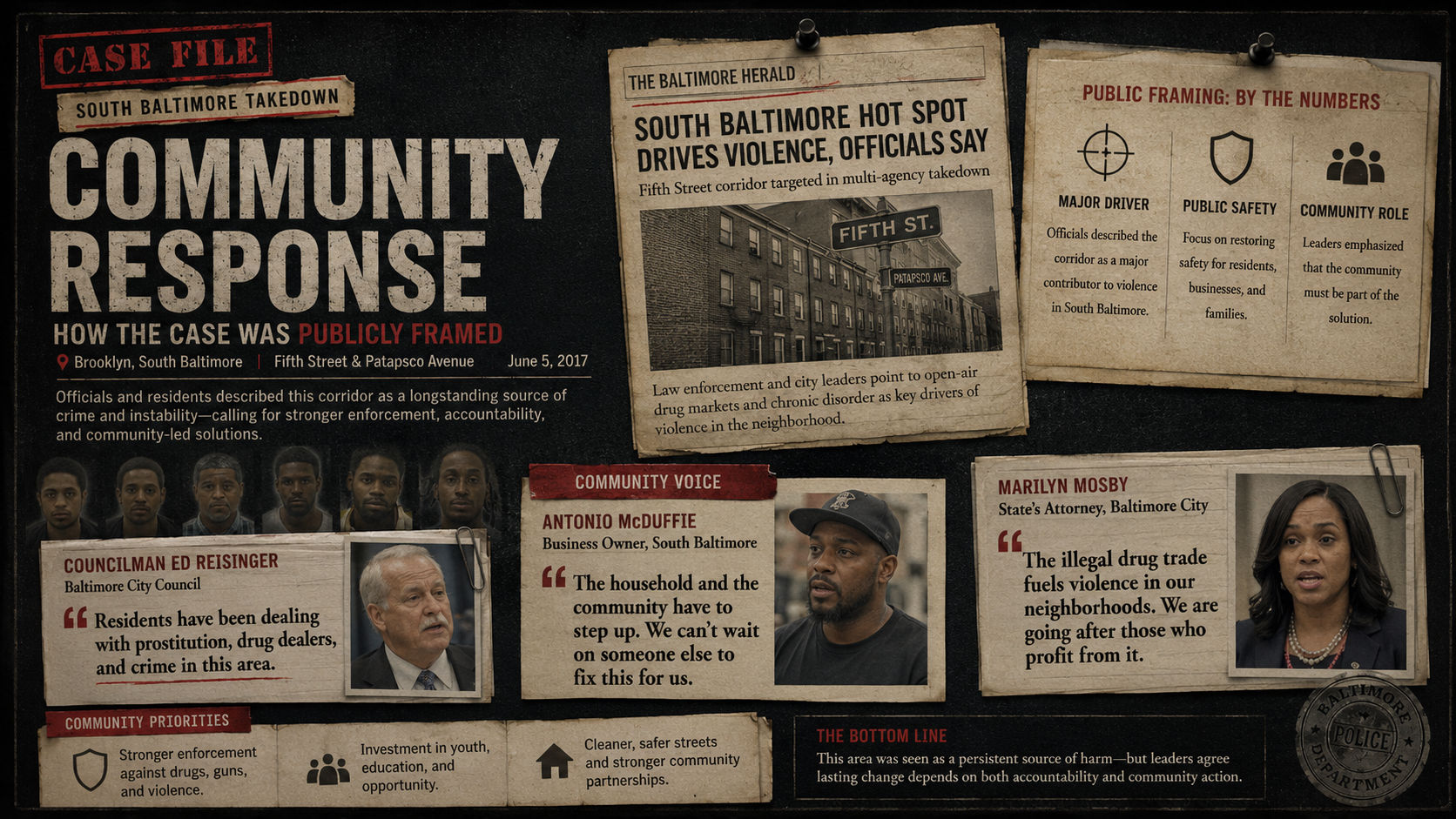
Councilman Ed Reisinger said people in Brooklyn and Curtis Bay had been dealing with drugs, prostitution, and crime and described the enforcement action as overdue. His comments reflected the accumulated pressure created by repeated illegal activity rather than reaction to one isolated case.
Antonio McDuffie, a local business owner who was preparing to open a church, argued that intervention could not come from police alone. He pointed toward families and the separation between generations inside the community.
The two responses approached the same problem from opposite directions.
Police could arrest suspected participants in a drug market. Prosecutors could pursue conspiracy charges. Neither action guaranteed that another group would not occupy the same territory after the defendants were removed.
The twenty-block area remained valuable to anyone attempting to sell narcotics there. Its streets, customers, vacant properties, transportation routes, and existing reputation did not disappear with the announcement of fourteen indictments.
That was the unspoken weakness behind the takedown. The alleged network could be disrupted. The conditions that allowed the market to exist were harder to indict.
What the Public Record Confirms
The verified record establishes that fourteen people were indicted in June 2017 on drug conspiracy and distribution charges connected to cocaine and heroin activity in Brooklyn, South Baltimore.
The investigation focused on fewer than twenty blocks around Fifth Street and Patapsco Avenue.
Police said the area had experienced seven homicides and twenty-one nonfatal shootings during the previous year and had become a significant contributor to Baltimore’s violence.
Eight defendants were in custody at the time of the announcement, while six remained wanted.
Authorities described the defendants as violent repeat offenders and connected the enforcement action to guns, drugs, gangs, and neighborhood violence.
The public record does not establish that the fourteen defendants committed the seven homicides or twenty-one shootings. It does not reveal a confirmed gang name, identify the hierarchy of the alleged organization, or show that each defendant participated in every form of conduct described by police.
Most importantly, an indictment is an accusation. It does not establish guilt.
The Court Record Gap
The announcement created a clear beginning but no accessible ending.
The public reporting does not provide a complete defendant-by-defendant accounting of convictions, dismissals, guilty pleas, acquittals, or sentences. Without that record, it is impossible to determine how much of the original police theory survived once the evidence entered court.
A fourteen-person conspiracy often fractures after indictment. Some defendants may plead guilty quickly. Others may challenge searches, dispute their participation, or face reduced charges. Prosecutors may rely on cooperation from one defendant to strengthen the case against another.
The strength of the evidence is rarely equal across an entire group.
One person may be captured on surveillance completing repeated transactions. Another may be connected through telephone records. Someone else may be accused because drugs were recovered from a shared location. A defendant’s name appearing in the same indictment does not reveal the quality or quantity of proof against that person.
The missing dockets also conceal whether prosecutors ever established the violent network described at the press conference or secured convictions only for narrower drug offenses.
Until the individual cases are reconstructed, the most consequential part of the investigation remains sealed behind the original announcement.
Official Record Versus the Larger Claim
The official charges accused fourteen people of participating in heroin and cocaine distribution.
The larger public claim was that the group operated inside a twenty-block zone that had become one of Baltimore’s concentrated sources of bloodshed.
Those statements are related, but they are not identical.
The indictments allowed prosecutors to pursue conduct they believed could be proven through drug and conspiracy laws. The press conference allowed police to explain why the operation mattered to the city’s homicide crisis.
What remains unclear is how directly the evidence connected the trafficking case to the shootings surrounding it.
No homicide charge was identified in the available coverage. No shooting victim was attached to the conspiracy. No weapon was publicly linked through ballistics to an incident. No defendant was individually accused in the press reports of pulling a trigger.
The violence supplied the reason for the investigation. The drug counts supplied the legal mechanism for the takedown.
Between those two layers sits the missing part of the file: the evidence police believed transformed a narcotics network into a major driver of neighborhood violence.
Final Breakdown
Fourteen indictments were announced as the answer to a twenty-block section of South Baltimore where seven people had been killed and twenty-one others had survived shootings during the previous year.
Police identified the drug market, named the defendants, captured eight of them, and released photographs of the six still wanted. What they did not release was the structure behind the case.
The public was never shown who allegedly controlled the supply, how the cocaine and heroin moved through Brooklyn, which defendants occupied which roles, what detectives seized, or how closely the network was tied to the gunfire that made the neighborhood an enforcement priority.
That missing separation defines the entire case.
The indictment accused fourteen people of trafficking drugs.
The press conference portrayed their removal as an attack on Baltimore’s violence.
The unreleased court and investigative records contain the evidence needed to determine where one claim ended and the other began.


