Reporting and analysis may discuss allegations and online theories. Allegations are not findings of guilt. Verify important details in the cited public record.
The Case File
At the corner of West Cumberland and North Cleveland Streets, there was a small North Philadelphia storefront with a simple sign that read Cumberland Coffee & Snacks. From the outside, it looked like the kind of place people might pass without thinking twice. Snacks in the window. A corner business. A neighborhood stop that blended into the block.
But according to Pennsylvania prosecutors, that coffee shop was not just a coffee shop. Authorities say it was the alleged front for a drug trafficking organization that had been rooted in the neighborhood for years, with cocaine and crack cocaine allegedly being sold, cooked, packaged, and moved through a network that stretched far beyond one corner store. The takedown became known by the name that made the case instantly viral: Operation Cocaine and Coffee.
On April 1, 2026, Pennsylvania Attorney General Dave Sunday stood with state and local law enforcement and announced that 17 people had been charged as alleged members of what authorities called the Louis Alexander Drug Trafficking Organization. The alleged leader, 56 year old Louis Alexander, was taken into custody along with 15 others during the execution of search warrants, while a 17th person surrendered on March 27, 2026. Prosecutors said the group was tied to drug dealing, firearms, and a years long operation that had left residents living around the area with a constant fear of crime and violence.
The Coffee Shop On Cumberland
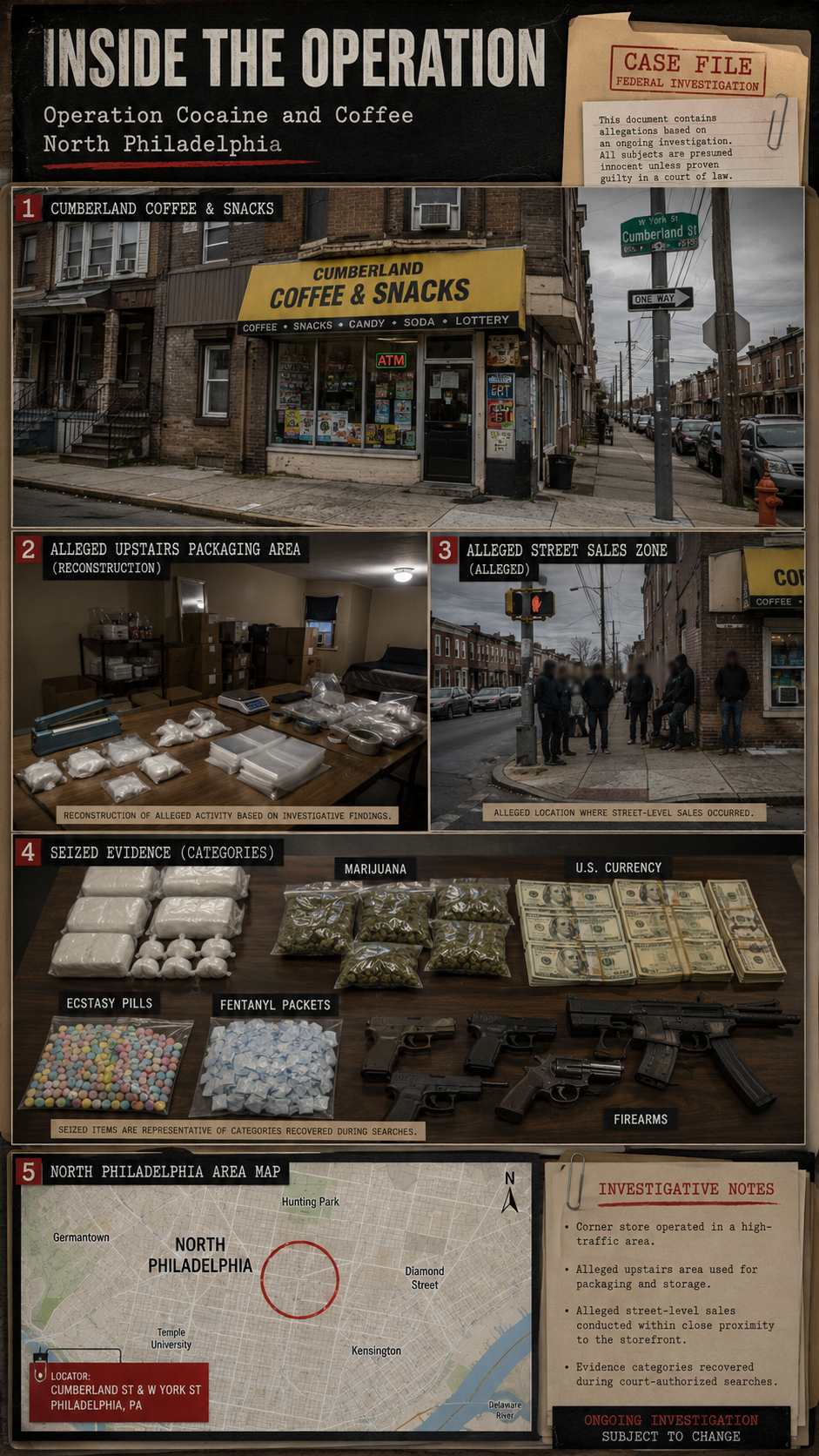
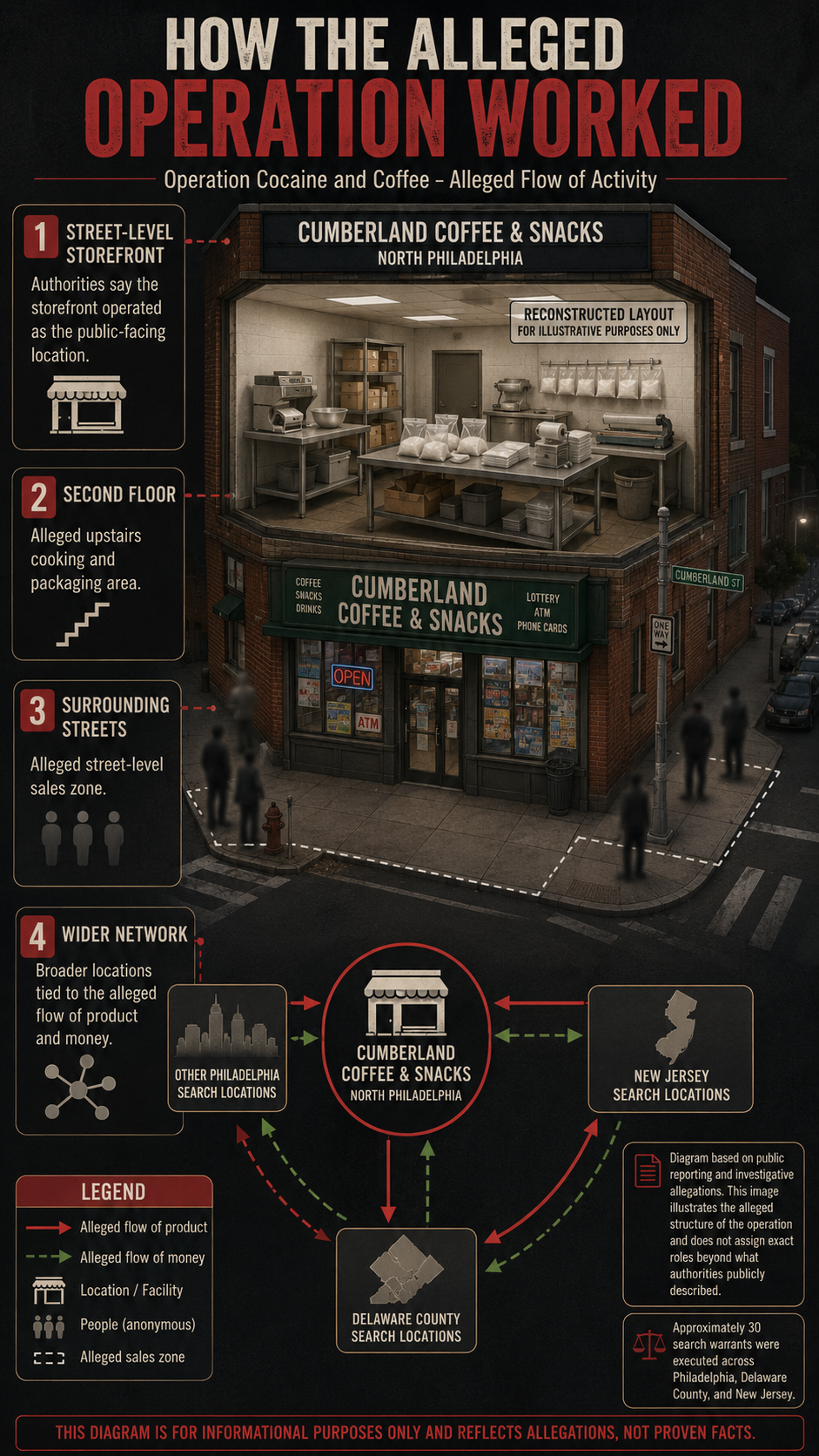
The center of the case was Cumberland Coffee & Snacks, located near West Cumberland and North Cleveland Streets in North Philadelphia. Authorities described the store as a front allegedly used by Alexander and his crew. Fox 29 reported that investigators said drugs were sold out of the shop, cocaine was cooked and packaged upstairs, and drugs were also sold out on the street.
That detail is what made this case stand out. This was not presented as a hidden stash house deep inside an abandoned property, or a quiet apartment used only after dark. Prosecutors described a visible business on a neighborhood corner, a place with signage and snacks, allegedly operating as part of a larger drug trafficking network in plain view.
CBS Philadelphia reported that officials said the coffee shop did not have a cash register. Prosecutor Michael Barry, who CBS reported had been investigating the organization as far back as 2011, said law enforcement did not see coffee pots inside the shop while executing warrants, though they did find snacks and sodas. That single detail changed the way the storefront was viewed in the case: prosecutors were not describing a business with hidden criminal activity on the side. They were describing what they believed was a business being used to cover the true purpose of the location.
The Alleged Organization
The Pennsylvania Attorney General’s Office identified the group as the Louis Alexander Drug Trafficking Organization. Louis Alexander was described as the alleged 56 year old leader, and prosecutors said the defendants faced charges that included felony counts of corrupt organizations, possession with intent to deliver, and illegal possession of firearms. The state also made clear that all charges are allegations, and every defendant is presumed innocent unless and until proven guilty in court.
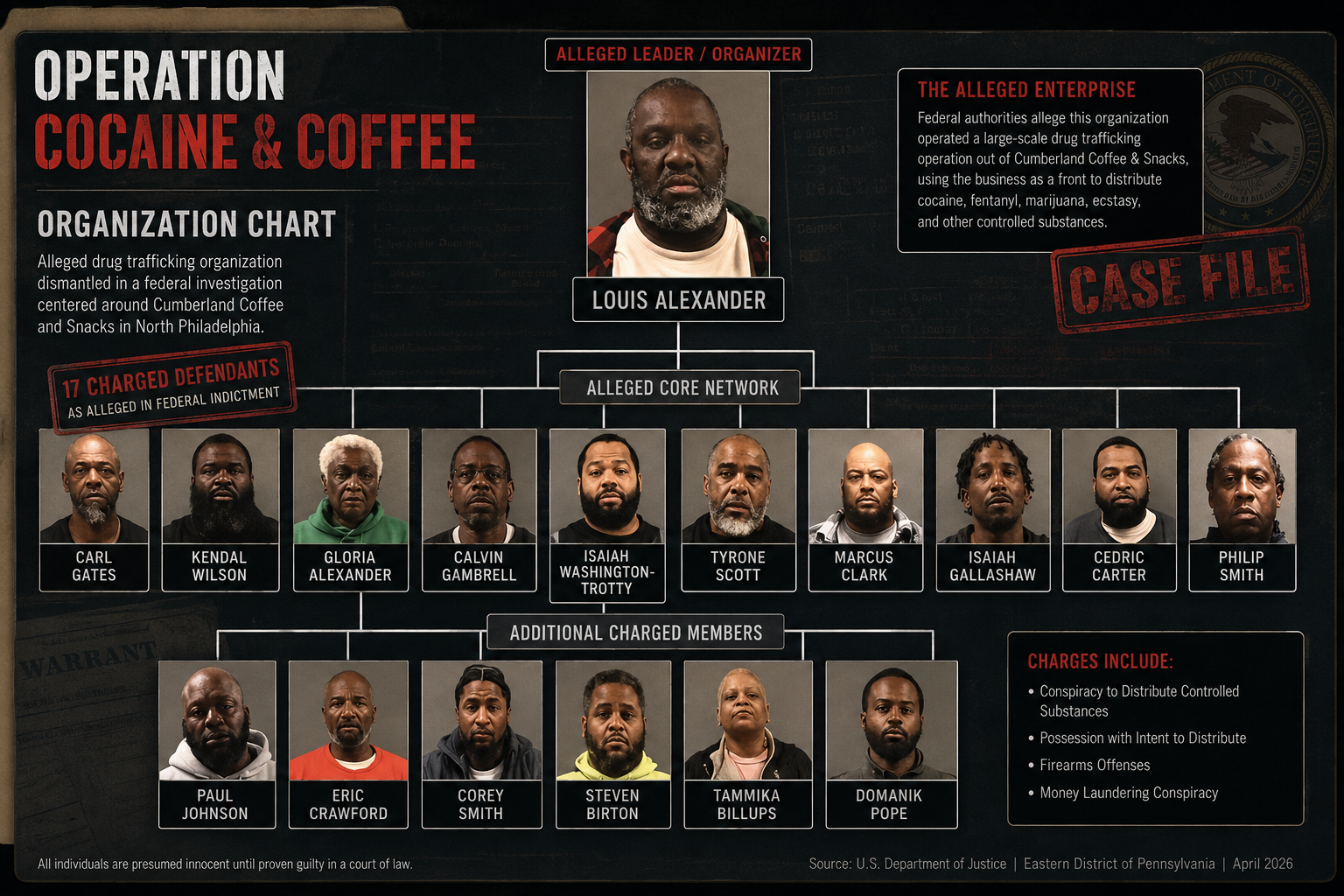
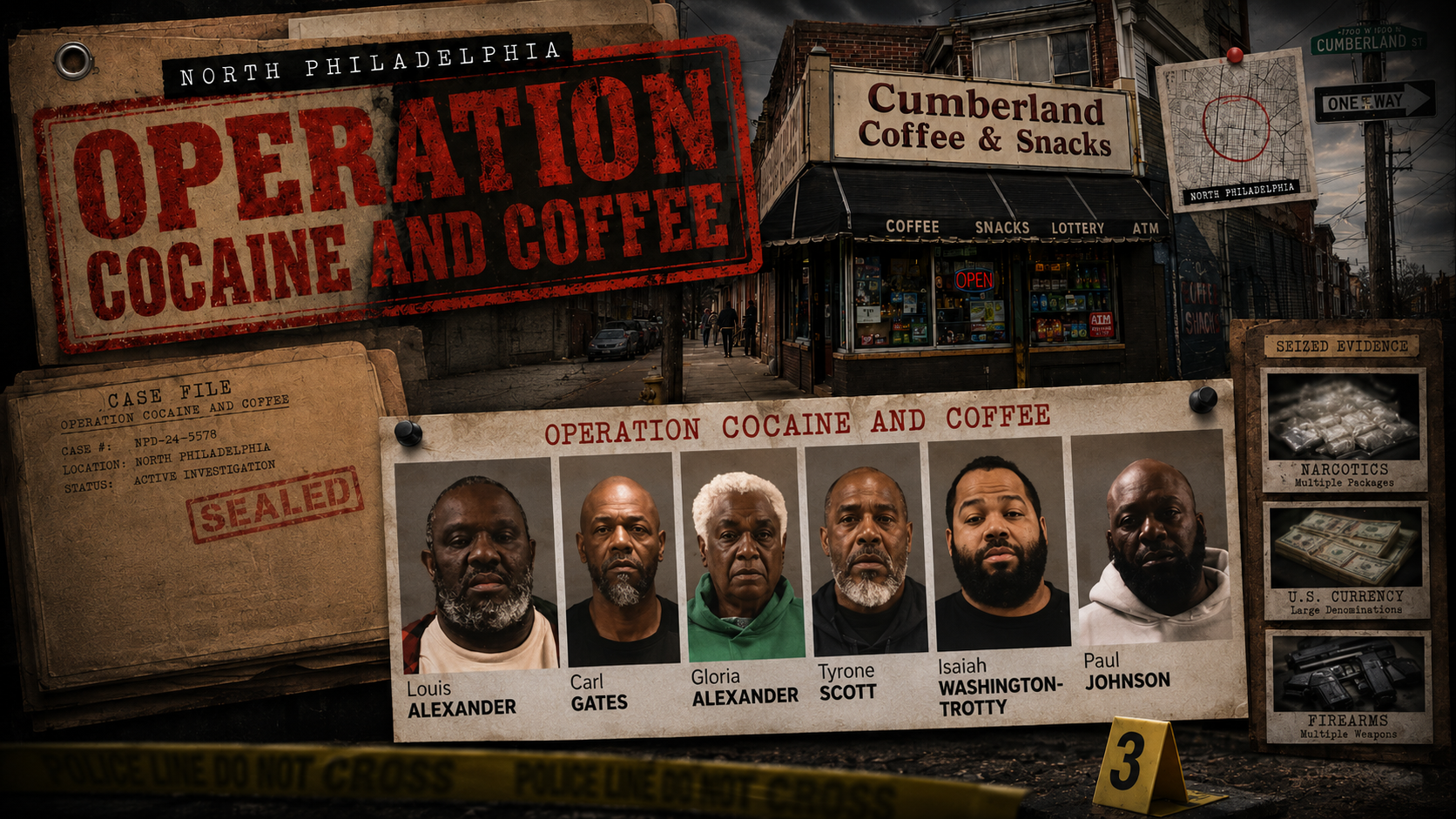
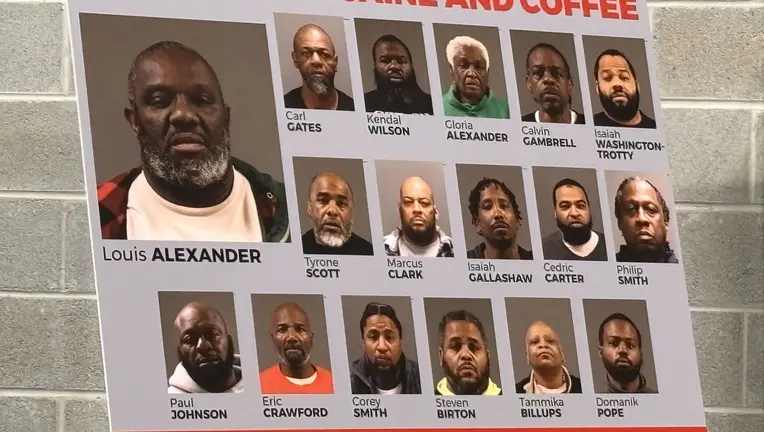
The people charged in the case were Louis Alexander, Carl Gates, Kendal Wilson, Gloria Alexander, Isaiah Washington Trotty, Tyrone Scott, Marcus Clark, Isaiah Gallashaw, Cedric Carter, Paul Johnson, Eric Crawford, Corey Smith, Steven Birton, Tammika Billups, Domanick Pope, Calvin Gambrell, and Philip Smith. Officials said many of the defendants were incarcerated after arraignment, with bail amounts varying by person. Louis Alexander was reported to be held on $750,000 bail.
What also caught attention was the age range. CBS Philadelphia reported that Attorney General Sunday said some suspects were in their 50s, 60s, and 70s. That gave the case a different profile from the usual street level takedown. Prosecutors were not describing a crew made up only of younger dealers moving fast through a block. They were describing a long established network, with older alleged members and a neighborhood footprint that officials said had lasted for more than a decade.
The Timeline
The earliest public timeline point comes from comments reported by CBS Philadelphia and KYW Newsradio, where prosecutor Michael Barry said the organization had been on law enforcement’s radar going back as far as 2011 or 2012. That means investigators were describing a pattern they believed stretched across more than a decade, centered around the area near Cumberland Street, Cleveland Street, and North 18th Street.
During the final week of March 2026, law enforcement served search warrants at about 30 locations. The warrants were mostly in North Philadelphia, but officials said they also reached other parts of Philadelphia, Delaware County, and New Jersey. Sixteen alleged members were arrested during those warrant operations, and the 17th person surrendered on March 27, 2026.
On April 1, 2026, the Pennsylvania Attorney General’s Office publicly announced the takedown. Attorney General Dave Sunday, Pennsylvania State Police, Philadelphia police, and other agencies presented the case as a coordinated operation against an alleged organization that had used firearms, drug sales, and neighborhood control to protect a profitable trade.
The Raid And Search Warrants
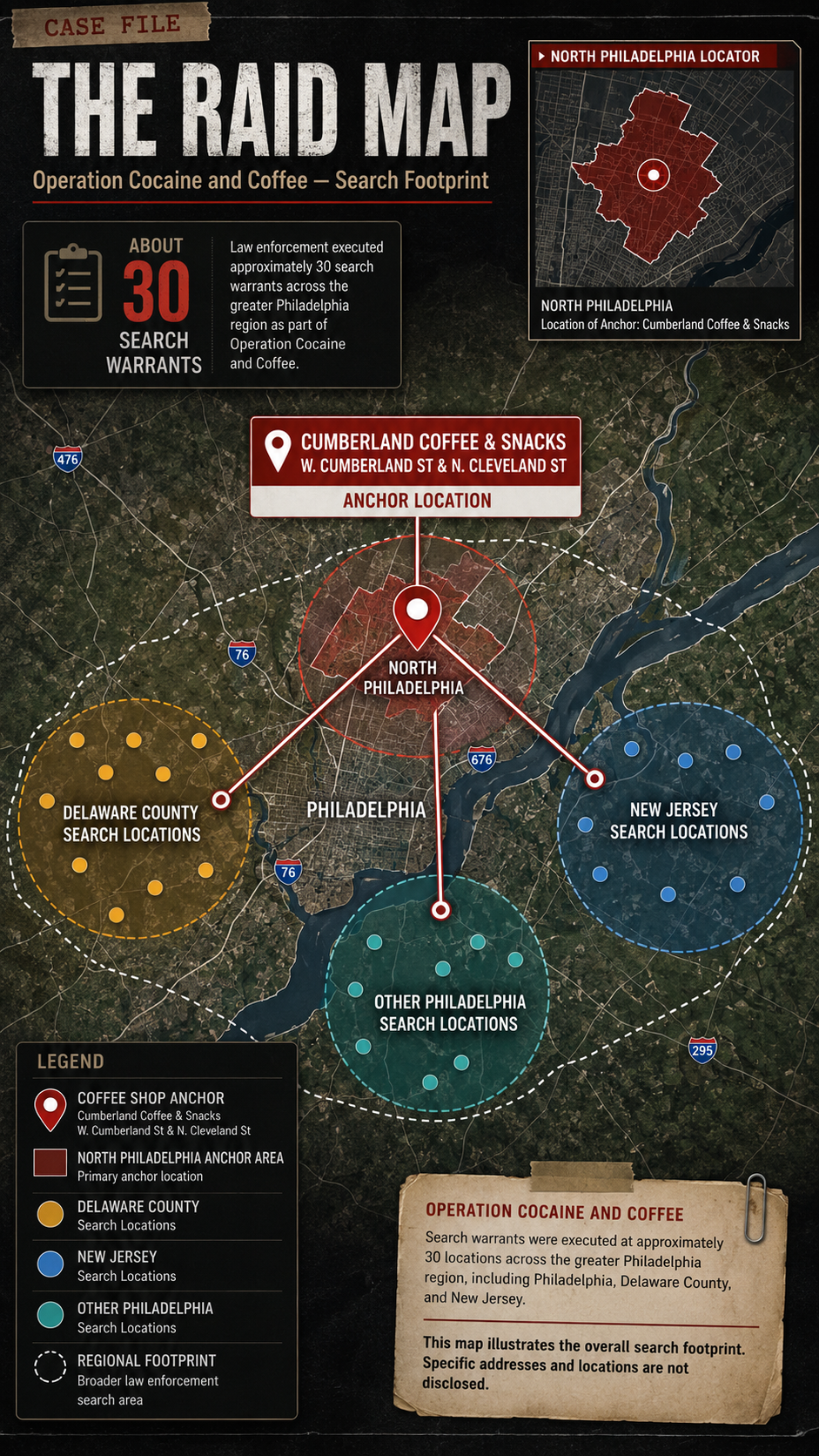
The final takedown was not limited to one building. According to the Attorney General’s Office, officers, troopers, and agents served warrants at 30 locations. Most were in North Philadelphia, but the search network also extended into other areas of Philadelphia, Delaware County, and New Jersey. That wide footprint is important because it shows prosecutors were not treating Cumberland Coffee & Snacks as an isolated location. They were presenting it as one visible piece of a larger alleged organization.
The agencies involved included the Pennsylvania State Police, Philadelphia Police Department, ATF, DEA, FBI, Homeland Security Investigations, Philadelphia Sheriff’s Office, Monroe Township Police Department in New Jersey, and the Gloucester County Prosecutor’s Office in New Jersey. The size of that list matters because it shows how far the investigation had moved beyond a simple street corner complaint. This became a multi agency operation with state, local, and federal resources.
CBS Philadelphia also reported that investigators searched a nearby barbershop and bar, which prosecutor Michael Barry said showed the reach the group had in the community. Officials did not publicly lay out the full function of every location, but those added searches widened the case beyond the coffee shop and pointed to a broader alleged neighborhood network.
The Seizure List
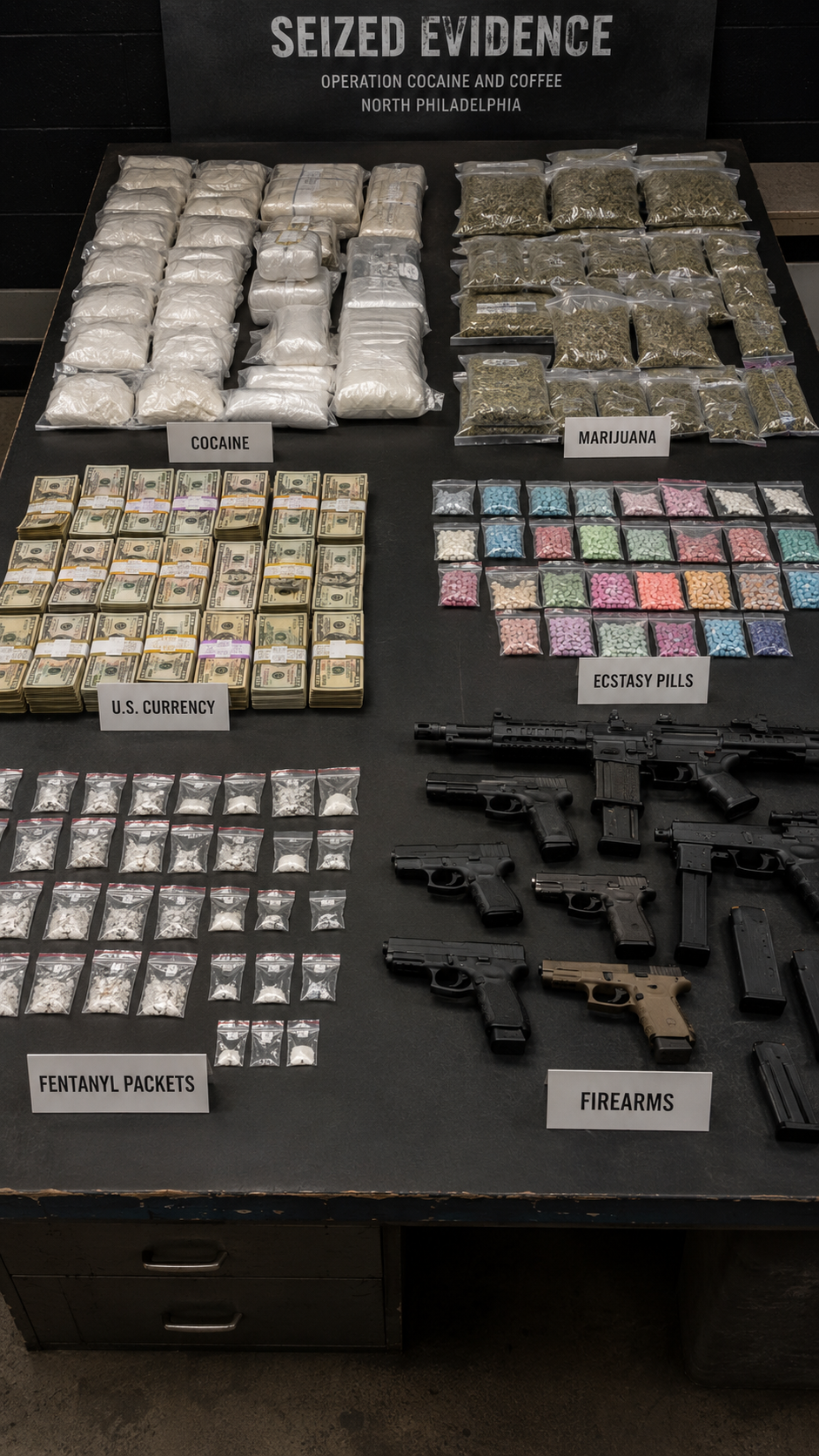
The evidence numbers gave the case its weight. According to the Attorney General’s Office, investigators seized quantities of cocaine, crack cocaine, fentanyl, marijuana, Ecstasy pills, cash proceeds from drug dealing, and 27 firearms. Officials said more than 4 pounds of cocaine and 130 pounds of marijuana were recovered during the operation.
KYW Newsradio reported an even more specific cash figure from the press conference, saying authorities seized $116,000, along with the 27 guns, 130 pounds of marijuana, 4 pounds of cocaine, fentanyl, and other narcotics. The official Attorney General release confirmed cash proceeds were seized but did not list that exact dollar amount in the written release.
The 27 firearms are one of the biggest unresolved parts of the case. The Attorney General’s Office said the investigation remains ongoing regarding the firearms and possible involvement in violent crimes. That means the guns are not just listed as property recovered in a drug investigation. Prosecutors are still examining whether any of those weapons may connect to other violent incidents. That part has not been fully answered publicly, and it should not be treated as proven unless law enforcement files more evidence or future charges.
The Second Floor Claim
The second floor of Cumberland Coffee & Snacks is one of the most important parts of the case. Authorities alleged that drugs were not only being sold through the storefront, but also cooked and packaged upstairs. Fox 29 reported that cocaine was cooked and packaged on the second floor, while KYW Newsradio reported Attorney General Dave Sunday saying crack cocaine cooking was being done upstairs as part of the network’s logistics.
That claim changes the case from a simple sales location into an alleged production and packaging site. If prosecutors prove it in court, the upstairs area becomes more than just storage space. It becomes the alleged processing layer between supply and street level sales.
Officials also said the organization sold drugs on the streets surrounding the shop. CBS Philadelphia reported that authorities described specific roles inside the group, with some alleged members acting as street dealers, others as suppliers, and others collecting money. That role structure is central to the corrupt organization charge, because prosecutors are trying to show that this was not random individual dealing, but an organized system.
The Neighborhood Footprint
CBS Philadelphia reported that Attorney General Sunday said the organization considered the area around North 18th and West Cumberland Streets its turf for many years. That word matters because prosecutors were not just talking about a building. They were talking about claimed control over a section of North Philadelphia, where residents, homeowners, and families had to live around the alleged operation.
Attorney General Sunday described North Philadelphians as people who had been exposed for too long to criminals who allegedly carried firearms to protect a lucrative drug trade. He said investigators built the case for years so that when law enforcement finally acted, the goal was to end the alleged enterprise instead of just arresting a few street level dealers.
That statement explains why the case took the shape it did. Prosecutors claimed they were not looking only for the people selling on the corner. They wanted the alleged structure behind the corner, the people supplying, packaging, collecting, protecting, and maintaining the network.
The Official Facts Versus What Is Still Unproven
The official facts are clear. Seventeen people were charged. Louis Alexander was named as the alleged leader. Cumberland Coffee & Snacks was identified by authorities as the alleged front. Search warrants were served at about 30 locations. Investigators seized drugs, cash, and 27 firearms. Prosecutors say cocaine and crack cocaine were central to the operation, with fentanyl, marijuana, and Ecstasy also recovered.
The unproven side is just as important. These are charges, not convictions. Prosecutors still have to prove the allegations in court. The public record does not yet explain exactly how every defendant allegedly fit into the network. The state has not publicly connected the seized firearms to specific violent crimes. Officials said that part of the investigation is ongoing, which means no responsible case file should present that connection as confirmed.
There is also no full public breakdown yet of every searched location, every seized item by address, or every alleged role by name. The Attorney General’s chart publicly shows the defendants and the location imagery, but the deeper complaint level details are not fully laid out in the public reporting available right now. That leaves room for future updates if court filings, criminal complaints, preliminary hearings, or additional law enforcement documents become available.
Why This Case Hit So Fast
The story spread because the contrast is impossible to ignore. A corner coffee shop is supposed to be harmless. It is supposed to be where people buy a drink, grab a snack, and keep moving. Prosecutors allege this one was being used as a base for drug sales, packaging, cocaine cooking, firearms, and a network that stretched from North Philadelphia into Delaware County and New Jersey.
The name Operation Cocaine and Coffee made it even more clickable. It sounded like a headline made for the internet, but behind the name was a real multi agency investigation, 17 defendants, 30 search locations, 27 guns, and a seizure list that included cocaine, crack cocaine, fentanyl, marijuana, Ecstasy, and cash.
For the Philly case file section, this case is valuable because it does not require viewers to know drill politics, gang history, or old street beefs to understand why it matters. The entire hook is sitting on the sign outside the building. A coffee shop on a North Philadelphia corner became the center of an alleged drug trafficking case that prosecutors say had been affecting the neighborhood for years.
The Final Breakdown
Operation Cocaine and Coffee is not just a drug bust story. It is a case about what authorities say was a long running neighborhood operation hiding behind a small business, with alleged drug sales happening through the shop, processing happening upstairs, and street level activity happening around the same corner.
The strongest confirmed pieces are the 17 charged defendants, the 30 search locations, the 27 firearms, the more than 4 pounds of cocaine, the 130 pounds of marijuana, and the official claim that Cumberland Coffee & Snacks was being used as a front. The strongest unanswered piece is where the firearm investigation goes next, because prosecutors have already said they are still looking at possible involvement in violent crimes.
Until the case moves further through court, every defendant remains presumed innocent. But from a case file standpoint, the takedown already shows why this corner became such a major law enforcement target. Prosecutors described a storefront that looked ordinary from the outside, but allegedly sat at the center of a drug network that had been operating in the neighborhood for years.
Source notes for verification: Pennsylvania Attorney General’s Office, Fox 29 Philadelphia, CBS Philadelphia, NBC10 Philadelphia, 6ABC Philadelphia, and KYW Newsradio.