Reporting and analysis may discuss allegations and online theories. Allegations are not findings of guilt. Verify important details in the cited public record.
The Strikers RICO Case File
Federal Prosecutors Say The Strikers Turned Luxury Car Theft Into A Violent Criminal Enterprise
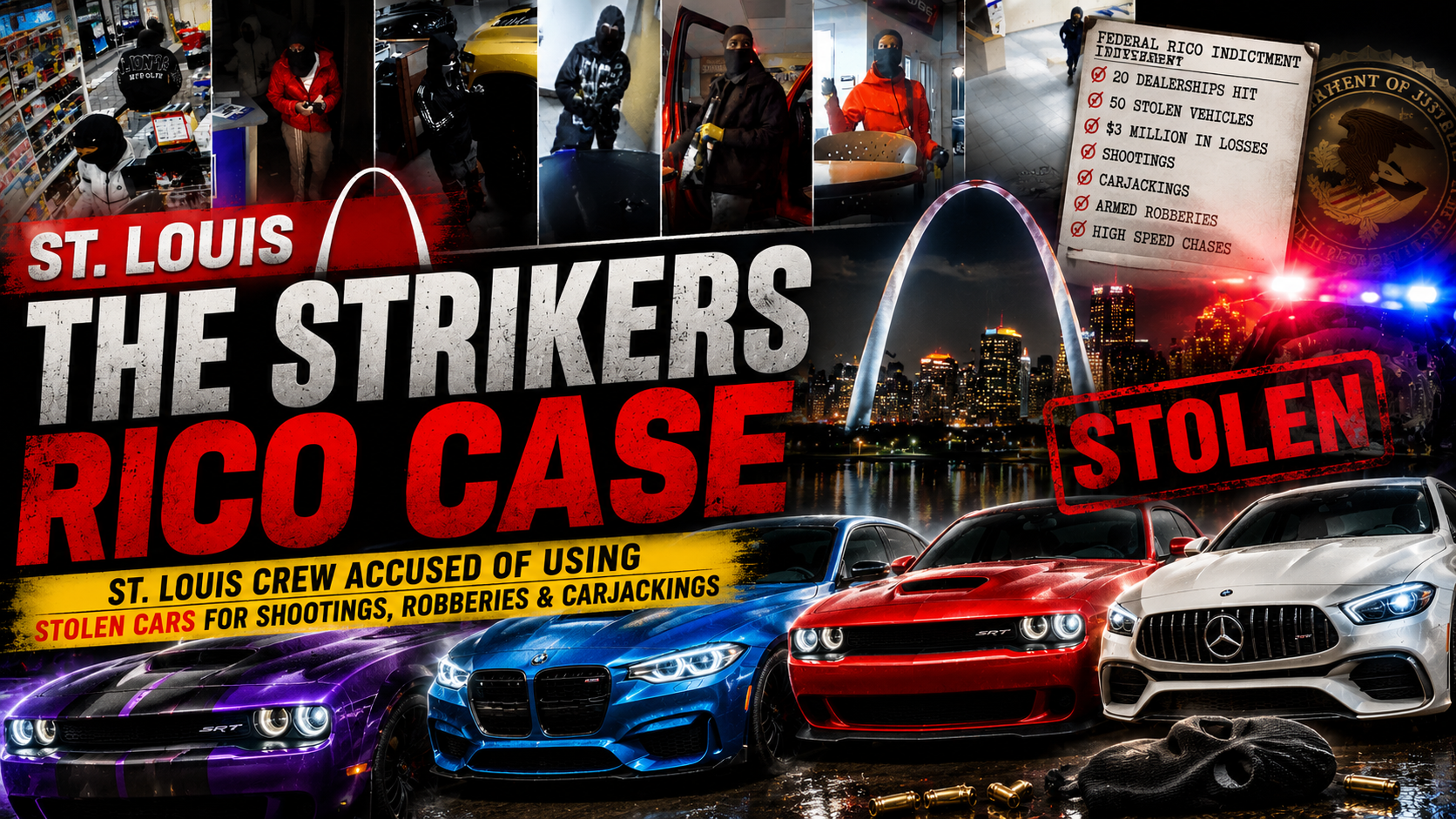
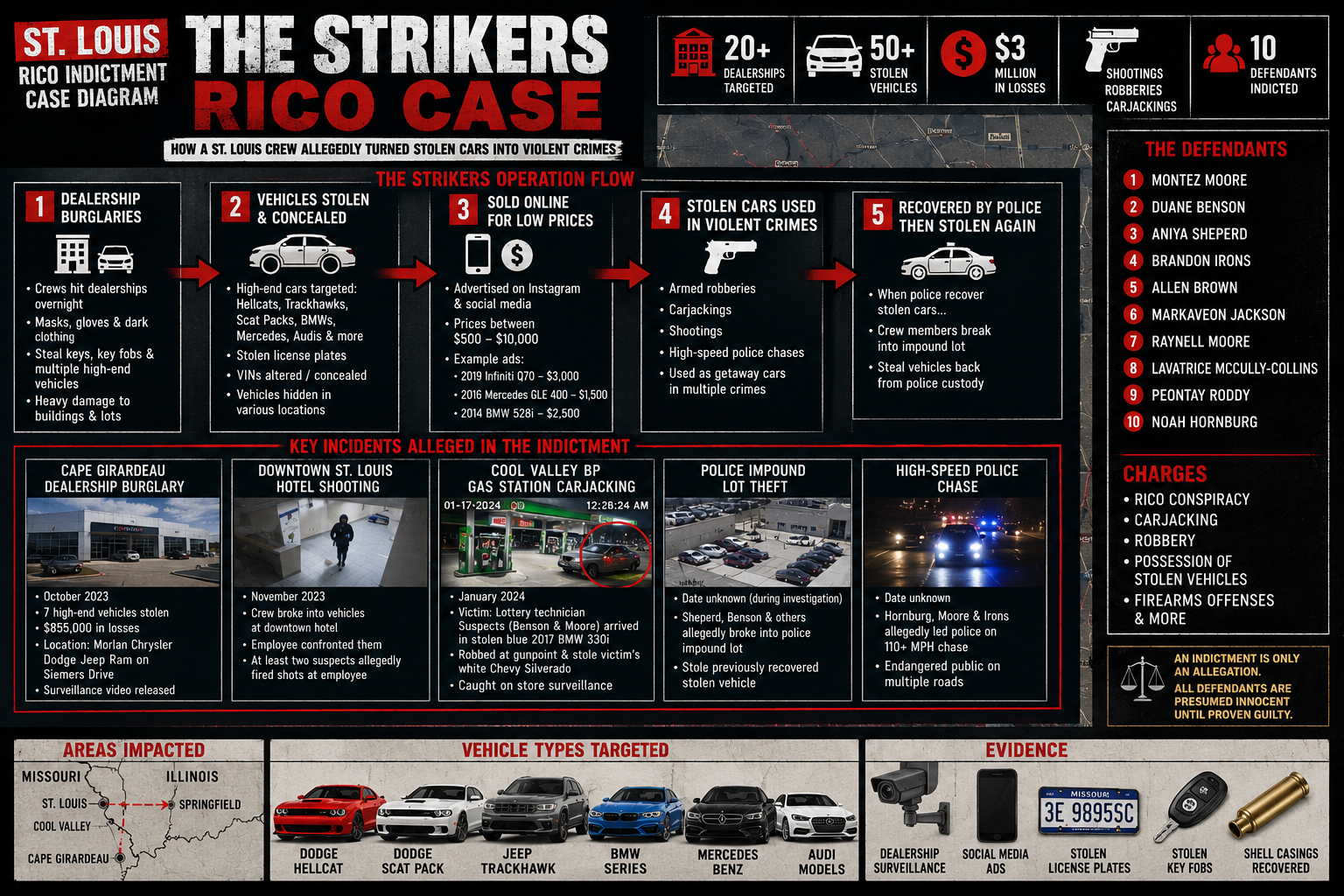
When federal prosecutors unsealed the superseding indictment against the group known as the “Strikers,” they did not describe the organization as a normal auto theft crew. The Department of Justice alleged the group operated as a violent racketeering enterprise responsible for dealership burglaries, stolen luxury vehicles, armed robberies, carjackings, shootings, high-speed pursuits, and the interstate trafficking of stolen cars across Missouri and Illinois. According to the indictment, the operation centered around high-performance vehicles like Dodge Hellcats, Scat Packs, Trackhawks, BMWs, Mercedes-Benzes, and Audis. Prosecutors say the crew stole vehicles from dealerships during overnight break-ins, used stolen license plates and altered VIN information to conceal the cars, then sold them online through social media for prices dramatically below market value.
Federal authorities alleged the crimes took place from approximately July 2023 through May 2024. During that period, prosecutors say the Strikers burglarized around twenty dealerships, stole approximately fifty vehicles, and caused losses estimated at roughly three million dollars. Unlike many theft rings that quietly move stolen property for profit, prosecutors claim the Strikers regularly used the stolen vehicles during additional crimes. The indictment repeatedly connects stolen cars to robberies, shootings, and pursuits involving law enforcement. That is the core reason the federal government elevated the case into a RICO conspiracy instead of treating it as a standard theft investigation.
The case was announced publicly by the U.S. Attorney’s Office for the Eastern District of Missouri and was tied directly to the Department of Justice Violent Crime Initiative in St. Louis. Federal officials described the operation as one of the more aggressive organized car theft conspiracies uncovered in the region in recent years.
The Defendants Named In The Federal Indictment
The superseding indictment named ten defendants tied to the alleged Strikers organization. Those defendants were Montez Moore, Duane Benson, Aniya Sheperd, Brandon Irons, Allen Brown, Markaveon Jackson, Raynell Moore, Lavatrice McCully-Collins, Peontay Roddy, and Noah Hornburg. All were identified as being from the St. Louis area.
According to federal prosecutors, Montez Moore, Duane Benson, and Aniya Sheperd had already been facing earlier charges connected to the investigation before the superseding indictment expanded the alleged conspiracy. The government later added the remaining defendants as investigators continued piecing together the alleged structure of the organization.
The charges tied to the case included racketeering conspiracy, carjacking, robbery, possession of stolen vehicles, firearms offenses, and related violent crime allegations. Prosecutors emphasized in official statements that the indictment itself only represents allegations and that all defendants remain presumed innocent unless proven guilty in court.
The Alleged Structure Of The Organization
Federal prosecutors claim the Strikers functioned more like an organized street network than a random theft crew. According to the indictment, members allegedly worked together during dealership burglaries, transportation of stolen vehicles, concealment operations, online sales, and violent follow-up crimes involving the stolen cars.
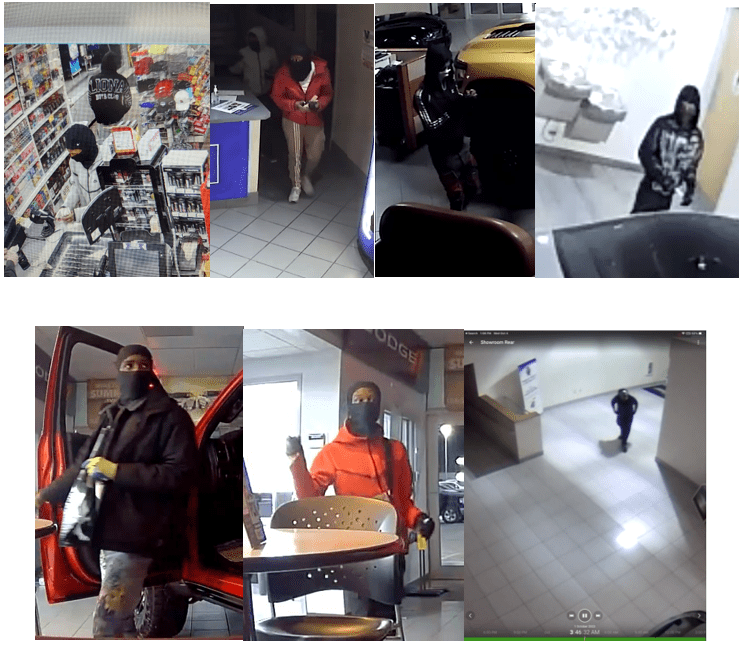
The DOJ alleges members regularly wore masks, gloves, and dark clothing while carrying out dealership burglaries. Prosecutors say they targeted dealerships late at night or during early morning hours, broke into buildings to steal keys and key fobs, then quickly removed multiple vehicles before police could respond.
Investigators alleged the group specifically targeted high-demand performance vehicles because those cars had strong black-market demand and could be sold rapidly through social media. Prosecutors say some vehicles were sold for only a fraction of their actual value. One example cited by the DOJ involved social media posts allegedly advertising a 2019 Infiniti Q70 for $3,000, a Mercedes-Benz GLE 400 for $1,500, and a BMW 528i for $2,500.
That pricing became one of the most important details in the case because it allegedly showed how quickly the crew wanted to move the vehicles. Prosecutors argued the organization was not concerned with maximizing resale value through legal channels. Instead, the government alleges the cars were treated like disposable assets that could be quickly converted into cash or reused in other crimes.
The Cape Girardeau Dealership Burglary
One of the biggest incidents tied to the case occurred in Cape Girardeau, Missouri. Prosecutors alleged members of the Strikers burglarized a dealership and stole seven high-end vehicles worth approximately $855,000. Local reporting connected the incident to Morlan Chrysler Dodge Jeep Ram on Siemers Drive.
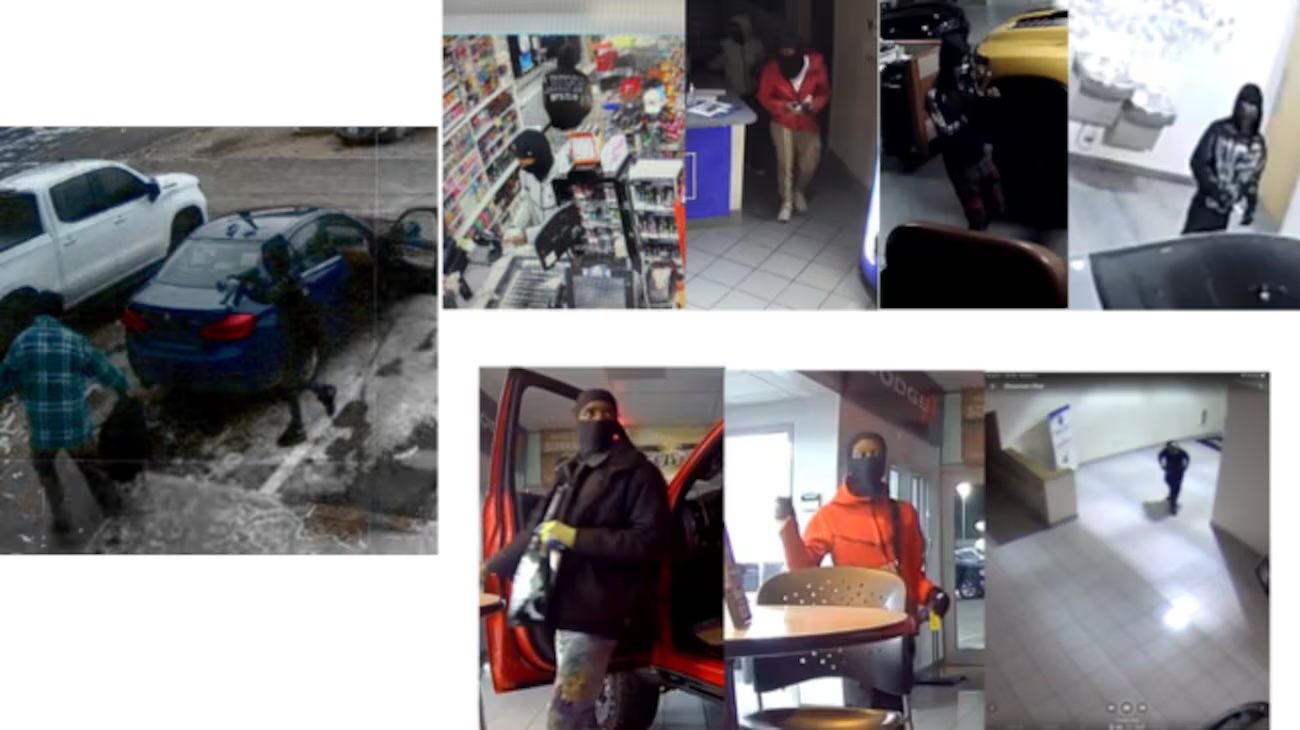
The burglary became one of the most visual incidents connected to the federal case because surveillance footage from the dealership was later released publicly. Local reports described multiple vehicles disappearing from the lot during the overnight operation. The stolen vehicles reportedly included high-performance Dodge models that had become frequent targets nationwide due to their popularity and resale demand.
Investigators later tied some of the stolen vehicles from dealership burglaries to other crimes across the St. Louis region. That connection became one of the main pillars of the RICO conspiracy allegations.
The Downtown St. Louis Hotel Shooting Allegation
One of the most serious allegations in the indictment involved a shooting tied to vehicle break-ins at a downtown St. Louis hotel in November 2023. According to federal prosecutors, at least two alleged Strikers members broke into vehicles near the hotel during the early morning hours. When a hotel employee pursued them, prosecutors allege shots were fired at the employee.
The indictment did not publicly release every detail tied to the shooting allegation, but the accusation immediately shifted the tone of the case from organized theft to violent criminal conduct. Prosecutors repeatedly used this incident to argue that members of the organization allegedly escalated to gun violence whenever they were confronted or interrupted during crimes.
That allegation became one of the strongest arguments supporting the government’s racketeering theory because prosecutors portrayed the shooting as part of the enterprise’s operational pattern rather than an isolated incident.
The Cool Valley Gas Station Carjacking
The most heavily documented violent allegation in the case involved the January 2024 armed robbery and carjacking of a lottery machine technician outside a BP gas station in Cool Valley, Missouri.
According to federal prosecutors, Duane Benson and Montez Moore allegedly arrived in a stolen blue 2017 BMW 330i that had previously been taken from a dealership in Springfield, Illinois. Prosecutors claim the suspects waited for the lottery technician to exit the gas station before confronting him at gunpoint.
The DOJ alleged the technician was robbed before his white Chevrolet Silverado pickup truck was stolen during the ambush. Authorities also stated the robbery and carjacking were captured on surveillance video. Federal prosecutors later included still images from the footage in public court-related releases discussing the case.
This incident became one of the central pieces of the federal narrative because prosecutors alleged the suspects used a previously stolen luxury vehicle to carry out another violent crime. According to the government, this demonstrated how dealership thefts allegedly fueled additional criminal activity throughout the region.
The Police Impound Lot Allegation
One of the most unusual allegations in the indictment involved claims that members of the organization allegedly stole a vehicle back from a police impound lot after authorities had already recovered it.
Federal prosecutors alleged Aniya Sheperd, Duane Benson, and others participated in breaking into an impound facility to retrieve a previously seized stolen vehicle. While the indictment did not publicly reveal every operational detail behind the alleged theft, prosecutors used the incident to portray the group as highly bold and organized.
That allegation immediately stood out because most stolen vehicle cases end once law enforcement recovers the car. Prosecutors instead argued the Strikers allegedly continued pursuing stolen vehicles even after police intervention, reinforcing the government’s theory that the organization operated with coordination and planning.
The High-Speed Pursuit Allegation
Federal prosecutors also tied several defendants to a high-speed police pursuit involving a stolen vehicle. According to the indictment, Noah Hornburg, Montez Moore, and Brandon Irons allegedly fled from law enforcement at speeds exceeding 110 miles per hour on public roads.
Authorities used the pursuit allegations to further argue that the organization endangered the public beyond dealership burglaries and vehicle thefts. Prosecutors repeatedly described the alleged conduct as reckless and violent, especially when combined with the robbery and shooting allegations already tied to the case.
The Vehicles Prosecutors Say Were Frequently Targeted
The indictment and supporting announcements repeatedly referenced Dodge Hellcats, Scat Packs, Trackhawks, BMWs, Mercedes-Benzes, Audis, and other high-performance luxury vehicles. Investigators believe those cars were heavily targeted because they carried high street demand and could be quickly resold.
The Hellcat angle became especially important because Hellcat thefts have exploded nationwide in recent years. Across social media platforms and regional news reporting, Hellcats and Scat Packs have become heavily associated with organized theft crews due to their performance, popularity, and resale demand. Federal prosecutors appeared to lean heavily into that public awareness when describing the alleged Strikers operation.
The Social Media Angle
One of the strongest modern-crime aspects of the case involves prosecutors alleging the organization used social media to move stolen vehicles quickly. According to the DOJ, some vehicles were advertised online for prices far below legitimate market value.
That detail matters because it allegedly transformed the operation from isolated thefts into a functioning underground marketplace. Prosecutors essentially argued the organization created a rapid pipeline where stolen luxury cars could be burglarized from dealerships, concealed temporarily, posted online, and sold almost immediately.
Investigators believe that speed helped the alleged organization avoid longer-term detection while continuously generating cash flow.
St. Louis Context And Why The Case Drew Federal Attention
The case emerged during a period when St. Louis and surrounding areas were already experiencing increased concern over organized car thefts and violent vehicle-related crimes. Hellcat thefts, dealership burglaries, and interstate vehicle trafficking operations had become growing issues across multiple Midwest cities.
Federal authorities appear to have viewed the Strikers investigation as an opportunity to target what prosecutors believed was a larger organized structure rather than isolated offenders. The use of the RICO statute allowed investigators to connect dealership burglaries, violent incidents, vehicle trafficking, robberies, and coordinated criminal behavior into one broader conspiracy case.
That strategy also allowed prosecutors to frame the alleged organization as a continuing criminal enterprise rather than a series of disconnected incidents.
Reddit Discussion And Online Street Reactions
Unlike major Chicago drill indictments or rapper-related RICO cases, the Strikers case did not generate massive nationwide Reddit discussion at the time the indictment was announced. There were smaller local conversations discussing dealership burglaries, Hellcat thefts, and the rise of organized car theft crews in St. Louis, but there was not a dominant megathread tied directly to the federal case.
Some discussions online focused on how aggressively Hellcats and Scat Packs were being targeted nationwide, while others questioned how many stolen vehicles were circulating through underground markets across Missouri and Illinois. Several commenters also discussed how dealership burglaries had become increasingly organized, with crews allegedly using scanners, key programmers, and coordinated lookout systems.
At the time of this file, there was no large verified Reddit theory ecosystem surrounding the Strikers case itself comparable to major gang homicide investigations. Most available discussion centered around the scale of the alleged operation and the unusually violent allegations tied to a car theft conspiracy.
The Most Important Allegation In The Entire Case
The single most important allegation in the entire federal case is not the dealership burglaries themselves. It is the government’s claim that stolen luxury vehicles were repeatedly used during additional violent crimes.
That allegation is what transformed the investigation from a property crime case into a federal racketeering conspiracy. Prosecutors are essentially arguing that the stolen vehicles became operational tools for armed robberies, shootings, pursuits, and additional criminal activity across the region.
Without that connection, this likely would have remained a major organized auto theft case. With that connection, federal authorities portrayed the Strikers as a violent criminal enterprise operating across state lines.
Unlock the full case file.
Continue with the complete investigation, source material, member video, and related evidence.
Unlock Full Case FileMembership starts at $5/month · Secure checkout