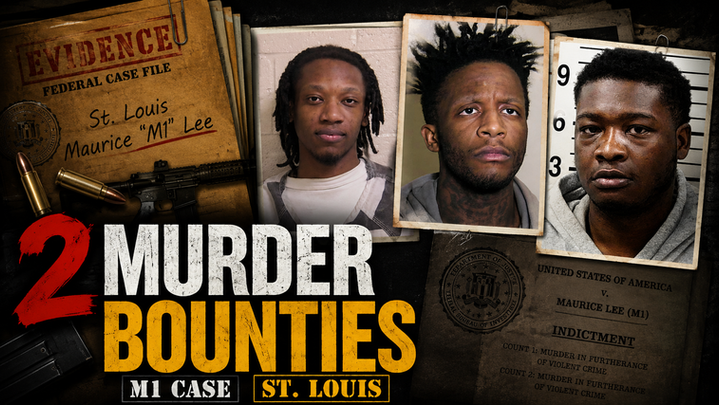
Reporting and analysis may discuss allegations and online theories. Allegations are not findings of guilt. Verify important details in the cited public record.
CASE FILE
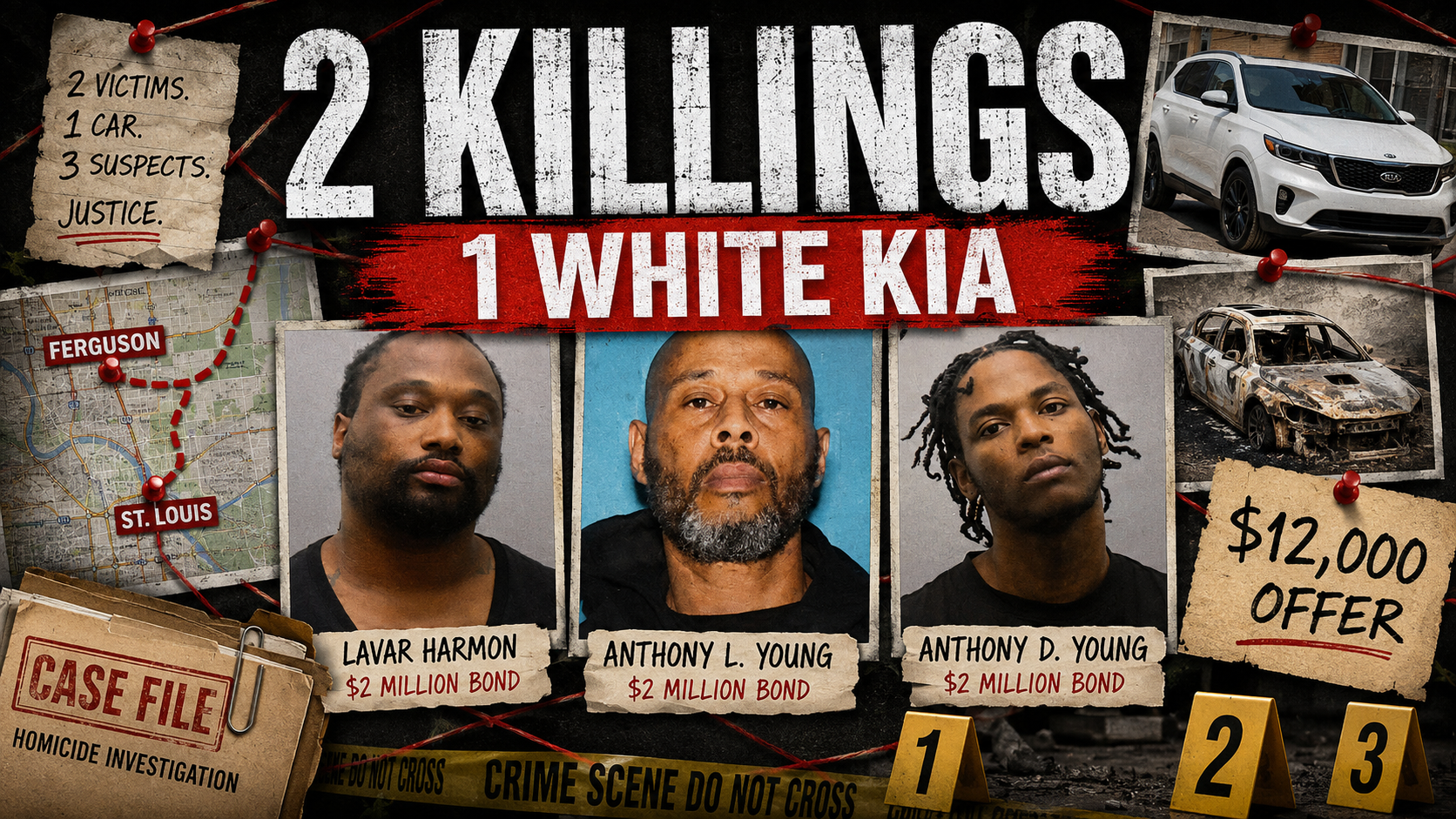
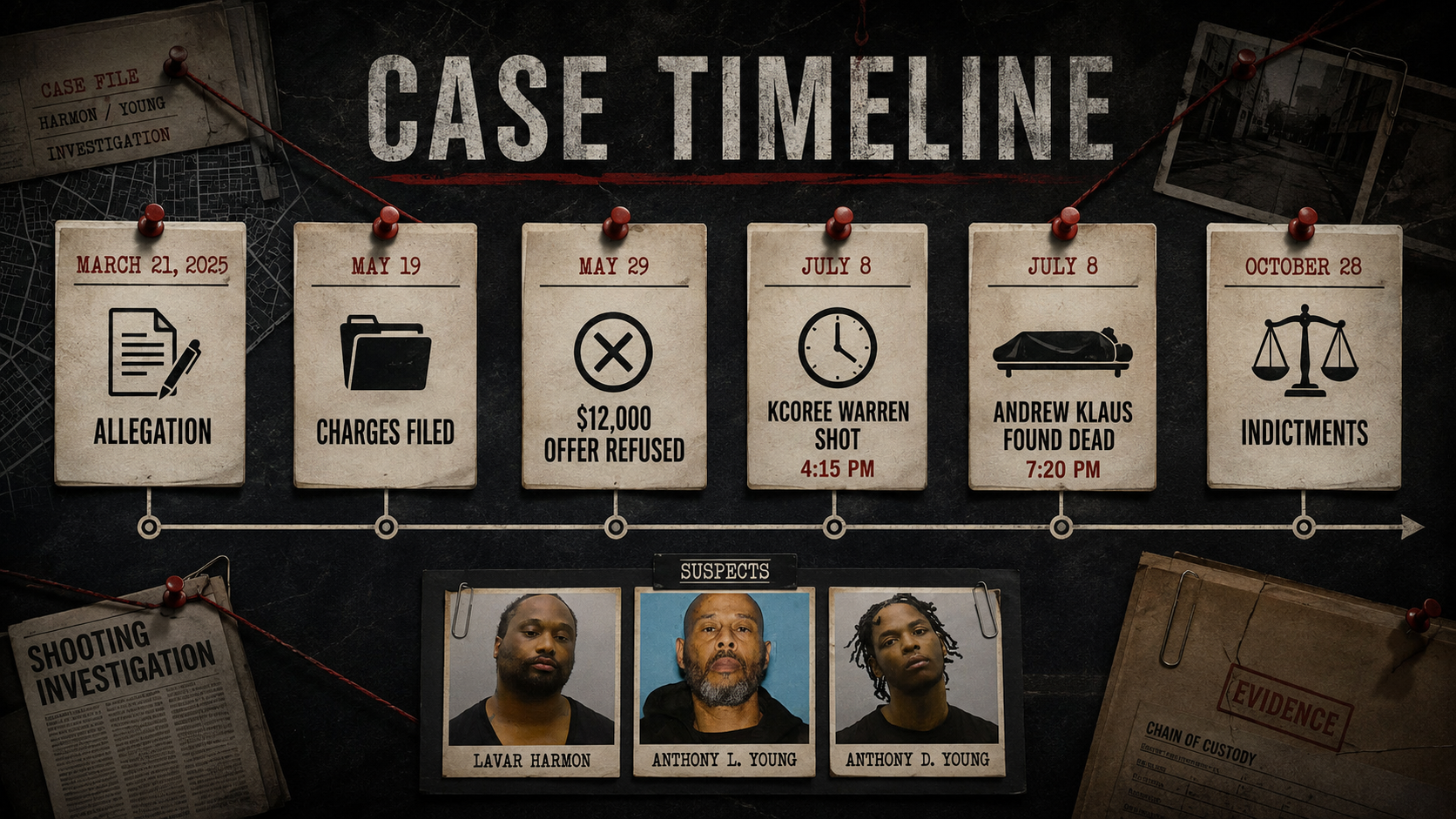
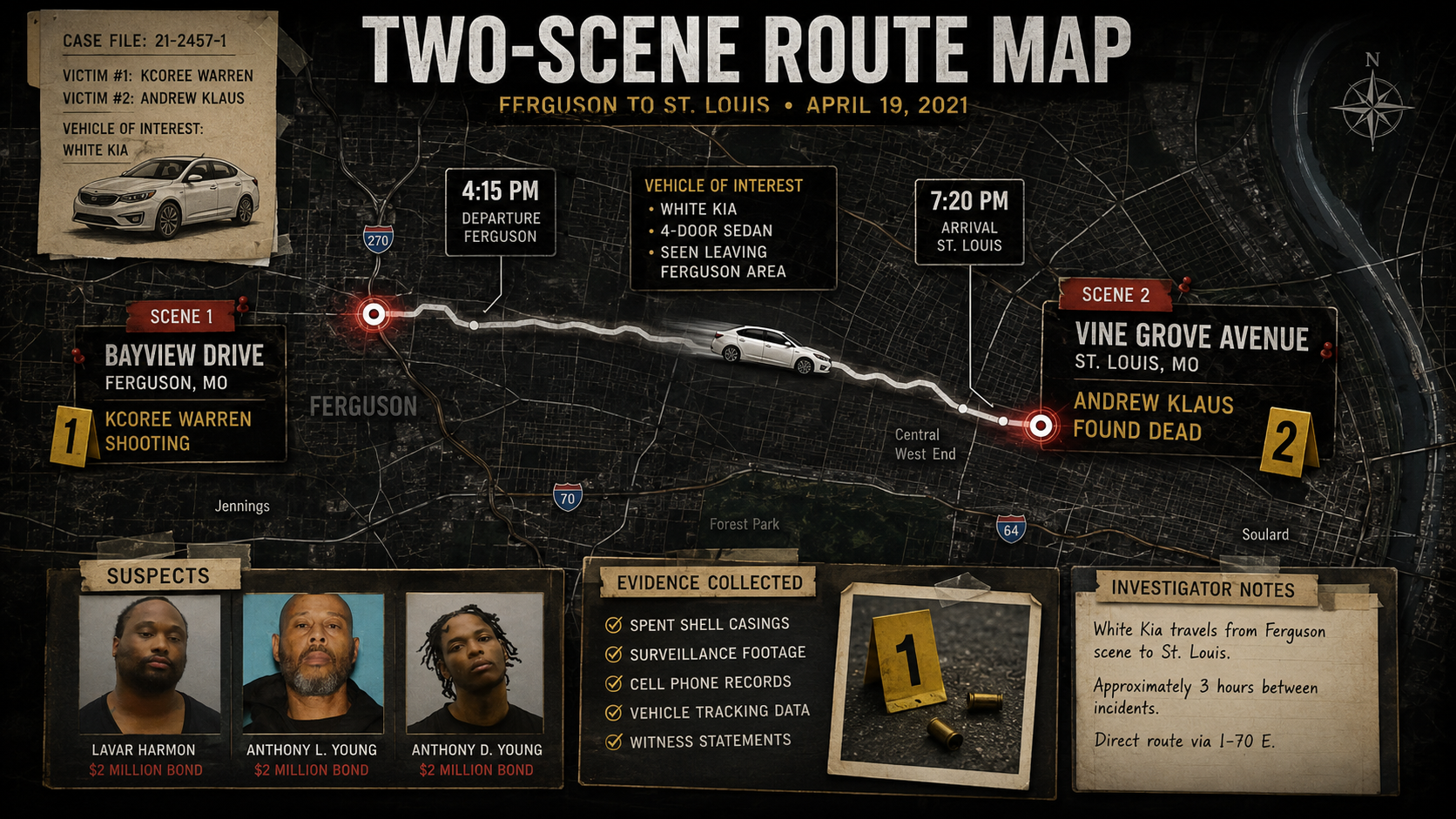
At approximately 4:15 p.m. on July 8, 2025, a shooting was reported at a home on Bayview Drive in Ferguson, Missouri. Kcoree Warren, a 44-year-old father who had reported allegations involving his teenage daughter, was taken from the residence to a hospital and pronounced dead. A white Kia was reportedly seen leaving the property.
Roughly three hours later, another homicide investigation opened approximately 12 miles away in the City of St. Louis. Officers responding to the 3100 block of Vine Grove Avenue found 19-year-old Andrew Klaus dead with what police initially described as a puncture wound to his head. The same white Kia associated with Warren’s killing was reportedly found burned nearby.
By the end of the investigation’s first major phase, authorities were no longer treating the two deaths as unrelated shootings. Prosecutors alleged that Klaus had killed Warren, then became the second victim in a coordinated sequence involving Lavor Harmon, Harmon’s uncle Anthony L. Young, and Young’s son Anthony D. Young. The origin of that alleged sequence, however, was not either homicide scene. It began months earlier with a report involving Warren’s 15-year-old daughter, a pending statutory-rape prosecution, and an alleged offer of $12,000 delivered to Warren’s front door.

The Case Before the Killings
According to St. Louis County court records summarized in public reporting, Lavor Harmon was accused of committing sexual acts with a girl younger than 17 on or around March 21, 2025. Charging documents reportedly stated that Harmon met the teenager while she was walking home from her school bus. The accessible public record identifies the girl only by her age and her relationship to Kcoree Warren, protecting her identity as a minor and alleged victim.
Charges were issued against Harmon on May 19, 2025. He was accused of one count of second-degree statutory rape and three counts of second-degree statutory sodomy. A grand jury later returned an indictment on the sexual-offense allegations in June. Harmon initially received a $150,000 bond with conditions prohibiting direct or indirect contact with the teenager.
Under Missouri law, second-degree statutory rape applies when someone 21 or older has sexual intercourse with someone younger than 17. Second-degree statutory sodomy is similarly defined by the ages of the participants. Those statutes do not require prosecutors to prove the same elements associated with a forcible-rape charge. Harmon’s charges nevertheless remain allegations; the publicly located record does not show a conviction, guilty plea, or trial verdict on those counts.
Kcoree Warren was more than the father of the girl named in the investigation. Court documents identify him as the person who made the original report and was expected to participate in the prosecution. His cooperation placed him inside an active felony case—and, according to prosecutors, made him the target of an effort to interfere with it.
The $12,000 Offer
On May 29, ten days after charges were reportedly issued against Lavor Harmon, Lavonda Harmon arrived at Warren’s residence with an unidentified man. Lavonda was Lavor’s sister and lived in Texas. A Ferguson police officer later stated that the purpose of the visit was to influence Warren not to participate in the prosecution.
The accompanying man allegedly offered Warren $12,000. The court language is important: the allegation was not simply that someone discussed money or attempted to resolve a family dispute. Investigators said the offer was made in exchange for Warren no longer participating in the pending felony prosecution. Warren refused.
Public retellings frequently describe the encounter as an attempt to make Warren “drop the charges.” That wording oversimplifies the legal process. Warren did not personally control whether the State of Missouri continued prosecuting Harmon. What he could do was provide information, cooperate with investigators, assist the alleged victim, appear when required and give testimony. The alleged objective, according to the warrant, was to remove that participation from the case.
Missouri’s witness-tampering statute specifically covers offering a direct or indirect benefit to induce a witness to withhold evidence or assistance, avoid legal process or interfere with a prosecution. Lavonda Harmon was ultimately charged with tampering with a witness in a felony prosecution. She was arrested on July 11, three days after Warren’s death, and later released after posting a $100,000 bond. The unidentified man accused of presenting the offer was not publicly named in the materials located for this file.
The $12,000 must also be kept separate from the later homicide allegations. No publicly located filing states that this amount was offered to Andrew Klaus, paid to a gunman or used as compensation for Warren’s murder. The documented allegation describes $12,000 as an attempted payment to Warren for his silence. Prosecutors later said further evidence could potentially produce murder-for-hire charges, but no such charge was included in the October announcement.
The Bond Motion
After Warren’s death, prosecutors used the alleged bribery attempt and the developing homicide investigation to request a dramatic increase in Lavor Harmon’s bond. In their motion, they argued that Harmon’s family members and associates had engaged in conduct demonstrating a significant danger to the teenager, her relatives and the larger community.
The motion also noted that Harmon had been on federal supervised release when the state case developed. Prosecutors characterized him as a flight risk and alleged that his history reflected organized criminal behavior. They argued that his family knew about the pending warrant and charges but attempted to influence Warren’s family instead of directing Harmon to surrender. A judge granted the request and increased Harmon’s bond from $150,000 to $2 million cash.
At that stage, the public court record did not yet identify who allegedly killed Warren. It described a male arriving at the residence, shooting him, leaving in a white Kia and later being found murdered in St. Louis. The name Andrew Klaus would enter the public accusation months later, when prosecutors announced the double-homicide indictments.
Bayview Drive
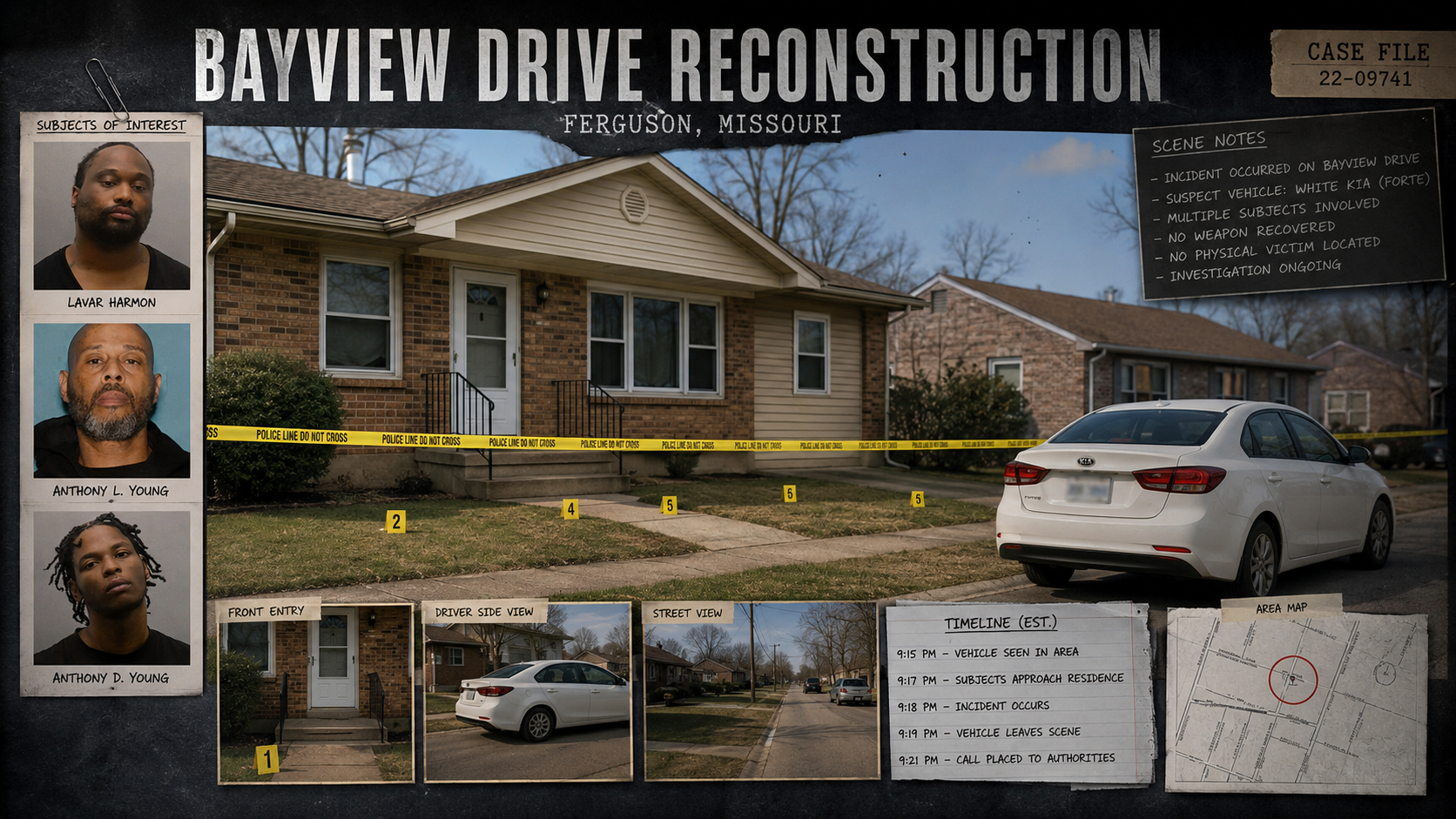
The shooting at Warren’s Ferguson home was reported at approximately 4:15 p.m. on July 8. Warren was transported to a hospital but died from his injuries. The alleged victim from the statutory case and another minor were reportedly inside the home when the shooting occurred. The public record does not state whether either child directly witnessed the gunfire, saw the shooter or provided an identification.
Later accounts have added details about the exact manner in which the shots entered the residence, including claims that Warren was shot through a glass door. That description does not appear in the accessible excerpts from the bond motion or the initial local police reporting reviewed for this file. Without the complete Ferguson homicide report, crime-scene photographs or probable-cause statement, the precise physical reconstruction remains unconfirmed.
The public record does not disclose the number of shots, firearm caliber, shell-casing count, bullet trajectories, recovered projectiles, shooting distance or whether a weapon was recovered. It also does not establish what the shooter said, how long the person remained at the house or whether entry was attempted. The only publicly described movement is a male arriving, Warren being shot and a white Kia being observed leaving the scene.
Those omissions matter because the first-degree murder allegation requires more than proof that Warren was killed. Missouri law requires prosecutors to establish that a defendant knowingly caused a death after deliberation. The public accusation supplies a motive theory—silencing Warren—and an alleged network, but the evidence prosecutors intend to use to prove planning and deliberation has not been released in detail.
Vine Grove Avenue
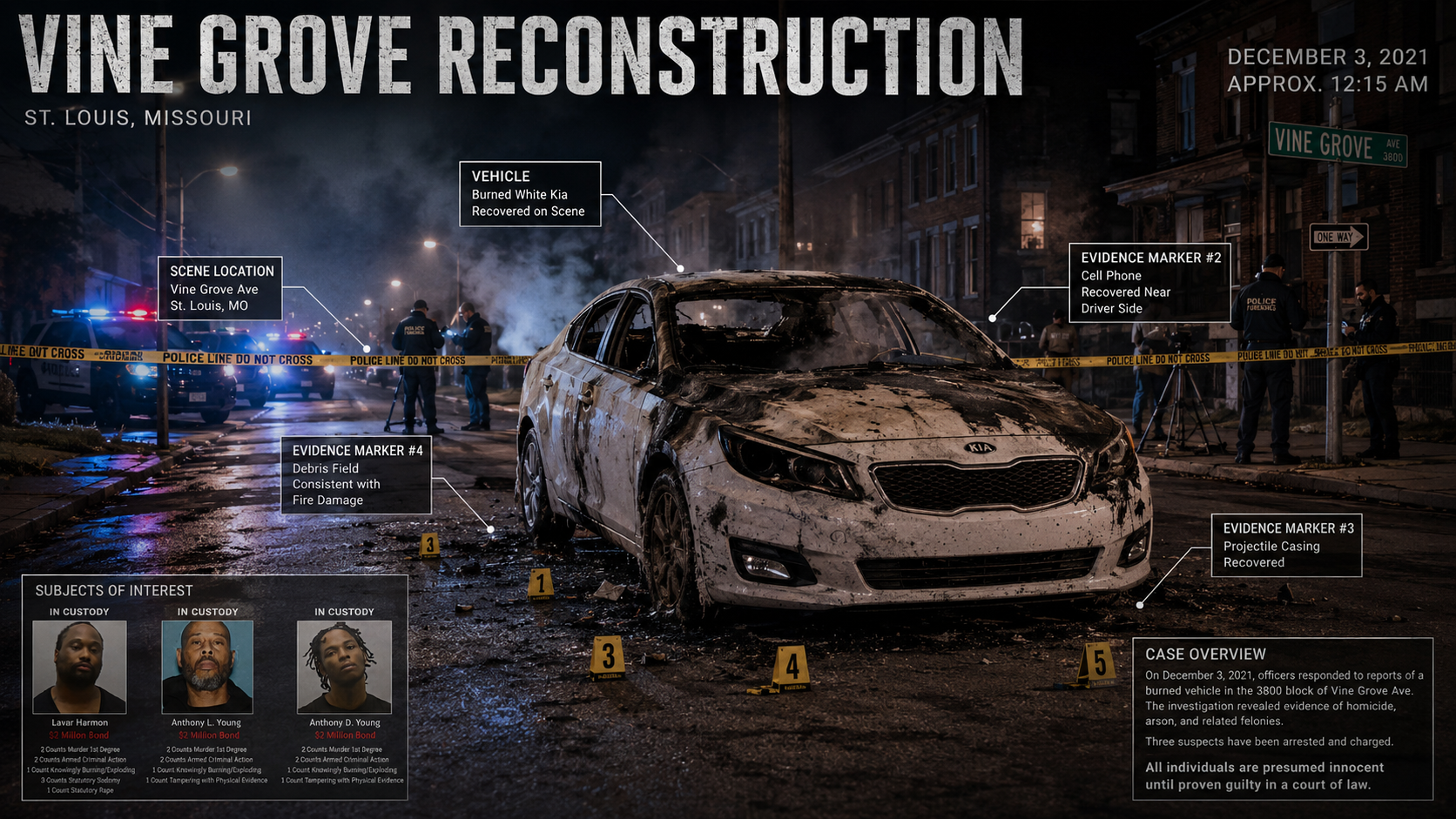
At approximately 7:20 p.m., St. Louis Metropolitan Police received a call concerning a shooting in the 3100 block of Vine Grove Avenue in the Greater Ville neighborhood. Officers found a young man dead at the scene. Police initially described a puncture wound to his head but did not publicly identify the weapon or release an autopsy finding. On July 14, authorities identified him as 19-year-old Andrew Klaus of Imperial, Missouri.
Klaus occupied two distinct positions in the investigation. At Vine Grove Avenue, he was the victim of a homicide. In the later prosecution theory, he was also the person accused of killing Warren earlier that afternoon. Because Klaus died before he could be arrested, charged or tried, the accusation that he shot Warren will not be tested through a criminal case against him.
The two dispatch times place the shootings approximately three hours and five minutes apart. During that interval, prosecutors allege, Klaus left Warren’s home in the Kia, traveled into St. Louis and was killed. The accessible record does not reveal where Klaus went between the two scenes, who accompanied him, whether he communicated with the indicted men or how investigators reconstructed his movements.
Authorities later alleged that Lavor Harmon, Anthony L. Young and Anthony D. Young were present when Klaus was killed. Public reporting does not describe who fired a weapon, who arranged the meeting, who transported Klaus or whether the killing occurred exactly where his body was discovered. Presence at a scene and criminal responsibility are not automatically identical; the unreleased indictment evidence would have to explain how prosecutors moved from alleged presence to two first-degree murder charges against each defendant.
The White Kia
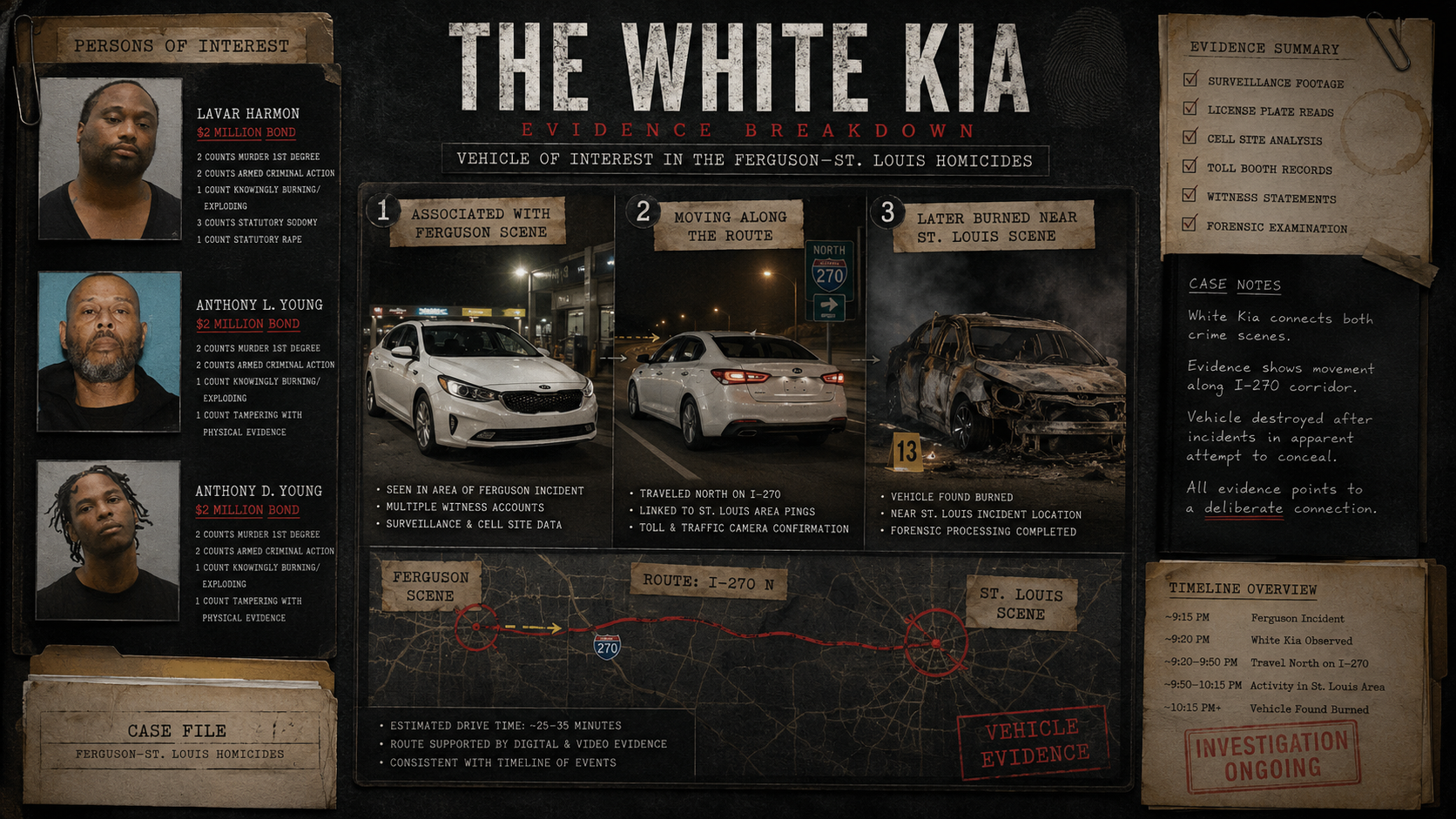
The white Kia is the clearest publicly disclosed object connecting the two homicide scenes. Prosecutors said a white Kia was observed leaving Warren’s residence. The same vehicle was later found burned near the location where Klaus was discovered dead. Police reportedly believed it belonged to Klaus.
If the vehicle identification is correct, it gives investigators a physical bridge between Bayview Drive and Vine Grove Avenue. It could place the same automobile within the timeline of both killings, provide a route for surveillance reconstruction and preserve evidence from Warren’s scene. Its destruction could also explain why prosecutors added burning and physical-evidence-tampering charges.
What the public record does not reveal is just as important. No accessible report provides the Kia’s model, year, license plate, registration history, vehicle identification number or exact recovery location. There is no released description of who was seen driving, whether additional occupants were visible, how the car was tracked or whether traffic cameras captured its route.
The forensic condition of the Kia also remains undisclosed. There is no public inventory of fingerprints, DNA, blood, cartridge casings, firearm residue, phones, clothing or personal property recovered from the interior. Investigators have not publicly described whether an accelerant was detected, where the fire began, when it was set or who allegedly set it.
Missouri’s knowingly-burning-or-exploding statute applies when a person knowingly damages another person’s property by starting a fire or causing an explosion. Physical-evidence tampering separately covers altering, destroying, suppressing or concealing an object with the purpose of impairing its availability or reliability in an official investigation. The existence of both counts indicates that prosecutors view the fire as more than incidental property damage, but the public charge summary does not assign the act to a specific defendant.
The Family Network Named by Prosecutors
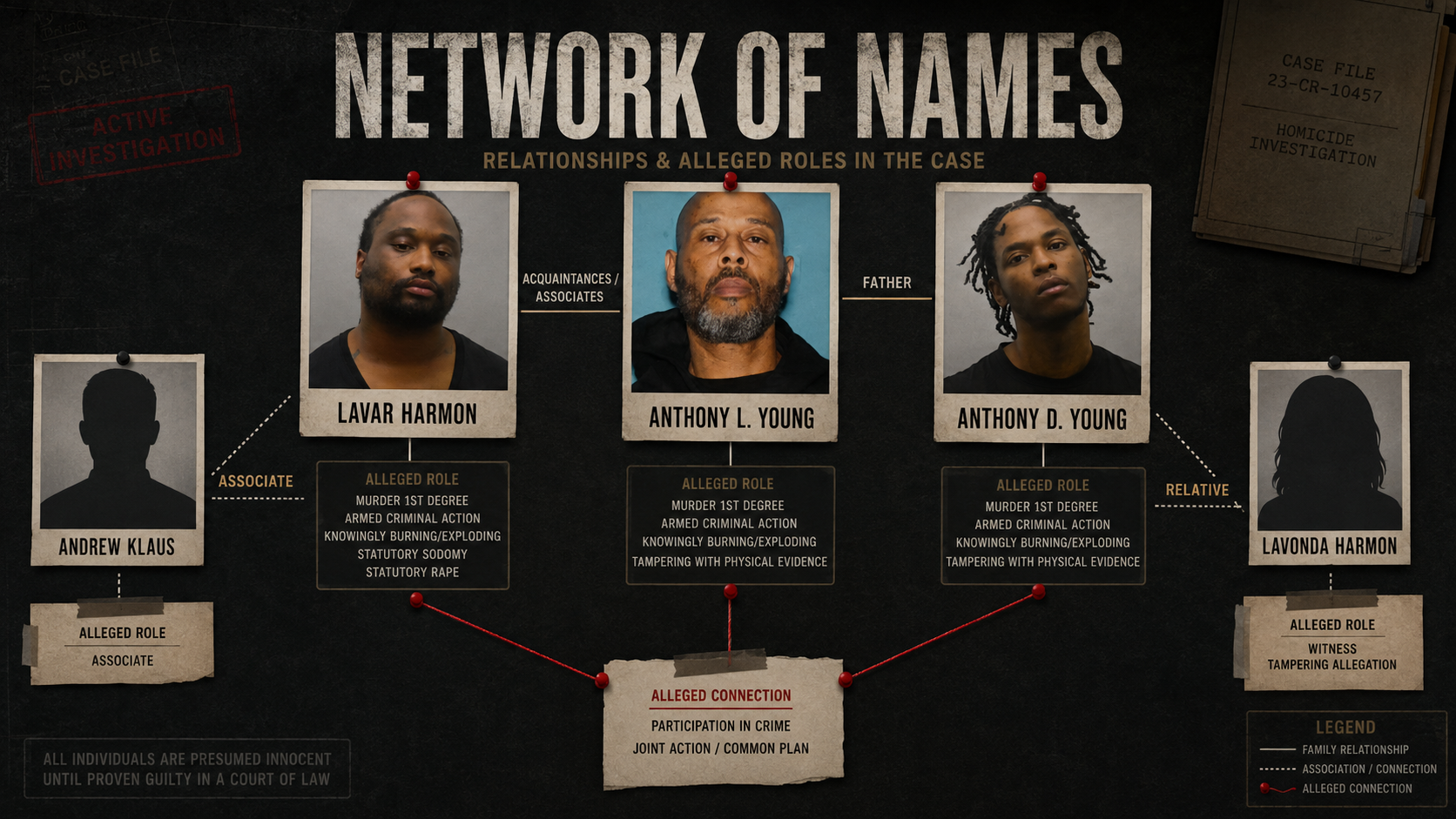
On October 28, 2025, a St. Louis County grand jury returned indictments against three related men: 40-year-old Lavor Harmon, his 52-year-old uncle Anthony L. Young, and Young’s 23-year-old son Anthony D. Young. Anthony D. Young was therefore both Anthony L. Young’s son and Lavor Harmon’s cousin. The charges were publicly announced the following day.
Prosecutors described Lavor Harmon as the person who orchestrated the plan to kill Warren after the $12,000 offer was refused. Anthony L. Young and Anthony D. Young were identified as alleged co-conspirators. Andrew Klaus was described as an associate who carried out Warren’s shooting.
The public announcement did not identify Klaus as a relative. It described him as an associate of the three men. It also did not explain how the relationship was established—whether through phone contacts, witness statements, social-media records, surveillance, prior criminal associations or another source.
For Klaus’s death, prosecutors alleged that Harmon and both Youngs were present. That statement places all three men at the second end of the timeline, but it does not reveal their individual actions. No publicly available narrative states who confronted Klaus, who possessed a weapon, whether there was a discussion before the killing or whether one defendant later gave information against another.
That gap is especially significant because a conspiracy can be reconstructed through communications and shared conduct even when every participant does not personally commit every physical act. The available coverage, however, does not provide the messages, calls, meetings or overt acts that would show the alleged agreement. It gives the structure of the state’s theory without opening the evidence supporting that structure.
The October Indictments
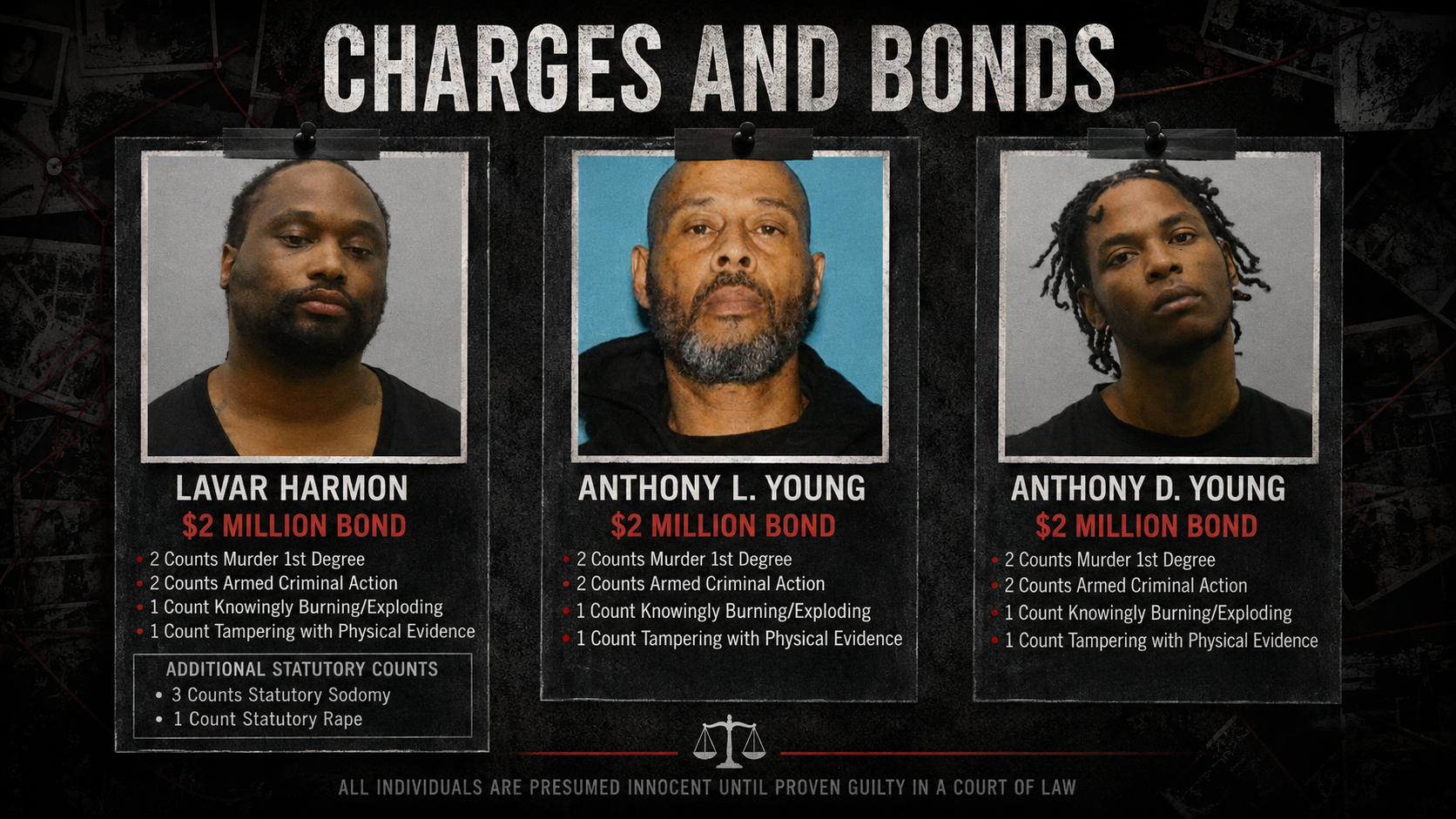
Spectrum News reported that each of the three men was indicted on six charges: two counts of first-degree murder, two counts of armed criminal action, one count of knowingly burning or exploding, and one count of tampering with physical evidence. The two murder counts correspond to the deaths of Kcoree Warren and Andrew Klaus. The two armed-criminal-action counts attach to the alleged use of a dangerous instrument or deadly weapon during those killings.
A separate First Alert 4 report summarized five counts against each man—two first-degree murders, two armed-criminal-action counts and one burning count—without listing evidence tampering. Because the full indictments were not available in the sources reviewed, that discrepancy should remain visible rather than being silently resolved. The more detailed Spectrum account expressly reported six counts and named physical-evidence tampering as the sixth.
Under Missouri law, first-degree murder requires a knowing killing after deliberation. Armed criminal action applies when a felony is committed through the use or assistance of a dangerous instrument or deadly weapon and carries punishment separate from the underlying felony. The charge does not, by itself, identify which defendant allegedly held the weapon; the state’s theory of responsibility would be developed through the indictment instructions, accomplice-liability law and trial evidence.
The burning and evidence-tampering counts create a third phase in the alleged case. The first phase involved the pending sexual-offense prosecution and the attempted influence of Warren. The second contained the two killings. The third concerned destruction or concealment after those deaths. Public reporting strongly associates that phase with the burned Kia, although the full charging language is needed before assigning every count to the vehicle with certainty.
Lavor Harmon was held in the St. Louis County jail on a $2 million bond. Anthony L. Young and Anthony D. Young were already in federal custody on unrelated matters when the county indictments were announced; county bonds of $2 million were also reported for them. The unrelated federal matters should not be treated as proof of the new murder allegations.
The Murder-for-Hire Question
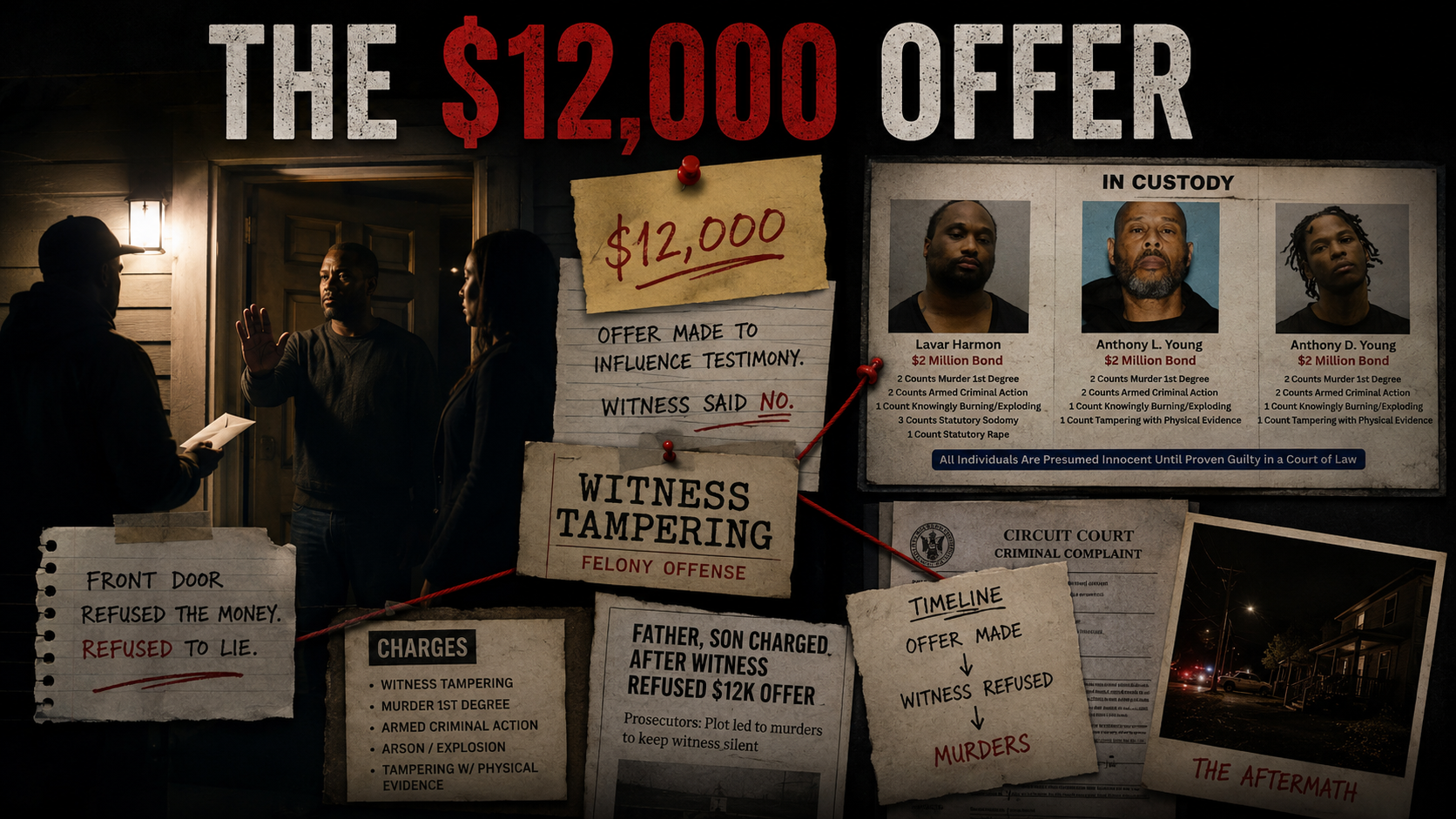
During the October announcement, prosecutors said continued investigation could lead to murder-for-hire charges if additional evidence were discovered. That statement generated headlines describing Klaus as a “hitman” and Warren’s death as a completed contract killing.
The public record does support a claim that prosecutors believe Klaus was recruited or coordinated with the three defendants to kill Warren. It does not publicly establish that Klaus received money, was promised money or entered a formal paid agreement. The only disclosed dollar amount remains the $12,000 allegedly offered to Warren.
The distinction is not cosmetic. A coordinated murder, a conspiracy and a murder-for-hire arrangement overlap but are not identical accusations. Prosecutors’ statement confirms that murder-for-hire was being considered as an investigative possibility; it also confirms that no such charge had been announced at that point.
The Evidence Prosecutors Have Not Opened
The public case is built around a powerful sequence, but the evidence establishing that sequence remains largely behind the indictment. Authorities have not released the surveillance footage that allegedly captured the Kia leaving Bayview Drive, if such footage exists. They have not identified the witness who saw it or stated whether the identification came from a camera, a person or both.
No phone extraction, tower-location analysis, geofence return or communication log has been made public. Those records could explain how investigators allegedly placed Klaus in contact with the Harmons and Youngs, tracked the vehicle, established the men’s presence at Vine Grove Avenue or identified planning before Warren’s death.
The same silence surrounds the weapons. The accessible reports do not identify the firearm used against Warren, the instrument responsible for Klaus’s head wound or any ballistic comparison between recovered evidence. No laboratory report connects either defendant to a gun, cartridge casing, projectile or firearm residue.
The evidence behind the alleged family conspiracy is also unreleased. Prosecutors have not publicly described whether a cooperating witness exists, whether one defendant made a statement, whether the unidentified man from the May 29 bribery attempt was located or whether financial records showed any payment connected with the killings.
The indictment announcement reveals the prosecution’s final theory but not the investigative steps that produced it. The white Kia is the public-facing bridge. The unreleased phone, witness, surveillance and forensic evidence—if presented at trial—would have to explain how investigators crossed from that vehicle to the individual defendants.
The Unidentified Man at the Door
One person appears early in the timeline and then disappears from the accessible record. The May 29 witness-tampering allegation states that Lavonda Harmon went to Warren’s home with an unidentified man. According to the police officer’s warrant statement, it was the man with Lavonda who effectively offered the $12,000.
Public reporting does not identify him as Lavor Harmon, either Anthony Young or Andrew Klaus. It does not state that he was later charged, interviewed or eliminated as a suspect. There is also no public explanation of whether investigators believe the offer came from Lavonda, Lavor, another relative or a broader agreement.
The unidentified man is therefore not a minor background detail. He was allegedly present during the first direct attempt to interfere with Warren’s participation. Determining his identity could reveal who knew about the prosecution, who had access to the money and whether the witness-tampering event connected to the later homicide group. The accessible record leaves that part of the chain unresolved.
The Defense Position
Before the October murder indictments, an attorney for Lavor Harmon said the defense had not seen evidence connecting the family to Warren’s killing and declined to make a further statement. That position came while the homicide investigation was still developing and before prosecutors publicly named Klaus or announced the full alleged network.
No substantive public defense response from Anthony L. Young or Anthony D. Young was located in the reporting reviewed for this file. There is also no publicly accessible account of their pleas to the county murder indictments, motions challenging the charges or requests to sever their cases.
All three men are presumed innocent unless proven guilty. The indictment establishes that a grand jury found sufficient grounds for the charges to proceed. It does not establish guilt, resolve the disputed evidence or substitute for a verdict.
Lavonda Harmon’s legal position must remain separate. She was publicly charged with witness tampering over the May 29 visit but was not identified in the October reporting as a defendant in either homicide. Online graphics that place her alongside the three murder defendants can create the false impression that all four face the same charges. They do not, based on the accessible record reviewed here.
Official Record Versus Online Retellings
The confirmed record establishes that Kcoree Warren was killed on July 8, 2025; Andrew Klaus was found dead later that evening; a white Kia was associated with both scenes and burned; and three men were later indicted for both deaths. It also establishes that Warren had reported allegations involving his daughter and refused an alleged offer of $12,000 to stop participating in the prosecution.
The sexual allegations against Lavor Harmon remain charges, not convictions. The accusation that Klaus shot Warren comes from police and prosecutors, but Klaus died before that allegation could be tested in court. The claim that Harmon and the Youngs were present when Klaus was killed is likewise a prosecution allegation awaiting adjudication.
The theory that Klaus was killed specifically to prevent him from exposing the other men is understandable, particularly when the vehicle was burned and evidence-tampering charges followed. The accessible public statements do not expressly identify that as the proven motive for Klaus’s death. They establish that prosecutors accuse the three men of his murder, not why they say the killing occurred.
Likewise, no verified public document says Klaus was paid $12,000. That amount belonged to the alleged attempt to influence Warren. Converting the witness offer into the supposed price of the murder changes the evidence and should not be repeated as fact.
No detailed Reddit investigation, credible alternative suspect theory or independently verified street account was located that adds reliable evidence to the official file. Most online discussions repeat the same news summaries, sometimes replacing allegations with conclusions or adding a cover-up motive that prosecutors have not publicly detailed.
Kcoree Warren Beyond the Court File
A fundraiser created by Warren’s brother, Joryn Parker, described Kcoree as his best friend, a loving father, a business owner and a single parent raising two daughters and a son. The fundraiser was created to cover funeral expenses and support the Warren family after he was killed inside his home.
That family description gives context to what the charging language reduces to “the father of the alleged victim.” Warren was supporting his daughter through a criminal investigation and had allegedly refused money offered in exchange for withdrawing that support. Prosecutors’ theory is that this cooperation became the reason he was targeted.
The presence of two minors during the Bayview Drive shooting adds another layer that has received little public explanation. The bond motion confirms they were at the home but protects the details of what they experienced and what they may have told investigators. Their statements, if any, remain outside the accessible record.
Andrew Klaus: Accused Gunman and Homicide Victim
Andrew Klaus was 19 years old and lived in Imperial, Missouri. At the time officers found him on Vine Grove Avenue, his death was treated as its own homicide with investigators requesting information from the public. Only after the wider case developed did officials publicly identify him as the alleged shooter in Warren’s death.
His alleged role in Warren’s killing does not erase his legal status as the victim of the second homicide. Someone killed him, and prosecutors accuse three men of responsibility. His death also prevents the public from hearing his response to the allegation, testing an identification in court or learning whether he had information about the other defendants.
The case against the surviving men may therefore require prosecutors to prove both sides of Klaus’s position: that he was connected to the plan against Warren and that the defendants later knowingly participated in killing him. The evidence proving one allegation may overlap with the other, particularly through the Kia and digital records, but those materials have not yet been publicly opened.
The Multi-Agency Investigation
The case crossed municipal and jurisdictional boundaries within hours. Ferguson police handled Warren’s shooting in St. Louis County. St. Louis Metropolitan Police investigated Klaus’s death inside the independent City of St. Louis. St. Louis County Police, the FBI, the St. Louis County Prosecuting Attorney’s Office and the United States Attorney’s Office also participated.
That collaboration suggests investigators had to combine evidence from separate homicide scenes, the earlier statutory case, the bribery investigation and unrelated federal custody matters. It also explains why the prosecution developed over several months rather than through immediate homicide arrests.
The investigation remained open when the indictments were announced. Prosecutors specifically left room for additional charges if more evidence emerged. The public announcement did not indicate that every participant had been identified or that the unnamed man from the May 29 visit had been cleared.
Current Court Status
The most recent detailed public reporting located for this case was published between October 29 and October 31, 2025, after the grand-jury indictments. Those reports described Lavor Harmon as being held in the St. Louis County jail and both Youngs as remaining in federal custody on unrelated charges, with $2 million county bonds reported for each defendant.
A search of publicly accessible reporting through July 29, 2026, did not locate a later trial verdict, guilty plea, dismissal or sentencing announcement involving the double-homicide counts. That does not establish that no hearings or docket activity occurred; it means no reliable later outcome was found in the materials available for this file.
The full murder indictments, Ferguson homicide report, St. Louis homicide report, autopsy findings, forensic laboratory results and complete probable-cause narratives were not publicly accessible in the sources reviewed. Those records would be required to reconstruct the shootings beyond the prosecution summary.
Final Breakdown
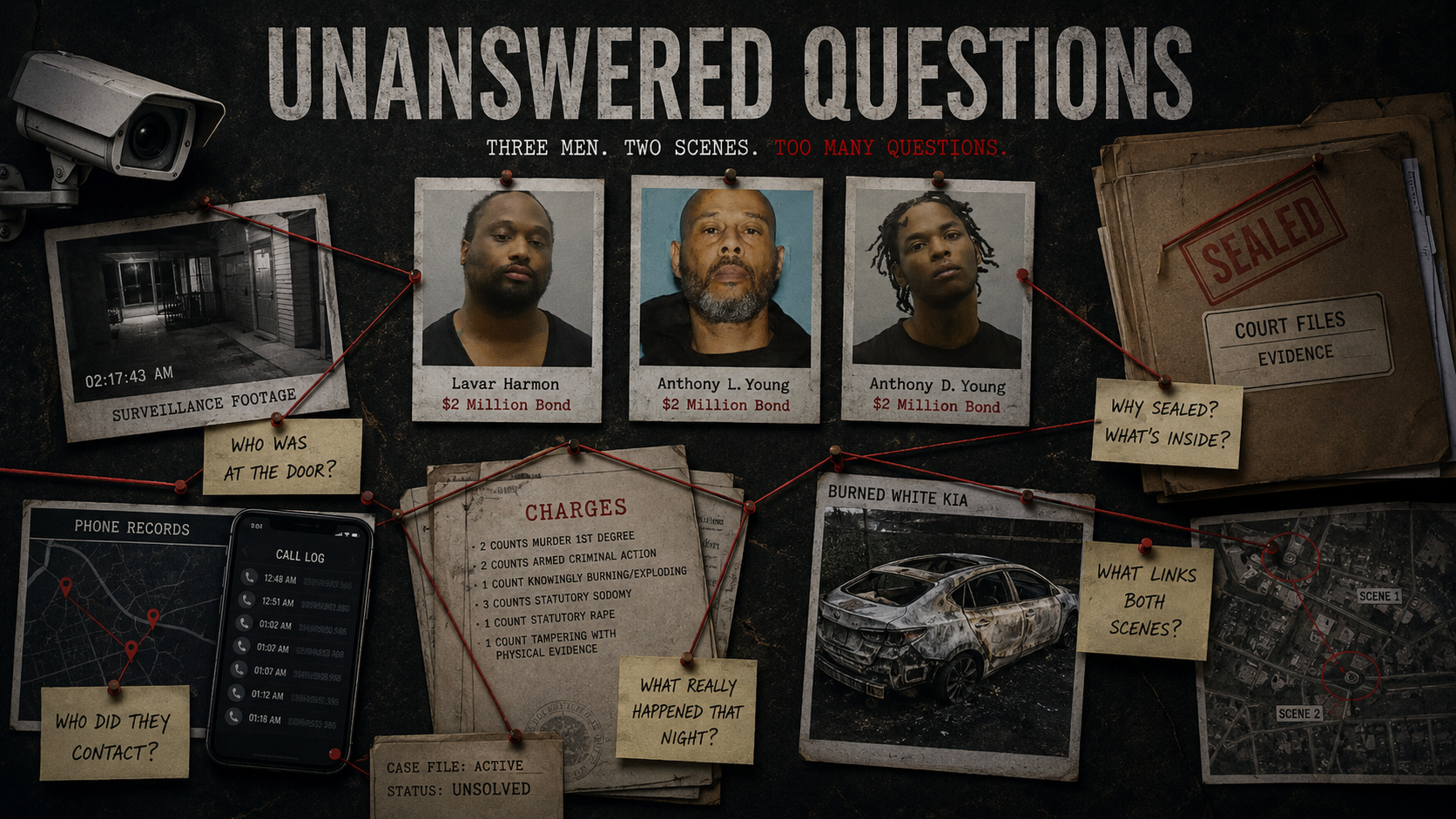
The public case rests on a three-hour corridor between two addresses: Warren’s home on Bayview Drive and the place where Andrew Klaus was found on Vine Grove Avenue. A white Kia appears at both ends, then burns before investigators can publicly explain what it contained.
Prosecutors have already named the alleged organizer, the two relatives accused of joining him and the associate accused of firing the first fatal shots. What remains sealed is the part that turns those names into a provable chain: the communications, movements, forensic findings and individual actions connecting each man to both deaths.
Until that evidence enters the open court record, the Kia remains the most visible object in the file—and the unanswered question remains who investigators can prove was inside the plan before it was destroyed.