
Reporting and analysis may discuss allegations and online theories. Allegations are not findings of guilt. Verify important details in the cited public record.
The Case File
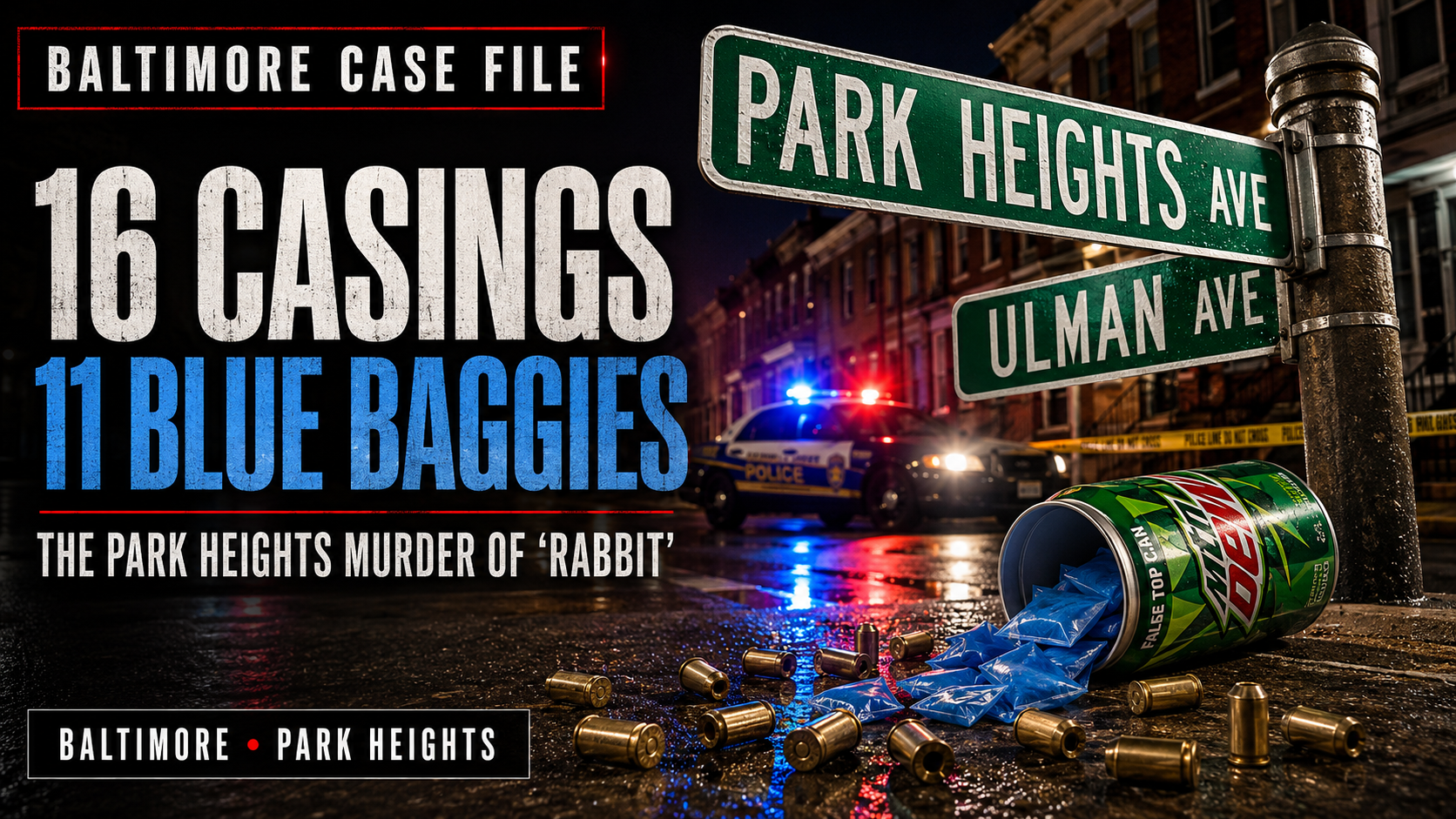
The first detail detectives released was brutally simple. At approximately 7:45 p.m. on February 3, 2017, police found 25-year-old Lawrence Lee Jones near the intersection of Park Heights and Ulman avenues with gunshot wounds to his head and chest. He was transported to a hospital, where he died. Early reporting said homicide detectives had no identified witnesses and no known motive. (WBFF)
The court record eventually revealed a far deeper investigation.
Rabbit had been shot as he walked toward a neighborhood food market. Sixteen nine-millimeter casings were recovered. Surveillance cameras had recorded the area. Ballistic evidence led detectives from the location where Rabbit collapsed back toward the front steps of a house on Ulman Avenue. Two months later, the firearm connected to the recovered bullets and casings surfaced in Baltimore County.
Beside the victim’s belongings, investigators documented an object that appeared to be an ordinary soda can. The top was false. Hidden inside were 11 blue baggies containing what the appellate opinion described only as a suspected controlled dangerous substance.
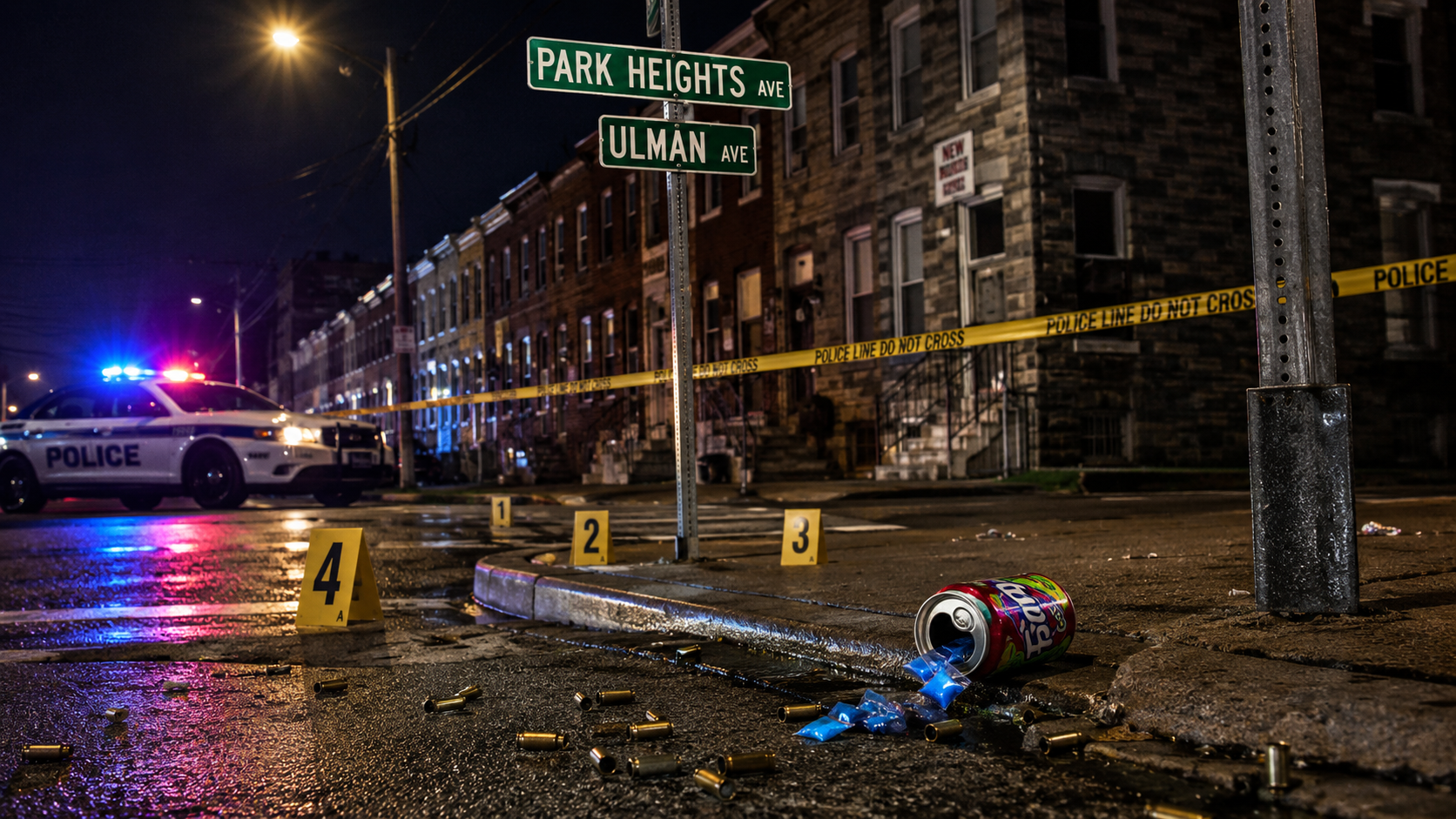
That color was not incidental to the prosecution’s case. A witness told detectives that Rabbit and Richard Jones had previously disputed Rabbit’s decision to package drugs in blue baggies. Richard acknowledged that a conversation about bag colors had occurred but insisted it had been resolved.
The case would be decided through the intersection of those details: the blue packaging, the porch where police believed the shots originated, surveillance from a nine-camera market system, an eyewitness identification, two men said to resemble each other, and testimony from a witness who later claimed unidentified people confronted him with a pistol and forced him to disappear.
February 3, 2017
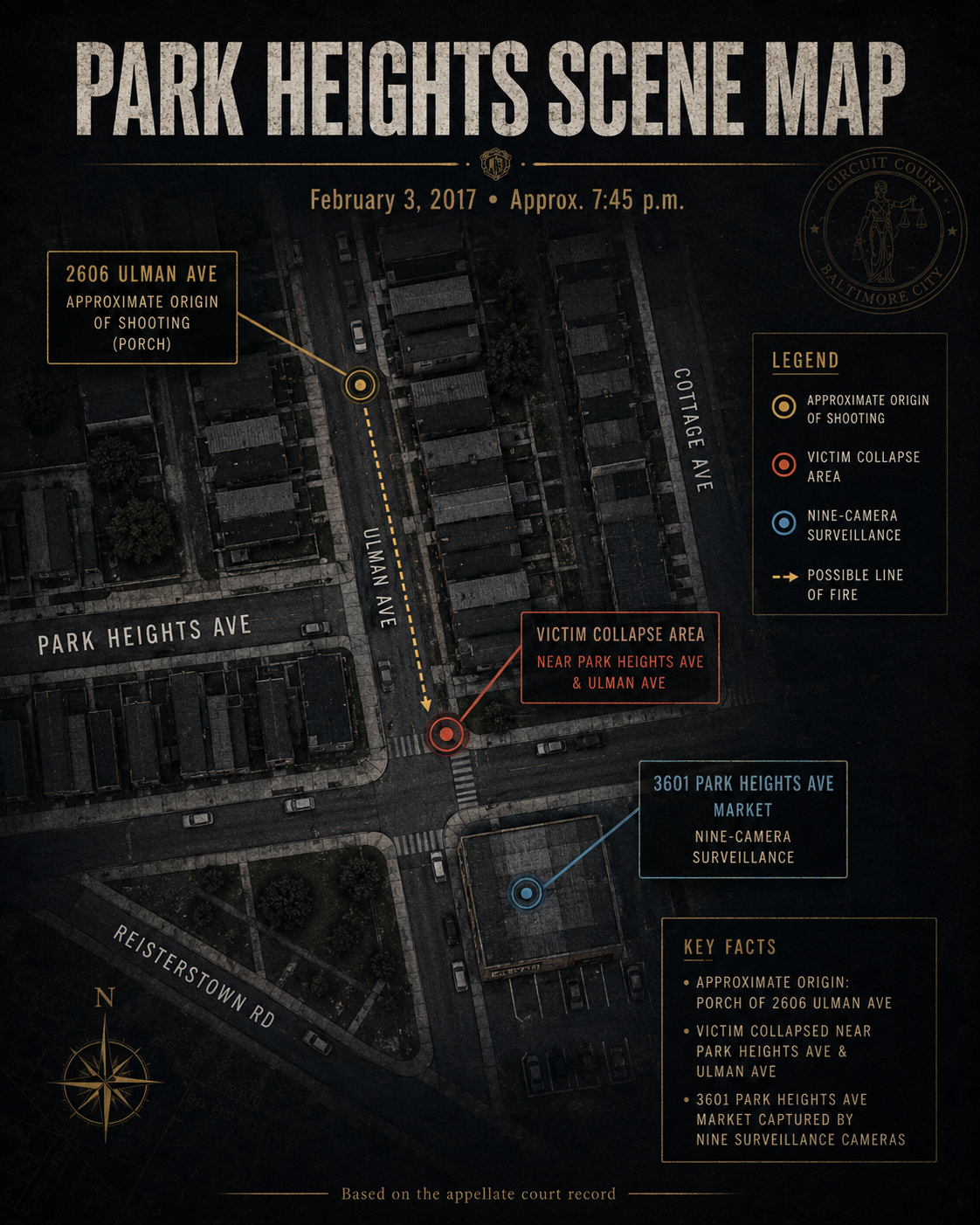
Baltimore City Police Officer Stephen Tandy responded to a reported shooting in the 2600 block of Ulman Avenue near Park Heights Avenue. When he arrived, Rabbit was lying on the ground and unresponsive. Medics transported him to a hospital, where he was pronounced dead. An autopsy later determined that he died from multiple gunshot wounds and classified the death as a homicide.
The public initially knew little more. Rabbit was 25 years old. Police said he had suffered gunshot wounds to his head and chest. No witness or motive was announced in the immediate aftermath. (WBFF)
The later court record places several people around Ulman and Park Heights before the shooting. Their accounts describe a small drug market operating around the intersection, with sellers, lookouts, neighboring porches, a nearby food market and surveillance cameras covering portions of the area.
Rabbit was walking toward the market when the gunfire began.
Exactly what happened in the seconds before the first shot is not fully reconstructed in the appellate opinion. It does not state whether Rabbit spoke to anyone, stopped near the porch or displayed the baton one witness said he had been carrying. The court record moves directly from the people present in the area to the sound of gunfire and Rabbit’s movement toward the market.
What investigators found afterward became the physical foundation of the prosecution.
The False-Top Soda Can
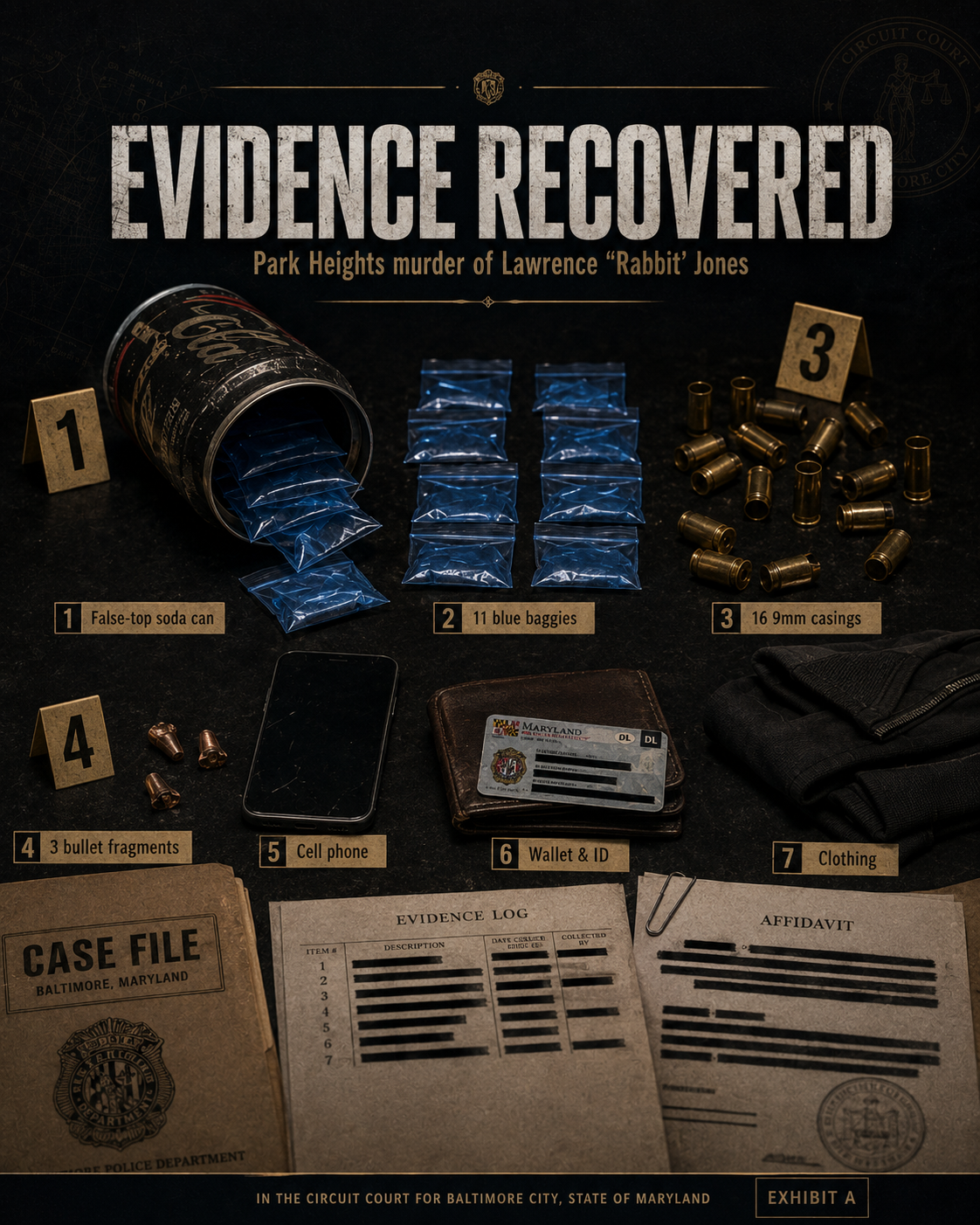
Among the items recovered at the crime scene was a soda can designed with a false top. Inside were 11 blue baggies containing a substance officers suspected was an illegal drug.
The opinion does not identify the soda brand, describe where the can was positioned in relation to Rabbit or disclose whether fingerprints, DNA or other forensic evidence connected it directly to him. It also does not report laboratory results confirming the substance inside.
What the document does establish is that the can was inventoried with the evidence found at the scene alongside Rabbit’s wallet, identification card, cellphone and clothing.
That distinction is important. The false-top can and blue baggies were part of the crime-scene evidence, but the appellate opinion does not state that prosecutors scientifically proved Rabbit owned or handled the container.
The color of the packaging nevertheless intersected with testimony about an earlier disagreement.
Kaii Myles told police that Richard and Rabbit had disputed Rabbit’s decision to package drugs in blue baggies. Richard admitted that the men had discussed the colors used to package their products. His version was that the issue had been exaggerated, resolved and never reached the level of a serious conflict.
Richard testified that he used clear baggies at the time.
The prosecution therefore had a possible motive connected to a visible piece of physical evidence. The defense had an alternative interpretation: an ordinary disagreement between two men who continued helping each other afterward.
The court opinion does not reveal whether the 11 blue baggies were displayed to the jury, tested for fingerprints or directly argued as the reason for the killing. It confirms the evidence and the dispute separately, leaving the connection to be evaluated through the larger case.
Sixteen Nine-Millimeter Casings
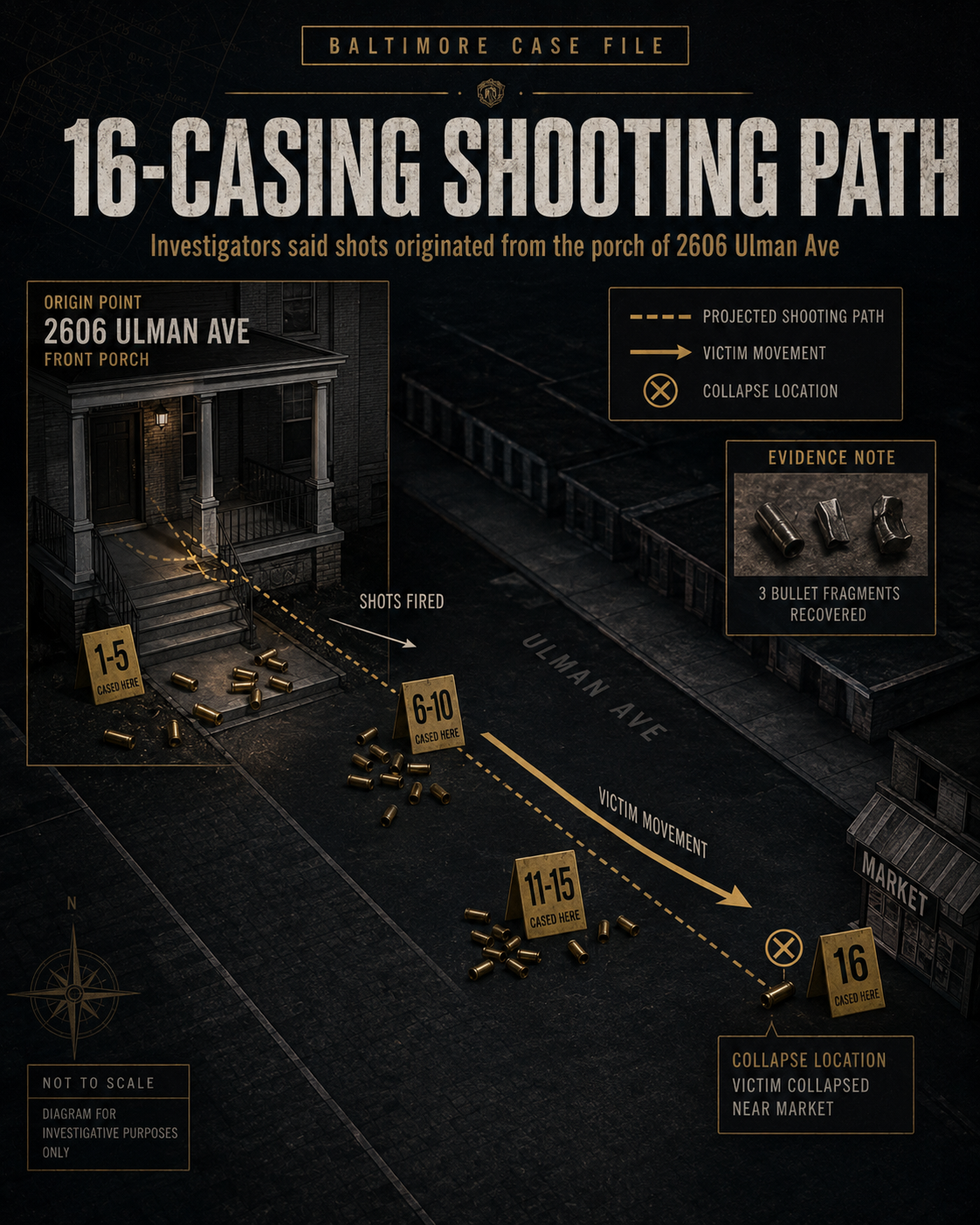
Investigators recovered 16 nine-millimeter shell casings and three bullet fragments. No firearm was found on Rabbit, beside him or elsewhere near the immediate crime scene.
Police determined that shots had been fired from the front porch of 2606 Ulman Avenue. Additional casings were located on and near the steps. Those casings were consistent with the nine-millimeter evidence recovered from the area where Rabbit was found.
Detective Joseph Brown Jr., the primary investigator, explained that a semiautomatic firearm typically ejects a casing approximately three to seven feet to the shooter’s right, although the pattern can change as the shooter moves. That testimony gave investigators a method for interpreting the distribution of the casings rather than treating each location as an unrelated deposit.
The physical trail connected the porch area to the location closer to the market.
The gun that fired the bullets recovered near the market and near 2606 Ulman Avenue was found in Baltimore County in April 2017. The appellate opinion does not identify who possessed it, where in Baltimore County it was recovered, why police encountered it or whether anyone was charged in connection with that recovery.
That omission leaves a major investigative gap in the public record. The firearm was ballistically connected to the Park Heights shooting evidence, but the document does not explain its path from Ulman Avenue to Baltimore County.
The Nine-Camera Market System
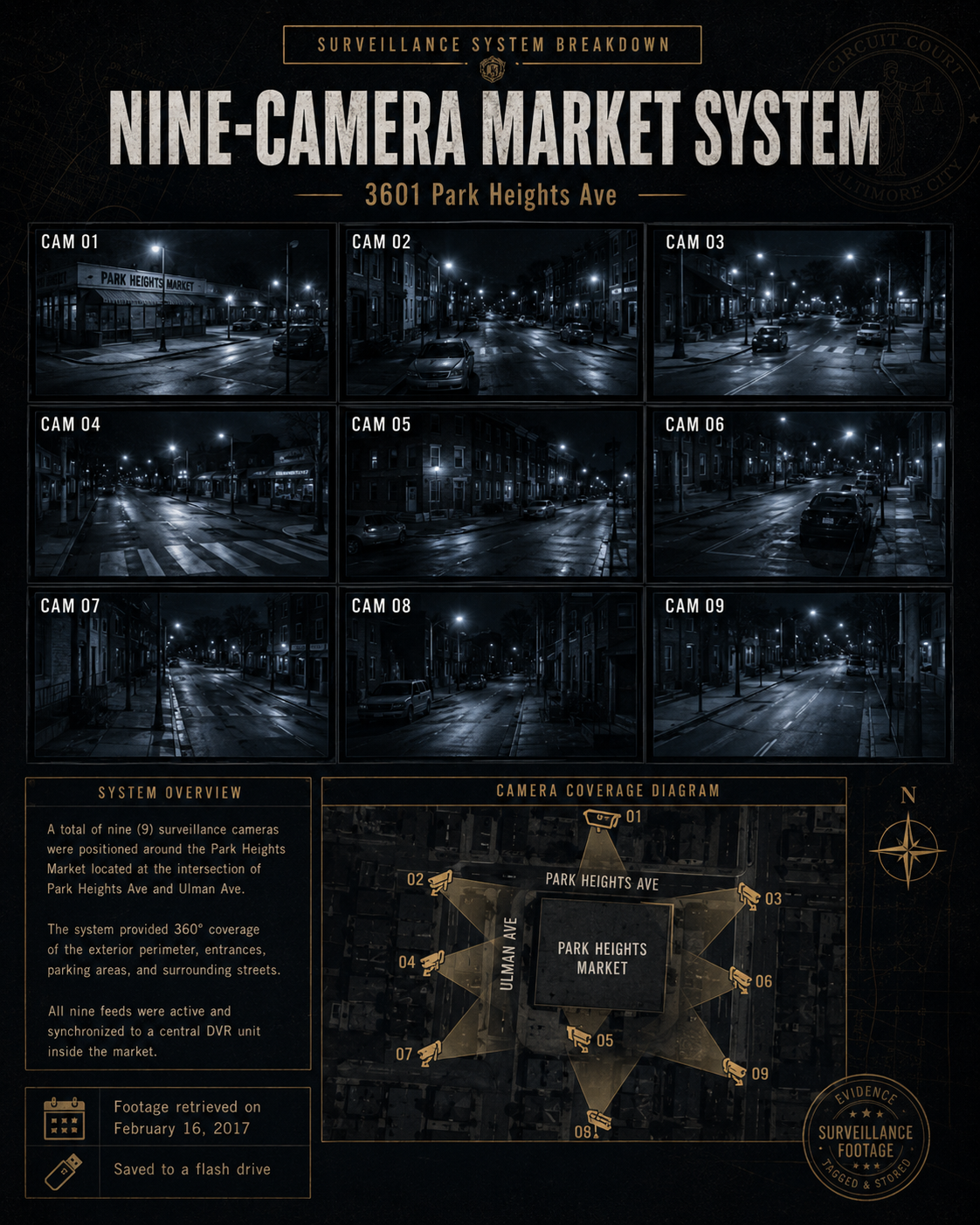
The shooting occurred near a food market located at 3601 Park Heights Avenue. The business included a liquor store and operated a recording system associated with nine surveillance cameras.
On February 16, 2017, nearly two weeks after the murder, Detective Stephen Henson retrieved the footage. He extracted the recordings from the market’s system, transferred them onto a flash drive and preserved them as evidence. The videos were later admitted at Richard Jones’s trial.
The appellate opinion states that the shooting was captured by surveillance cameras in the area. It does not provide a second-by-second description of the footage.
The public document does not explain which camera recorded the shooting, whether the shooter’s face was visible, how much of Rabbit’s movement was captured or whether the footage clearly distinguished Richard from Darrell Owens, the man the defense claimed closely resembled him.
That limitation matters because the footage was important enough to be collected, preserved and shown to the jury, yet the appellate ruling does not describe the decisive visual moment.
Richard acknowledged that he knew cameras covered the area. He was familiar with the market system and surveillance at a nearby charitable building he called the “Green Doors.” His awareness of the cameras became part of his defense narrative: he argued that he regularly entered the market and knew he could be recorded there.
The footage appears to have supported the State’s reconstruction, but the appellate opinion does not state that it independently identified the shooter without the accompanying witness testimony.
The People Around Ulman Avenue
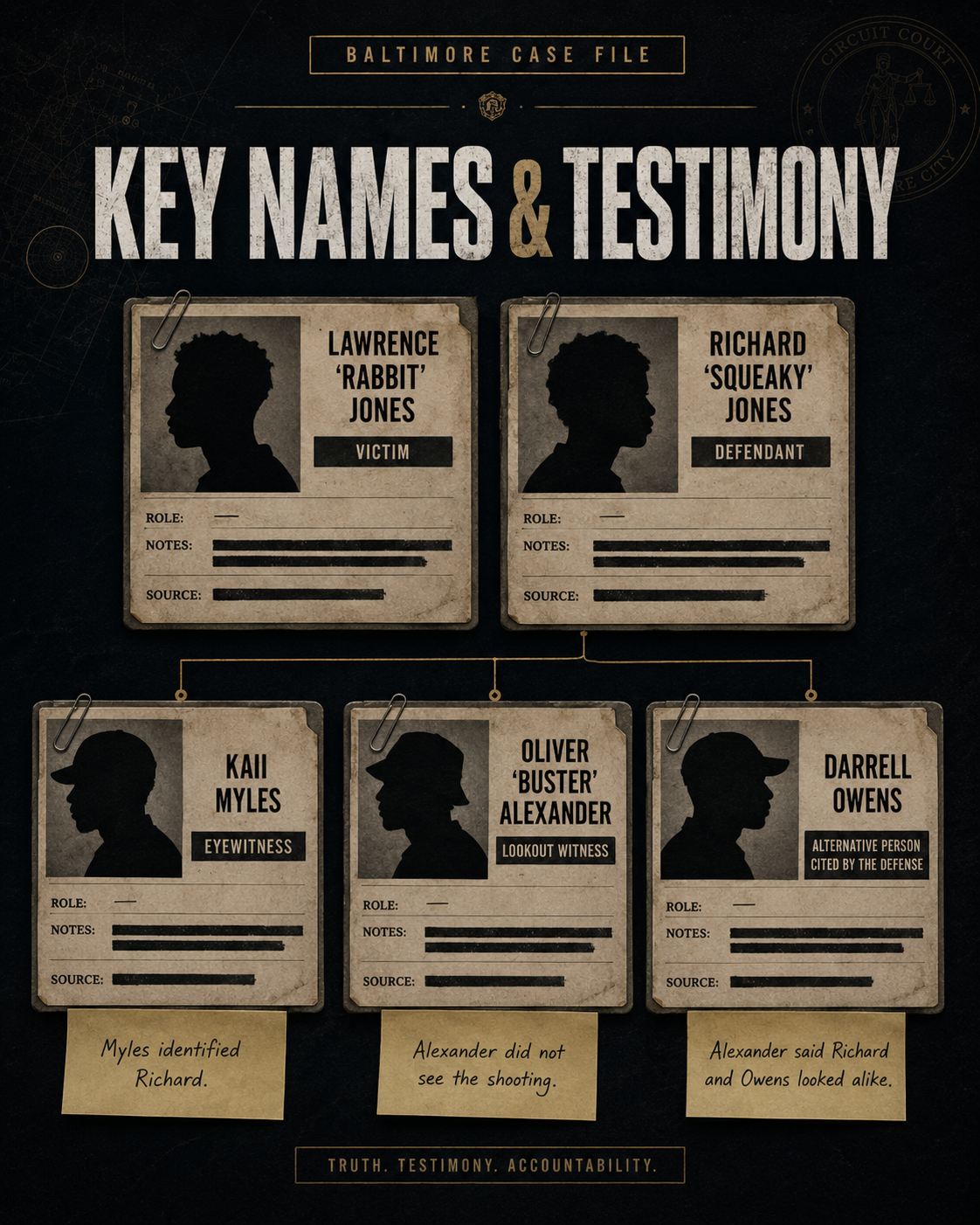
Three men became central to the trial record: Kaii Myles, Oliver Alexander and Darrell Owens.
Oliver Alexander, known as “Buster,” lived around Ulman and Park Heights. At the time, he had been using heroin daily for approximately 36 years. He supported his addiction by acting as a lookout for Richard, Myles and Owens as they sold drugs around the intersection.
Alexander saw Richard, Myles, Owens and Rabbit in the area before the shooting. He did not see any of them carrying a firearm. He did, however, report that Rabbit had a baton in his hand.
The opinion does not state that Rabbit raised the baton, threatened anyone with it or used it during a confrontation. It establishes only that Alexander said he saw Rabbit holding it before the gunfire.
Myles had moved into 2606 Ulman Avenue approximately three or four months earlier. He had known Rabbit since childhood and testified that he was selling drugs for Richard on the day of the murder.
Richard’s own testimony placed a wider group in the neighborhood drug market. According to him, Rabbit, Myles, Owens, Rabbit’s brother, a person named Jerome and Richard himself sold drugs around Ulman and Park Heights. Richard said Rabbit also worked in other areas, while he remained around Park Heights.
The killing therefore unfolded inside a network of people who knew each other, worked around the same intersection and had overlapping financial interests.
The Eyewitness
Myles testified that he was standing on the front porch of 2606 Ulman Avenue. Richard was on the neighboring porch, approximately four or five feet away. Rabbit was walking toward the food market.
Myles heard gunshots. In the statement he gave police, he acknowledged seeing Richard leave the porch and shoot at Rabbit.
Myles ran.
He continued toward Cottage Avenue, stopped and turned around. According to his account, he saw Richard behind him and believed Richard was going to shoot him next. Richard allegedly told him that he “was good.”
Myles kept moving, separated from Richard and ran through wooded ground at the bottom of Cottage Avenue.
That account made Myles the prosecution’s central eyewitness. It placed Richard within feet of the porch linked by the casing pattern to the gunfire and claimed that Myles personally watched him move from that porch and shoot Rabbit.
The strength of the case depended heavily on whether the jury believed him.
His own testimony gave the defense several ways to attack his credibility. He was involved in the same drug market. He claimed police treated him like a possible suspect. He said officers pressured him during questioning. Another witness believed Richard and Owens could easily be mistaken for each other. The surveillance footage was admitted, but the appellate opinion does not describe it as producing an unmistakable facial identification.
Myles’s credibility became the central fight at trial and remained the central issue after Richard was convicted.
From “No Witnesses” to a Police Statement
The first public report said detectives had no witnesses and no established motive. The later court opinion states that police went to Myles’s residence a day or two after the shooting and brought him to the homicide unit. (WBFF)
Myles described the encounter as coercive.
He testified that approximately six armed plainclothes officers arrived at his home. According to him, the officers were implicating him in Rabbit’s murder, and he believed he had no choice but to accompany them. At the station, he said he was locked in a room, denied food and prevented from leaving.
After he was questioned, an officer drove him home.
The defense argued that these circumstances created pressure for Myles to give detectives the identification they wanted. His claim that he felt trapped inside the homicide unit was used to suggest that his statement naming Richard had not emerged freely.
The prosecution responded with another explanation for his behavior: Myles had allegedly faced pressure outside the police station as well.
The Threat on “The Heights”
During redirect examination, prosecutors asked whether anyone other than law enforcement had approached Myles after Rabbit’s murder.
Myles said unidentified people confronted him. He did not know their names and did not recognize them. He described feeling vulnerable and said there was nothing he could do.
When asked directly whether he had been threatened, he said yes.
The questioning was interrupted by repeated defense objections and a bench conference. The defense argued that the threat testimony exceeded the proper scope of redirect examination. The judge allowed the prosecution to continue because the defense had attacked Myles’s identification by suggesting police pressure was the reason he accused Richard.
Myles then testified that unknown people approached him somewhere on “the Heights,” pulled a pistol on him and left him feeling vulnerable. After that encounter, he said he disappeared.
The testimony did not identify Richard as the person who threatened him. Myles did not claim that Richard ordered the confrontation, sent anyone to approach him or knew it had happened.
The appellate court later emphasized that the threat came from an unidentified person. The testimony was admitted to explain why Myles may have been reluctant to accuse Richard—not as evidence proving that Richard orchestrated witness intimidation.
That line is essential. The record supports that Myles testified he was threatened with a pistol. It does not establish who was responsible.
Buster’s Account
Oliver Alexander did not identify the shooter.
Before the gunfire, he saw Richard, Myles, Owens and Rabbit around the intersection. Rabbit had a baton, but Alexander saw no firearms. As Alexander walked down Park Heights toward his home, he heard approximately seven or eight shots.
He increased his pace and continued to his house near Park Heights Avenue and Reisterstown Road. When police vehicles later arrived, he began walking back toward the scene to learn what had happened.
On the way, Alexander encountered Richard near a sub shop at Park Heights and Reisterstown Road.
According to Alexander, Richard asked what had happened. Alexander responded that something had occurred farther up the street and that people had been firing guns. The two men then walked back toward the food market.
Approximately one week later, police visited Alexander’s home and had him review video recordings. The appellate opinion does not disclose what he identified or concluded after watching them.
Alexander’s account contained evidence that could be used by both sides. He placed Richard near the area around the time of the murder but also described encountering him away from the scene acting as though he did not know what had happened.
His estimate of seven or eight shots also differs from the 16 casings documented by investigators. The public court opinion does not resolve that discrepancy. Alexander may not have heard or counted every discharge, but the record does not provide a definitive explanation.
The Look-Alike Defense
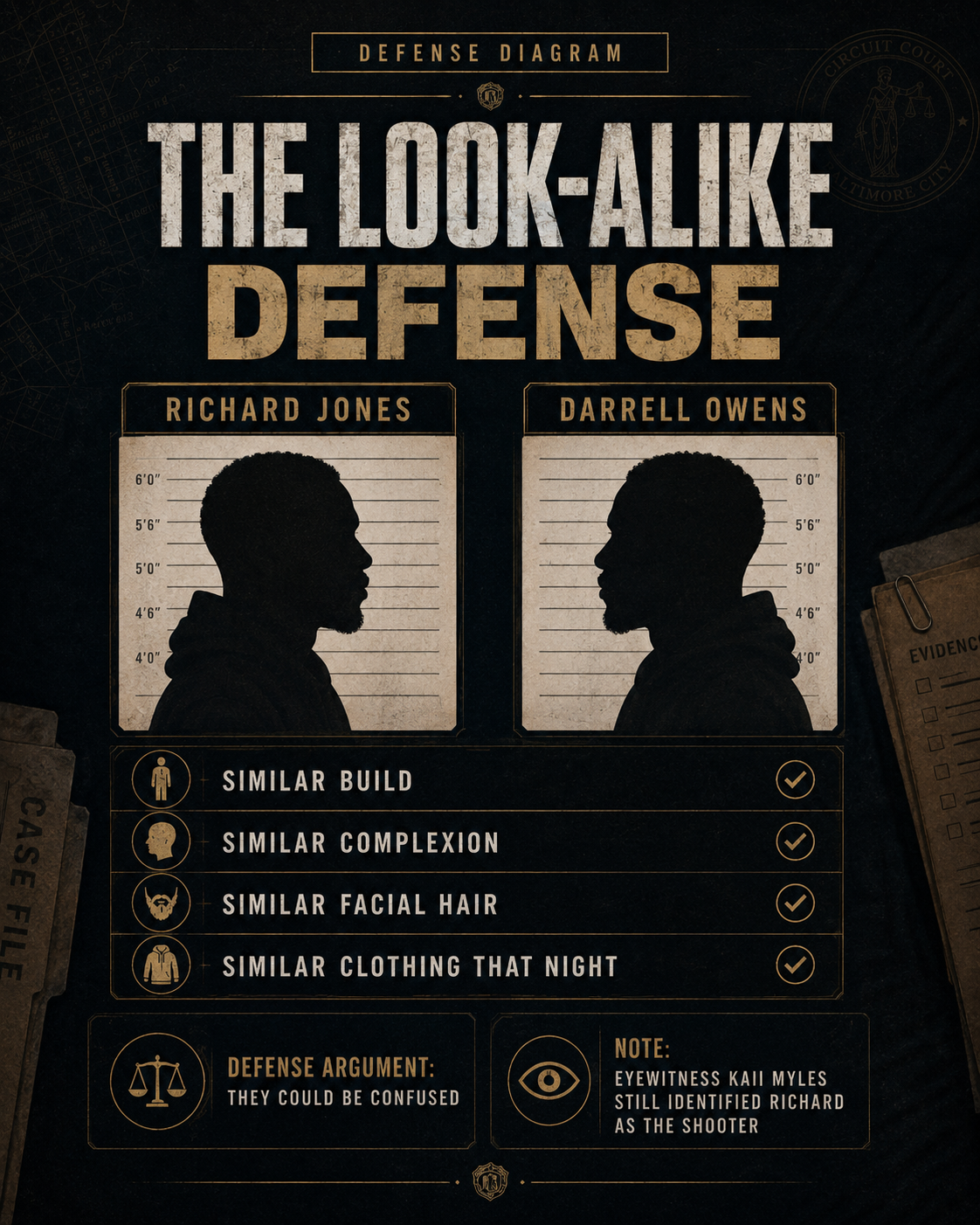
Alexander testified that Richard and Darrell Owens looked alike and could easily be confused.
Richard expanded that point when he testified. He said Owens had a similar build, size, complexion and facial hair. According to Richard, the two men were also wearing nearly identical clothing on the night Rabbit was killed: bubble coats, blue pants, hoodies and black shoes.
This was more than a general mistaken-identity argument. The defense placed another man who allegedly resembled Richard inside the same small area, around the same people and close to the same time as the shooting.
The appellate opinion does not state that Owens was accused of killing Rabbit. It does not describe gunshot-residue testing, cellphone-location evidence, fingerprints or DNA connecting Owens to the firearm or porch.
Its significance was visual uncertainty.
Myles said he saw Richard leave the porch and shoot. Alexander said Richard and Owens were easy to confuse. Richard said Owens looked like him and was dressed almost exactly like him. Surveillance footage existed, but the appellate opinion does not reveal how clearly the recording distinguished one man from the other.
The jury ultimately accepted the prosecution’s identification.
Richard Jones’s Version
Richard Jones, also identified in the record as “Squeaky,” “Squeek” and “Squeeky,” denied shooting Rabbit.
The two men were connected through family. Richard was married to Rabbit’s sister and testified that he had known Rabbit for more than 20 years. He described them as close.
Richard admitted selling drugs around Ulman and Park Heights. He also admitted that he and Rabbit had discussed the use of different-colored bags, but he denied that it had become a serious dispute. According to Richard, they continued helping one another after the conversation.
On February 3, Richard said he spent much of the day outside but repeatedly visited 3443 Park Heights Avenue, where his mother was visiting a former boyfriend. He later returned to the Ulman Avenue area to meet someone seeking to purchase drugs and to buy items from the market.
He saw Rabbit, Myles and Owens.
Richard testified that he was walking on Park Heights near Cottage Avenue when he heard numerous gunshots. He ran until he encountered Alexander near the sub shop between Park Heights and Reisterstown Road. After learning Rabbit had been shot, Richard returned to the market.
He said he did not contact police because he had not seen the shooting.
Richard also offered another possible source of conflict. He claimed Rabbit had been disputing with an unidentified man around Hillsdale and Norfolk over selling to a customer on that side. The opinion does not identify the man, describe an investigation into that claim or connect the alleged dispute to the murder weapon.
Richard denied arguing with anyone that night, denied possessing a gun and denied involvement in any threats against Myles.
After Rabbit’s death, Richard said he provided financial assistance to the family.
The Family Connection
The relationship between Rabbit and Richard complicated the motive.
This was not a case involving two strangers who crossed paths in an open-air market. Richard had known Rabbit for decades and had married into his family. They also operated in the same drug-selling environment.
The prosecution had testimony about a dispute involving blue baggies. Richard admitted the conversation but rejected the idea that it had become serious enough to produce violence. His description portrayed the men as competitors who still cooperated, watched out for each other and remained linked through family.
The court record does not provide text messages, recorded calls or independent witnesses describing a threat Richard made against Rabbit. No direct statement from Richard announcing an intent to kill him appears in the appellate opinion.
The State’s case instead combined circumstantial evidence with identification testimony: a dispute, the location of the casings, Richard’s presence in the area, Myles’s eyewitness account, surveillance evidence and the later recovery of the firearm.
The Firearm in Baltimore County
In April 2017, the gun connected to the bullets found near the market and the casings near 2606 Ulman Avenue was recovered in Baltimore County.
This should have been one of the clearest links in the public record. Instead, it is one of the least explained.
The appellate opinion does not state:
Who had the gun.
Whether it was recovered from a residence, vehicle or person.
Whether Richard had any documented relationship with the recovery location.
Whether fingerprints or DNA were obtained.
Whether the weapon had been reported stolen.
Whether another individual was arrested with it.
Whether investigators traced its ownership or transfer history.
The ballistic conclusion is clear. The chain of possession is not.
Because the appellate issues concerned the new-trial motion and Myles’s threat testimony, the court had no reason to reproduce every detail of the firearm investigation. The result is a public record that confirms the gun was found without explaining how that recovery strengthened or complicated the case against Richard.
The Arrest
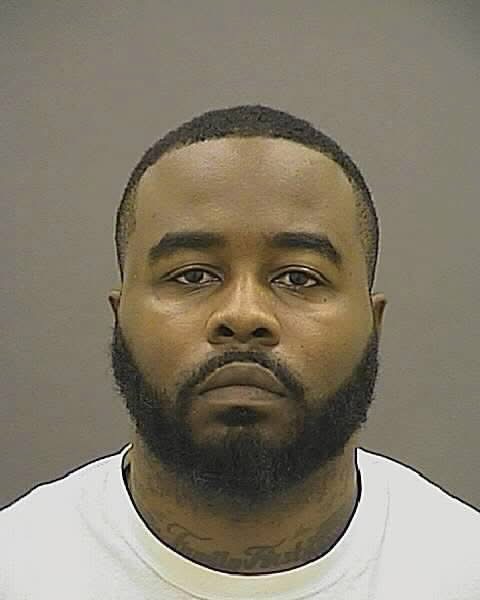
Baltimore police arrested Richard Jones on March 20, 2017, approximately six weeks after Rabbit’s death. Richard was 29 and lived in the 3400 block of Park Heights Avenue.
He was taken into custody in the 2800 block of Boarman Avenue and charged with first- and second-degree murder, handgun offenses and related charges. Police said investigators received information concerning a person of interest, developed the case and identified Richard as the primary suspect. (WBAL)
The arrest occurred before the murder weapon was recovered in Baltimore County the following month.
Public reporting described Rabbit’s death as following an ongoing dispute between the two men. The later appellate opinion supplied the alleged subject of at least one disagreement: the use of blue baggies in the neighborhood drug market. (WBAL)
The Trial
Richard’s trial brought together evidence that did not all carry equal weight.
The physical evidence established that Rabbit had been shot repeatedly with a nine-millimeter firearm. Casings linked the market area with the steps and porch near 2606 Ulman. The gun that fired the recovered projectiles was later found in Baltimore County.
The surveillance system documented the area, and the recordings were admitted into evidence.
Myles placed Richard beside the porch and identified him as the shooter. Alexander confirmed that Richard was nearby but did not witness the shooting. He also introduced the possibility of confusion between Richard and Owens.
Richard admitted selling drugs at the location, knowing the other people present and discussing bag colors with Rabbit. He denied that the conversation supplied a murder motive and denied possessing the gun.
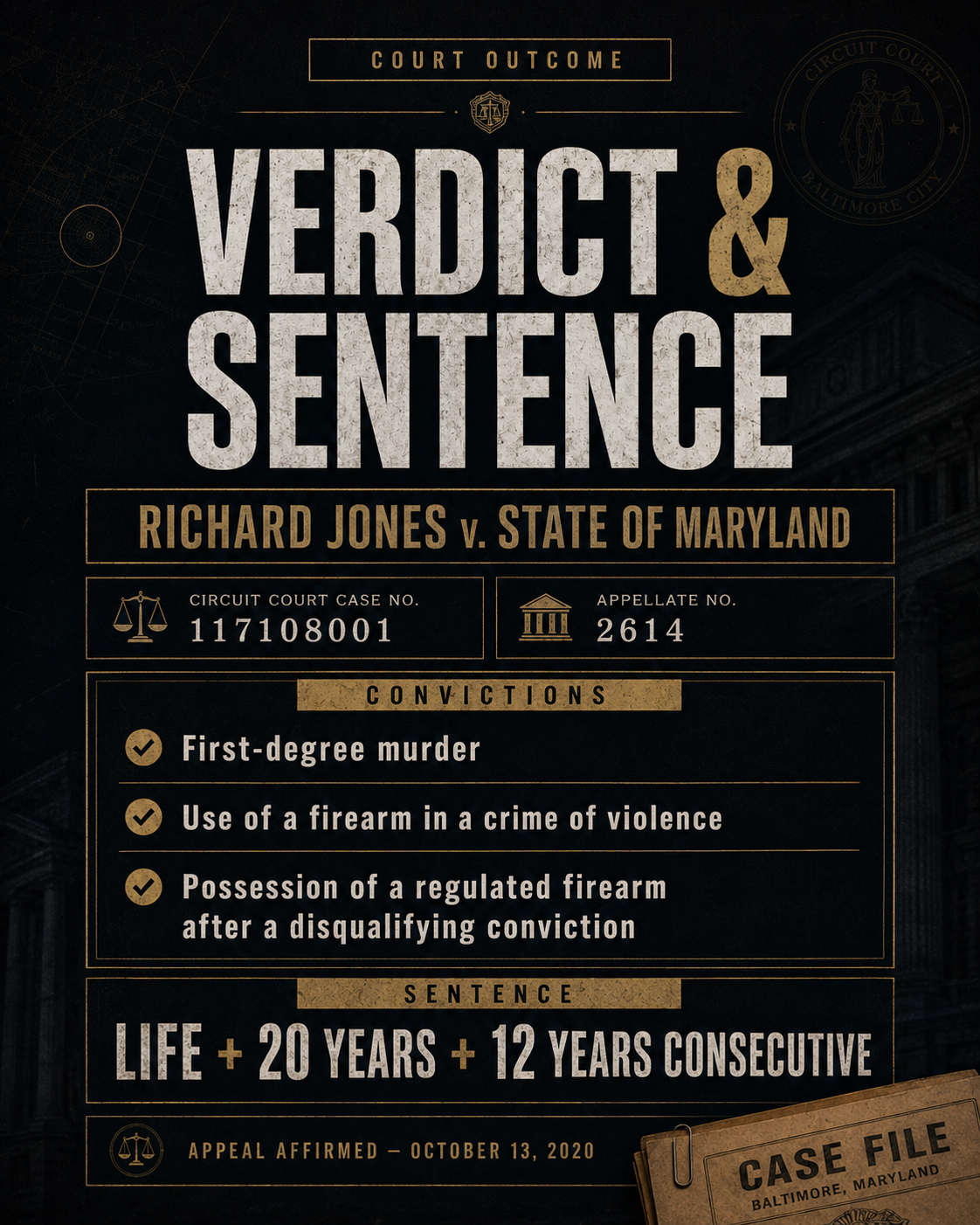
The jury returned its verdict on June 27, 2018. Richard was convicted of first-degree murder, using a firearm during a crime of violence and possessing a regulated firearm after a disqualifying conviction.
The Alleged Gun With “A Body” On It
Nine days after the verdict, Richard’s attorneys filed a motion for a new trial. They argued that the verdict was against the weight of the evidence and that the State’s case had been insufficient. They also said members of Richard’s family had provided information suggesting Myles gave false testimony.
The court denied the initial motion six days later.
On October 5, 2018, the defense filed a supplemental motion focused on Amy Jackson, a woman who had been interviewed by police and disclosed as a potential defense witness before trial. The defense said Jackson had been hospitalized during the proceedings and had been unavailable to testify.
According to the defense’s description of her expected testimony, one of Jackson’s family members had been approached by Myles after Rabbit’s shooting. Myles allegedly possessed a handgun and said the weapon had “a body” on it.
Jackson was also expected to say that her relative told her the gun was inside Myles’s home when police executed a search warrant, but Myles’s younger brother removed it before officers recovered it.
The claim was explosive because Myles was the eyewitness who identified Richard. The defense argued that evidence of Myles possessing a gun associated with a killing could materially affect his credibility.
The claim also had severe evidentiary limits.
Jackson did not personally hear Myles make the statement, based on the description in the motion. The allegation had passed through one of her family members. Most importantly, no evidence connected the alleged handgun to Rabbit’s murder.
At Richard’s October 12, 2018 sentencing, Jackson appeared and told the court that the prosecution’s eyewitness had lied about many things. The judge did not conduct a hearing on the supplemental motion at that time.
The appellate court later ruled that the information was not sufficiently material to require a new trial. There was no ballistic, forensic or circumstantial connection between the unidentified gun allegedly carried by Myles and the firearm used to kill Rabbit.
The allegation could have damaged Myles’s credibility. It did not establish that he had killed Rabbit or possessed the murder weapon.
Why the New-Trial Argument Failed
The appellate court identified two major problems with the defense’s supplemental motion.
First, the evidence did not qualify as truly undiscoverable. Jackson had been known to the defense before trial and had already been listed as a possible witness. Although she was reportedly hospitalized, Richard’s attorneys did not request a postponement, conduct a hospital deposition or show that they had taken sufficient steps to secure her information earlier.
The court concluded that the defense had not demonstrated the required level of due diligence.
Second, Jackson’s information did not directly challenge a central factual issue. The alleged gun was never connected to the murder of Rabbit. Her proposed testimony could impeach Myles generally, but it did not prove that his identification of Richard was false.
Without a demonstrated connection to the Park Heights firearm, the claim remained a credibility attack rather than newly discovered evidence capable of changing the verdict.
The court affirmed the denial of a hearing on the motion.
The Sentence
Richard received life imprisonment for first-degree murder.
The court added a consecutive 20-year sentence for using a firearm during a crime of violence, followed by another consecutive 12-year term for possessing a regulated firearm after a disqualifying conviction. The first five years of the final firearm sentence were imposed without the possibility of parole.
The total sentence was therefore life plus 32 consecutive years.
The Appeal
Richard challenged two decisions.
He argued that the trial court should have conducted a hearing on his supplemental motion for a new trial. He also argued that prosecutors should not have been permitted to introduce the testimony about unidentified people threatening Myles.
The Maryland Court of Special Appeals rejected both arguments.
The court found that Jackson’s proposed information had not been pursued with sufficient diligence and was not materially connected to the murder weapon. It also held that the threat testimony was properly used to rehabilitate Myles after the defense suggested police coercion was the sole reason he had accused Richard.
The appellate judges noted that Richard’s trial attorneys objected on the ground that the threat testimony exceeded the scope of cross-examination. They did not properly preserve the separate argument that the testimony unfairly suggested Richard or his associates had made the threat.
Even if that argument had been preserved, the court found no abuse of discretion. The State was entitled to show that Myles’s hesitation could have resulted from fear of an unidentified armed person rather than proof that detectives had manufactured his identification.
On October 13, 2020, Richard’s convictions and sentences were affirmed.
What the Official Record Establishes
Lawrence Lee Jones, known as Rabbit, was shot and killed near Park Heights and Ulman avenues on February 3, 2017.
Sixteen nine-millimeter casings and three bullet fragments were recovered.
A false-top soda can containing 11 blue baggies of suspected drugs was documented at the scene.
Investigators traced the gunfire toward the porch and steps of 2606 Ulman Avenue.
The firearm that discharged the projectiles recovered near the market and porch was found in Baltimore County in April 2017.
A nine-camera surveillance system operated from the nearby food market, and the recordings were admitted at trial.
Kaii Myles identified Richard Jones as the person he saw leave the porch and shoot Rabbit.
Oliver Alexander placed Richard in the area but did not see the shooting. He also testified that Richard and Darrell Owens looked alike.
Richard admitted selling drugs in the area and discussing bag colors with Rabbit but denied that the issue was serious or that he killed him.
A jury convicted Richard of first-degree murder and two firearm offenses.
The convictions were affirmed on appeal.
What the Public Record Does Not Establish
The appellate opinion does not reveal where the false soda can was positioned or whether forensic testing connected it directly to Rabbit.
It does not provide laboratory confirmation of what was inside the blue baggies.
It does not contain a frame-by-frame account of the surveillance footage or state whether the shooter’s face was clearly visible.
It does not explain who possessed the murder weapon when it was recovered in Baltimore County.
It does not describe fingerprints, DNA, cellphone-location records or gunshot-residue testing connecting Richard to the firearm.
It does not identify the people who allegedly pulled a pistol on Myles.
It does not prove Richard ordered, encouraged or knew about that threat.
It does not connect the gun Myles allegedly described as having “a body” on it to Rabbit’s murder.
It does not resolve why Alexander recalled seven or eight shots when investigators recovered 16 casings.
It does not identify the man Richard claimed had a separate drug dispute with Rabbit around Hillsdale and Norfolk.
Those gaps do not erase the jury’s verdict. They define the limits of what the publicly available appellate record explains.
Final Breakdown
The Park Heights case was not built on one perfect piece of evidence.
The surveillance cameras recorded the area, but the appellate opinion does not describe a clear facial identification. The casings traced the shooting toward an Ulman Avenue porch, but no gun was recovered there. The firearm surfaced two months later in Baltimore County, with no public explanation of who had it. The false soda can contained blue baggies matching the subject of an alleged dispute, but the opinion does not establish who owned the container.
At the center was Myles.
He placed Richard beside the firing location and claimed he watched him leave the porch and shoot Rabbit. His account fit the physical reconstruction, but the defense attacked the conditions under which he first accused Richard, the presence of a look-alike near the scene and later information suggesting Myles had discussed another gun.
The jury believed the State’s reconstruction.
The appellate court found no legal basis to reopen the verdict. The alleged second gun had never been linked to Rabbit’s murder, and the testimony about the armed threat against Myles was allowed only to explain why an eyewitness moving between police pressure and street pressure may have hesitated.
The final record leaves Richard Jones serving life plus 32 years.
It also leaves one detail almost completely unexplained: the gun used to kill Rabbit was recovered in Baltimore County in April 2017, yet the public opinion never says who carried it away from Park Heights, who had it when police found it or what that person told investigators.


