
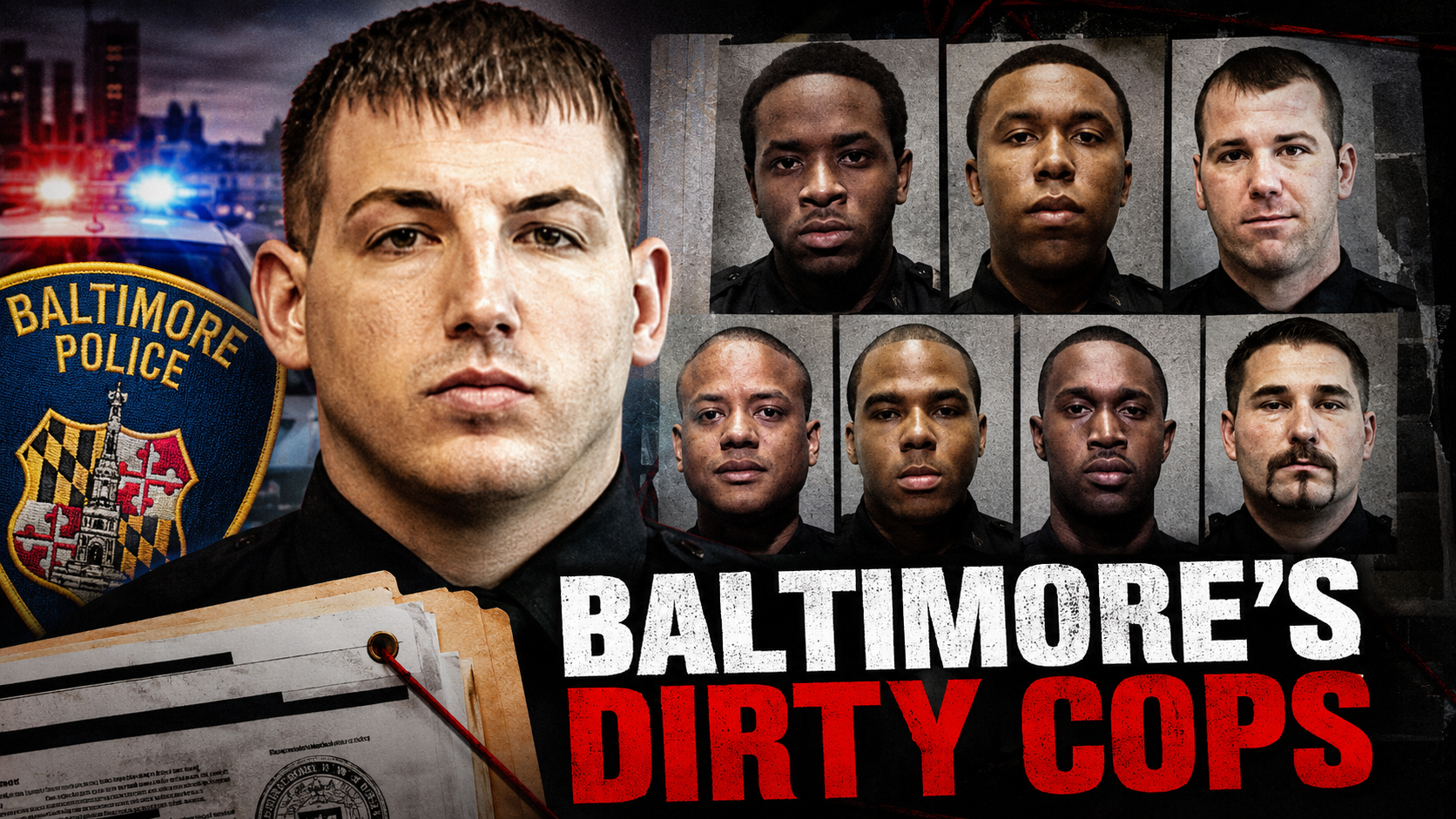
Reporting and analysis may discuss allegations and online theories. Allegations are not findings of guilt. Verify important details in the cited public record.
The Case File
Baltimore already had a long memory for police scandals, but the Gun Trace Task Force broke something different. This was not a single bad arrest, one planted weapon, or one officer caught lying in court. This was a specialized Baltimore Police Department unit that was supposed to take illegal guns off the street, only for federal prosecutors to later describe members of that unit as a racketeering crew operating behind badges, guns, police cars, search warrants, and official paperwork.
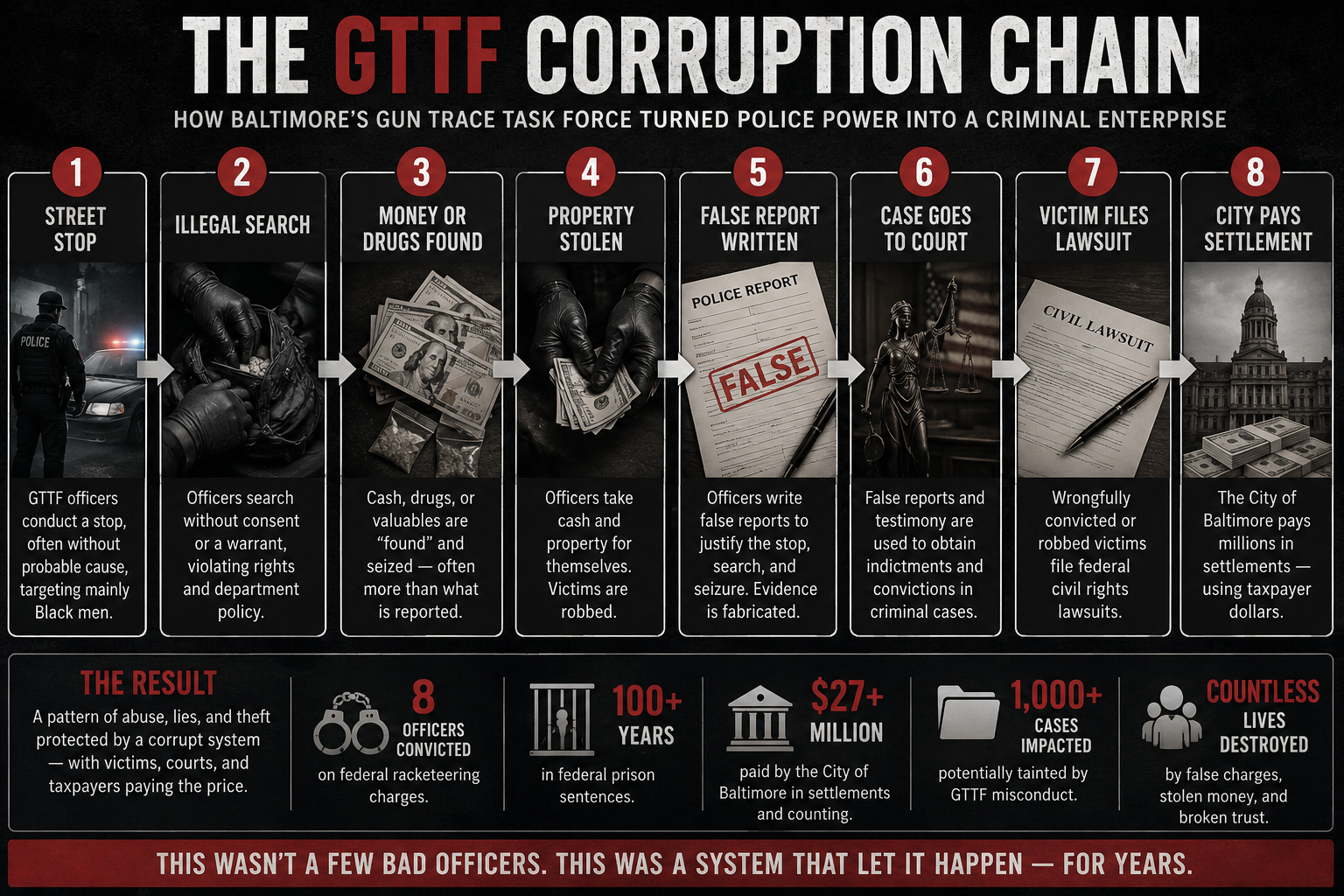
The public version of the scandal usually starts with one sentence: crooked cops robbed people. But the full file is much heavier than that. The surviving record shows a street level robbery operation, a collapse in supervision, years of tainted prosecutions, civil settlements paid with public money, and a department culture that rewarded aggressive numbers while failing to detect how those numbers were being produced. Federal agents arrested seven Baltimore Police officers in March 2017 on racketeering charges involving robbery, extortion, overtime fraud, false affidavits, and false police reports. The indictment accused them of stealing money, property, and narcotics from victims, including people who had not committed crimes.
This case file tracks the scandal from the 2010 conduct later tied into the fallout, through the 2017 federal takedown, the convictions and sentencings that followed, the 515 page Steptoe investigation, and the city settlement trail that was still shaping Baltimore’s public record years later. The case matters because the Gun Trace Task Force did not just damage individual victims. It damaged court cases, police credibility, city finances, and the basic question of whether official records from that era could be trusted.
The Unit Built To Chase Guns
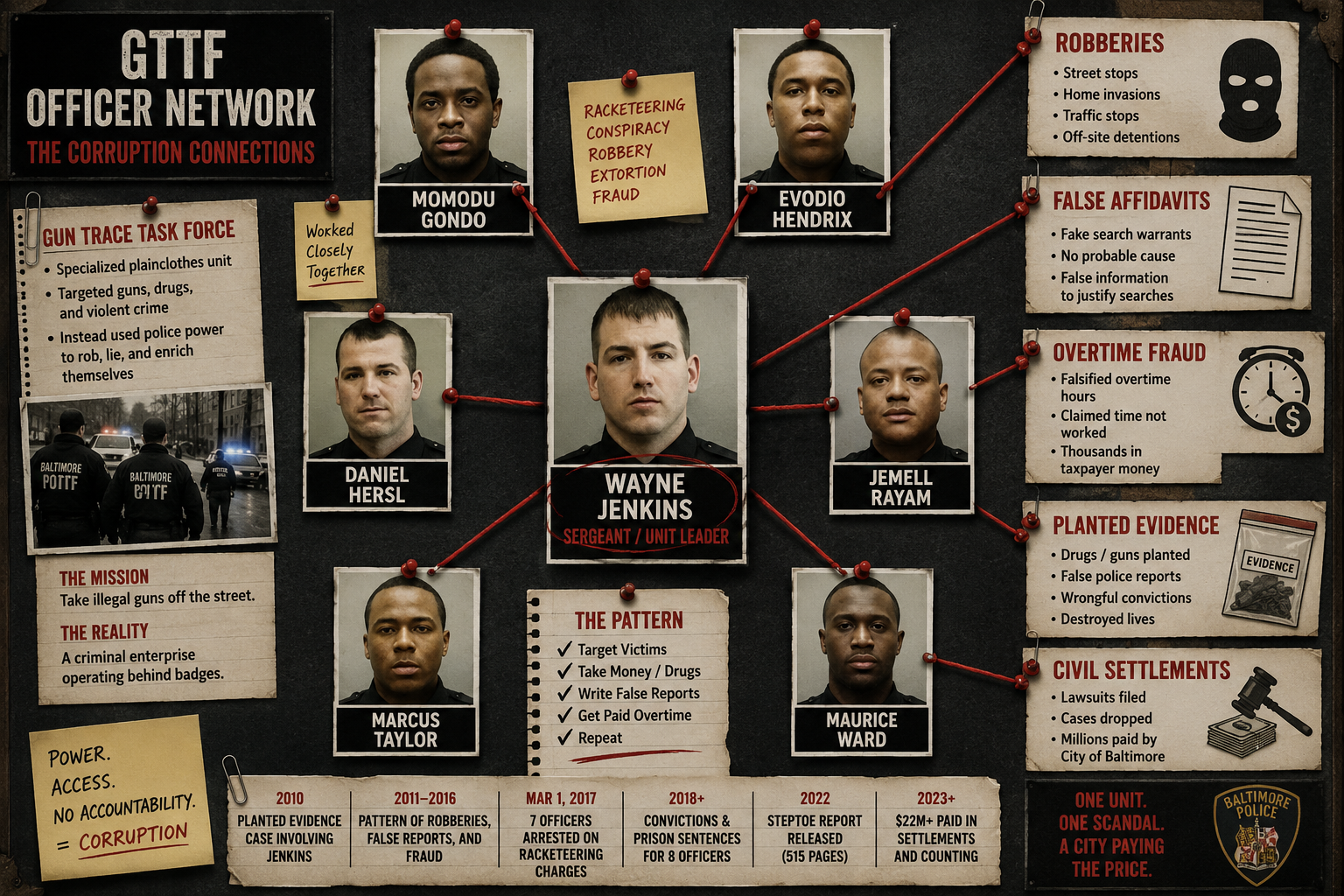
The Gun Trace Task Force was created for a purpose that sounded impossible to argue against. Baltimore was drowning in illegal firearms, shootings, and street level violence, and the city needed a specialized group that could trace guns, target repeat offenders, and move quickly through violent crime investigations. On paper, the unit existed to help take firearms off Baltimore’s streets.
That official mission is what makes the scandal so explosive. The unit was not buried in some forgotten corner of the department. It was part of the machinery Baltimore used to fight violence. The officers had access to vulnerable neighborhoods, suspects, search warrants, informants, tactical stops, overtime systems, and the kind of street power that can change a person’s life in minutes. Once that authority was abused, the victims were not only fighting individual officers. They were fighting police reports, court filings, charging documents, and an institution that often treated the badge as the first proof of truth.
The Federal Takedown
The federal indictment was unsealed on March 1, 2017, after a grand jury returned charges the previous week. The seven officers named in the racketeering indictment were Momodu Gondo, Evodio Hendrix, Daniel Hersl, Wayne Jenkins, Jemell Rayam, Marcus Taylor, and Maurice Ward. Prosecutors said the men used their police authority to commit robberies and extortion in 2015 and 2016 while assigned to the Gun Trace Task Force, with some charged conduct beginning before certain members officially joined the unit.
The allegations were not vague. The indictment said officers stole money, property, and narcotics. It said they swore out false affidavits, submitted false incident and arrest reports, filed false property seizure paperwork, and used official documents to conceal theft. In some cases, prosecutors said the victims had no evidence of criminal conduct against them at all. The amounts allegedly stolen ranged from $200 to $200,000.
The indictment also accused the officers of obstructing investigations by warning each other about Internal Affairs activity, coaching each other on false testimony, and turning off body worn cameras to keep encounters with civilians from being recorded. That detail is one of the most important pieces of the file because it shows the scandal was not only about theft. It was about controlling the record after the theft.
Wayne Jenkins And The Center Of The File
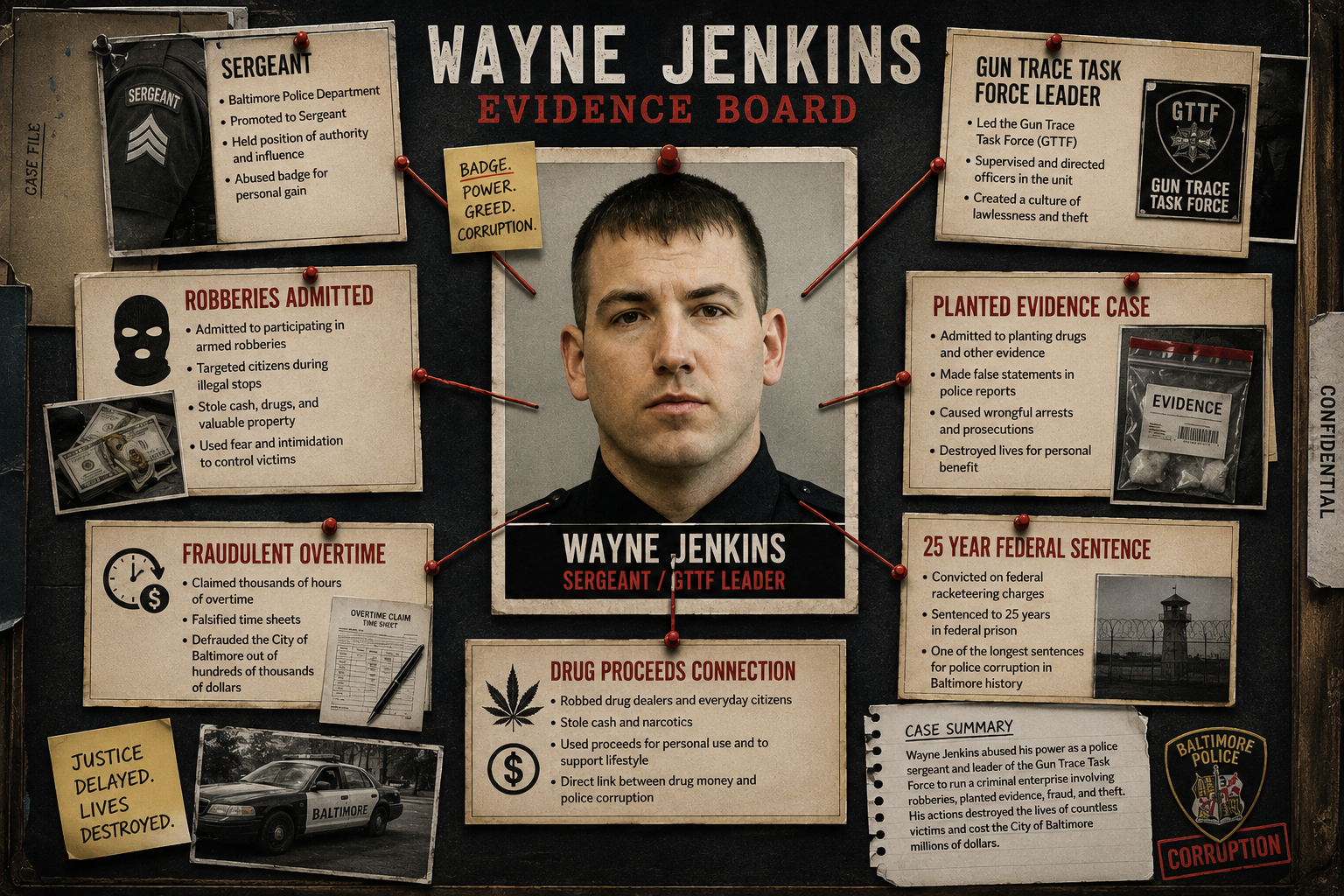
Wayne Jenkins became the central figure because he was the sergeant, the officer in charge, and the name that kept resurfacing across the most damaging parts of the scandal. He joined the Baltimore Police Department in 2003, was promoted to sergeant in 2013, and became the officer in charge of the Gun Trace Task Force in June 2016. In June 2018, U.S. District Judge Catherine C. Blake sentenced Jenkins to 25 years in federal prison, followed by 3 years of supervised release, after he was convicted of racketeering conspiracy, racketeering, robbery, falsification of records in a federal investigation, and deprivation of rights under color of law.
According to the federal sentencing record, Jenkins admitted that he and others stole money, property, and narcotics by detaining victims, entering homes, conducting traffic stops, and swearing out false search warrant affidavits. Prosecutors said Jenkins submitted false incident reports, arrest reports, property seizure reports, and charging documents to hide what had actually happened. He admitted participating in seven robberies between May 2011 and August 2016, and also admitted stealing dirt bikes from people riding them illegally before selling the bikes through an associate.
The Jenkins file reached beyond cash theft. Prosecutors said he admitted stealing boxes of high grade marijuana intercepted from the mail, stealing prescription medicine from someone looting a pharmacy during the April 2015 unrest, and giving stolen drugs to an associate who sold them and shared proceeds. According to the Department of Justice, that associate paid Jenkins between $200,000 and $250,000 in drug proceeds.
The Robbery Pattern
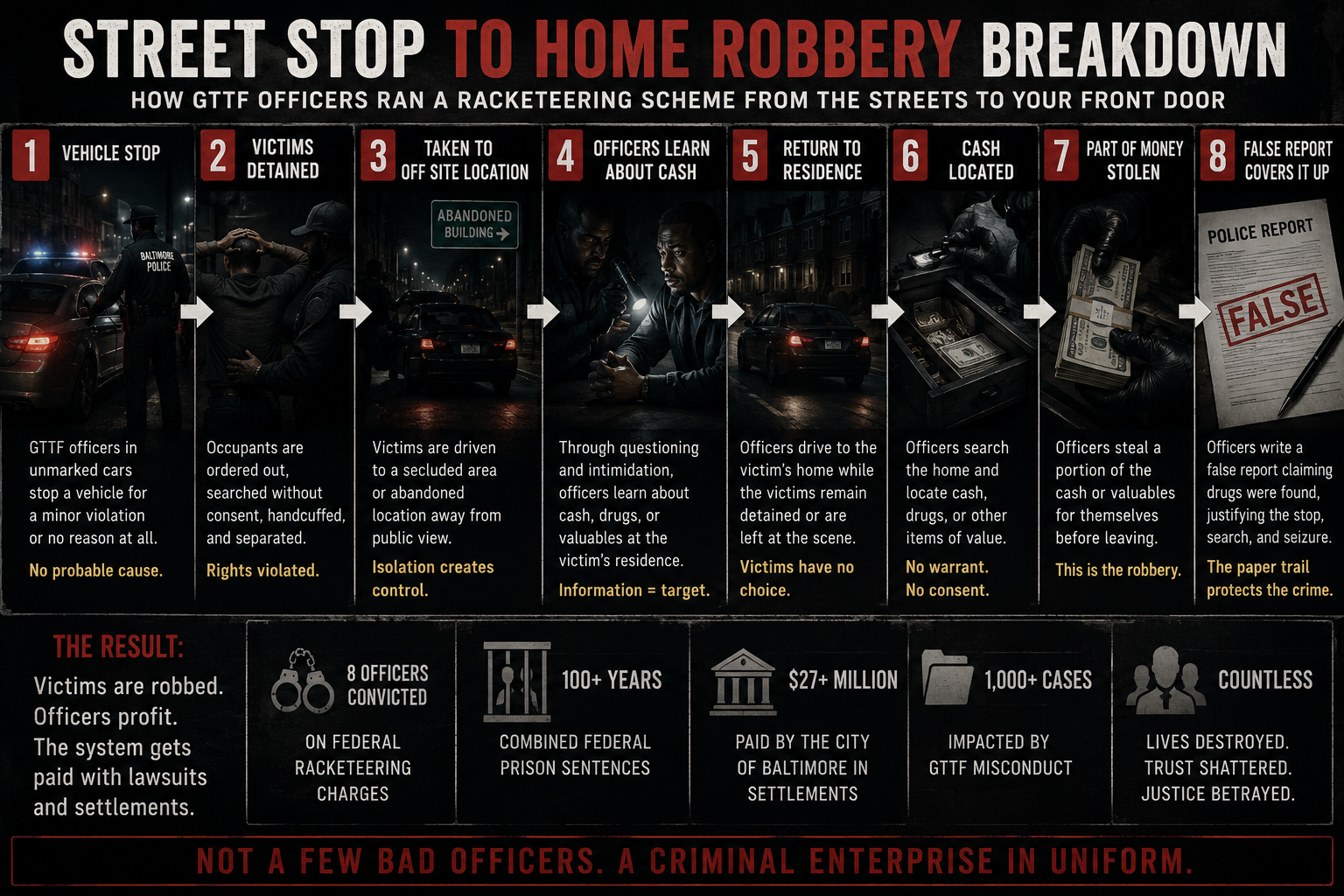
The pattern described by prosecutors was brutally simple. Officers could stop a person, search a car, enter a home, seize property, and then decide what version of events would exist on paper. If money was taken, the report could show less money than what was actually found. If a home search began from a false affidavit, the affidavit could become the official justification. If body camera footage created risk, the camera could be turned off. If another officer started asking questions, the warning could move through the circle before Internal Affairs ever caught up.
That is why the scandal was bigger than individual theft. The officers were not accused of robbing people in spite of their police power. They were accused of using police power as the tool that made the robberies possible. The uniform created fear. The badge created access. The paperwork created cover.
The $20,000 Bundle
One of the clearest examples came from July 8, 2016. According to the indictment, Jemell Rayam submitted a search warrant affidavit falsely claiming that he, Jenkins, and Gondo had conducted a full day of surveillance at the residence of two victims. Later that day, Rayam, Gondo, and Hersl stopped the victims’ vehicle, and Rayam allegedly stole $3,400 in cash. The victims were then taken to a Baltimore Police off site facility.
The indictment said Jenkins told Gondo by phone that he would meet them at the facility and that the others should introduce him as the U.S. Attorney. When Jenkins arrived, prosecutors said he falsely presented himself as a federal officer and asked one victim whether there was money at the victim’s home. After the victim said there was $70,000 in cash, Jenkins, Rayam, Gondo, and Hersl took the victims back to the residence. Inside a bedroom closet, officers found two heat sealed bundles, one with $50,000 and one with $20,000. Prosecutors said they stole the $20,000 bundle.
The same incident showed how the money trail and overtime fraud overlapped. Three days after the robbery, Jenkins went on vacation with his family in Myrtle Beach, South Carolina. Prosecutors said he falsely claimed overtime for five of the six days he was away. During that same week, Gondo allegedly told Rayam that working for BPD was “easy money” and that one hour could become eight hours on the official record.
Jemell Rayam And The Inside Record
Jemell Rayam’s sentencing record added another layer because it showed how long the conduct had been going on and how many forms it took. Rayam joined BPD in 2005 and was later assigned to the Gun Trace Task Force. According to his plea agreement, he schemed to steal money, property, and narcotics by detaining victims, entering residences, conducting traffic stops, and using false search warrant affidavits.
Rayam admitted that beginning in 2009, he robbed civilians he detained and, in some cases, arrested. Prosecutors said he shared proceeds with Gondo, Jenkins, Hersl, Taylor, and others, while keeping the proceeds himself on other occasions. Rayam participated in 15 robberies from June 2014 through October 2016, admitted he was armed with his BPD service weapon during the robberies, and admitted that victims were physically restrained during some of the crimes.
His file also described conduct outside the clean boundaries people usually imagine when they hear “police corruption.” Prosecutors said Rayam and others placed a tracking device on a victim’s car without court authorization before robbing the victim’s apartment. They stole a Rolex watch, a firearm, cash, and at least 800 grams of heroin. In another incident involving a store that sold birdseed, prosecutors said no illegal contraband or firearms were found, but Rayam later helped arrange a robbery of the storeowners’ home after learning they had $20,000 in cash meant for tax liabilities.
Planting Evidence And The 2010 Shadow
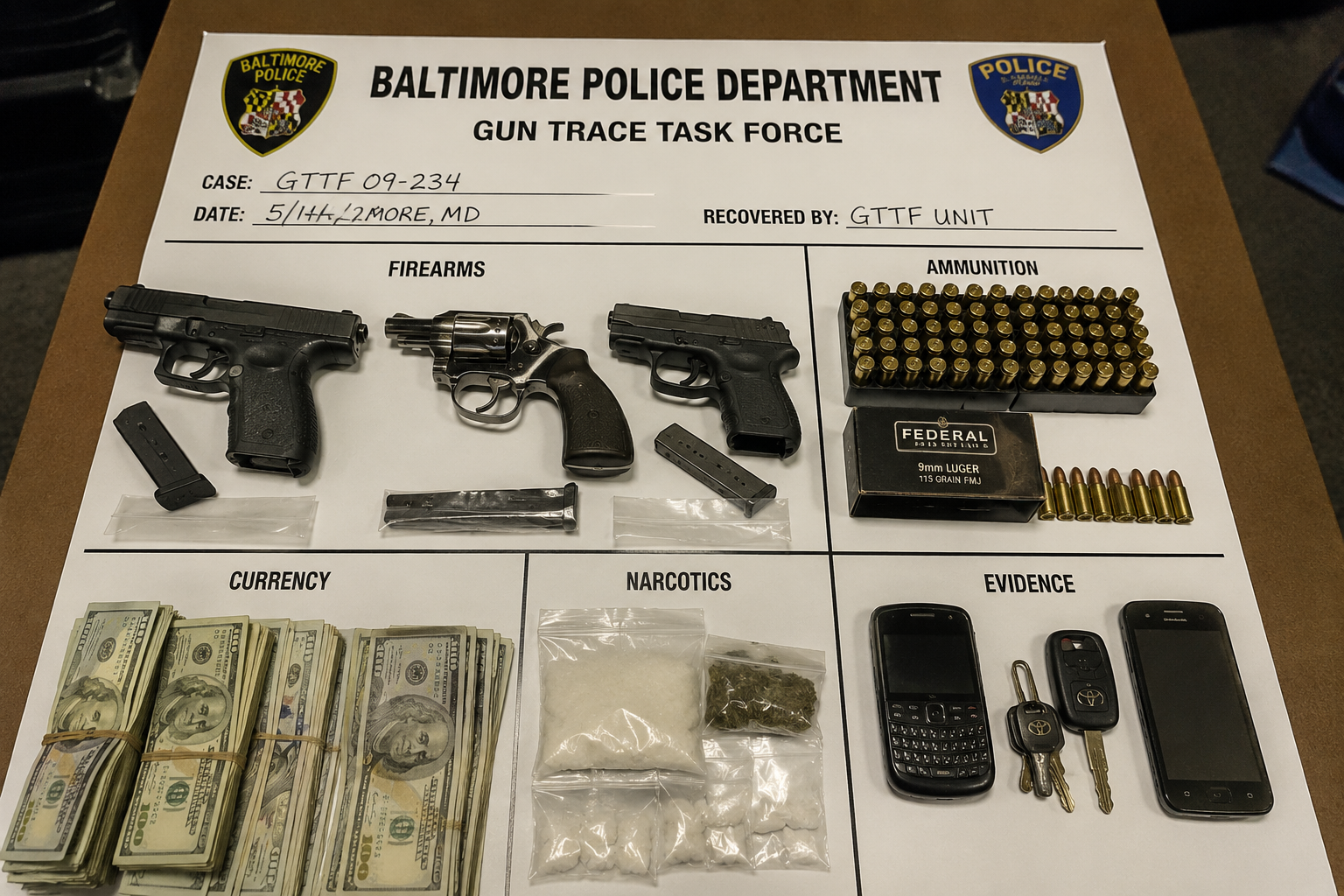
The scandal also reached backward into older cases. Jenkins pleaded guilty to planting evidence and authoring a false police report that resulted in the conviction and imprisonment of two Baltimore men in 2010. That detail is critical because it shows the fallout did not begin only when the Gun Trace Task Force was exposed in 2017. The scandal forced Baltimore to revisit earlier cases, earlier convictions, and earlier police narratives that had already passed through the courts.
This is where the harm becomes harder to measure. A stolen bundle of cash can be counted. A prison sentence caused by planted evidence becomes something else entirely. It rewrites years of a person’s life. It turns a false report into a courtroom record. It forces the city to later ask how many cases were built on officers whose credibility had collapsed.
The Steptoe Report
The most important document for understanding the full scandal is the Steptoe report, Anatomy of the Gun Trace Task Force Scandal: Its Origins, Causes, and Consequences. Released in January 2022, the report was 515 pages and covered events and decisions over roughly 20 years inside the Baltimore Police Department and the city of Baltimore. The investigation took 2 years, included more than 160 interviews, and reviewed hundreds of thousands of pages of documents.
The report’s core value is that it moved the scandal beyond the simple rogue cop explanation. It studied how the department’s history, command decisions, policing strategies, training gaps, supervision failures, accountability systems, and plainclothes enforcement culture helped create the conditions that allowed the scandal to continue. Steptoe’s public release said the report was designed to explain how a scandal of that scale could begin and continue for years without being detected.
The executive summary described the March 2017 indictment as only the first installment in a broader set of criminal charges against the original defendants and other BPD members over the following years. It also emphasized that the charged conduct included robberies during street stops, traffic stops, and residential searches, along with false affidavits, false reports, and overtime fraud.
The Department Before The Arrests
The Gun Trace Task Force scandal did not land in a vacuum. In August 2016, months before the federal arrests, the Department of Justice released a major civil rights findings report on the Baltimore Police Department. DOJ concluded there was reasonable cause to believe BPD engaged in a pattern or practice that violated the Constitution or federal law, including unconstitutional stops, searches, arrests, excessive force, retaliation against protected expression, and enforcement strategies that produced severe racial disparities.
That 2016 report matters because it shows the GTTF scandal erupted inside a department already under federal scrutiny for systemic problems in policy, training, supervision, and accountability. DOJ wrote that these deficiencies failed to equip officers to police effectively and within federal law. The GTTF case then became a living example of what can happen when specialized enforcement power operates inside weak oversight systems.
Convictions And Sentences
By the time the federal record was developed, eight former members of the Gun Trace Task Force had been convicted for racketeering and related charges. Jenkins received 25 years. Daniel Hersl and Marcus Taylor were convicted after trial and each received 18 years. Thomas Allers received 15 years. Momodu Gondo received 10 years. Jemell Rayam received 12 years. Evodio Hendrix and Maurice Ward each received 7 years.
The wider investigation also reached officers who were not original GTTF defendants. Steptoe’s public release said the federal investigation had resulted in the successful prosecution of a dozen former BPD officers, including several who were never members of the Gun Trace Task Force. The independent GTTF investigation page also described additional officers linked to the scandal through cover ups and efforts to frame a suspect.
The Cases That Collapsed
One of the deepest consequences of the scandal was not found only in prison sentences for the officers. It was found in the cases that collapsed behind them. Once officers were exposed for lying, stealing, planting evidence, and falsifying reports, every prosecution tied to their testimony became vulnerable. AP reporting described hundreds of cases that hinged on GTTF officers’ testimony being dropped after the scandal.
That part of the file is easy to overlook, but it may be one of the most important. Every dismissed charge and vacated conviction represented a second investigation into the original investigation. Courts, prosecutors, defense attorneys, and victims all had to revisit old files and ask whether a person had been arrested because evidence existed, or because an officer with a badge had created the version of events the system accepted.
The Settlement Ledger
The scandal also became a city finance story. Baltimore launched a public Gun Trace Task Force settlement tracker so residents could search individual lawsuits, case numbers, settlement amounts, and officers named in GTTF related settlements. Local reporting on the tracker said the city had paid more than $22 million in 39 cases by May 2023, with the tool designed to track future Board of Estimates approved settlements as well.
The Elbert Davis Sr. settlement became one of the clearest examples of the scandal’s long reach. Baltimore agreed in 2023 to pay $6 million to the family of Davis, who was killed during a 2010 police chase involving Gun Trace Task Force officers. AP reported that the settlement brought Baltimore’s total spending to $22.2 million for nearly 40 cases tied to the unit, with additional cases still pending at that time.
The Davis case showed how the damage spread beyond the people officers directly targeted. Davis was not the central suspect in a drug case. He became part of the scandal because the actions of corrupt officers triggered consequences that reached bystanders, families, lawsuits, and years of delayed accountability.
Official Facts Versus Wider Claims
The official facts are already severe. Federal records establish that GTTF members and connected officers were convicted, that Jenkins and Rayam admitted to robberies and false reports, that officers used police authority to steal money and property, and that fraudulent overtime claims were part of the criminal conduct. The federal indictment and sentencing records also establish the use of false paperwork, obstruction, and body camera manipulation as part of the wider pattern.
The wider institutional conclusions come mainly from the Steptoe investigation and DOJ’s 2016 civil rights findings. Those records do not mean every supervisor participated in the criminal acts. They do mean the department had structural failures that allowed misconduct to grow, survive, and avoid detection for years. That distinction matters. The convicted crimes belong to the officers who committed them. The conditions that allowed the scandal to breathe belong to a larger system.
The Unanswered Questions
The hardest question is not whether the Gun Trace Task Force officers committed crimes. The convictions answered that. The harder question is how many warning signs were missed before federal agents finally moved in. The Steptoe report was built around that problem, tracing the scandal back through years of department history, enforcement priorities, plainclothes policing, leadership decisions, and accountability breakdowns.
Another unresolved issue is how many people were harmed but never became part of a settlement, dismissed case, or public lawsuit. Some victims had property stolen. Others may have taken pleas based on false reports. Some may have had cases dropped years later without ever receiving a full public explanation. The settlement tracker and vacated convictions show part of the damage, but they cannot fully measure the private cost of years spent fighting a police record that was never clean.
Why This Case Matters
The Gun Trace Task Force case is one of Baltimore’s most important case files because it shows corruption operating at every level of consequence. At street level, people were stopped, searched, robbed, threatened, and falsely accused. At the paperwork level, reports, affidavits, overtime records, and charging documents turned criminal acts into official narratives. At the court level, cases had to be reexamined because the officers behind them could no longer be trusted. At the city level, Baltimore paid millions in settlements for conduct committed by police officers who had once been empowered to fight crime.
The scandal is not just the story of Wayne Jenkins. It is not only the story of a dirty plainclothes unit. It is the story of what happens when a department rewards results without asking enough questions about how those results are produced. The Gun Trace Task Force was supposed to trace guns. Instead, the record shows a unit whose own paper trail became evidence of robbery, fraud, planted evidence, false reports, destroyed credibility, and a city still paying for the damage years later.
Final Breakdown
The official record proves the core of the scandal beyond street rumor. Officers were charged. Officers pleaded guilty. Officers were convicted. Victims filed claims. Cases collapsed. Settlements followed. A 515 page independent investigation then went back through the machinery around the unit and documented how Baltimore’s police culture, enforcement strategy, and accountability failures helped create the conditions for the scandal.
That is what makes this case bigger than a police corruption headline. The Gun Trace Task Force was not just a unit that went bad. It became a criminal enterprise operating inside the one institution Baltimore residents were told to call when they needed protection.


