
Reporting and analysis may discuss allegations and online theories. Allegations are not findings of guilt. Verify important details in the cited public record.
The Case File
The name sounded almost childish, but the investigation behind it was anything but. Baltimore prosecutors said “39 Babies,” also known as the “GreenTeam,” was not just a group of young men using a zip code as a brand. It was, according to the state’s theory, a violent criminal organization tied to retaliatory shootings, carjackings, firearms trafficking, drug distribution, murder-for-hire discussions, and a string of gun crimes that spread across Baltimore’s Northern and Northeastern police districts. The number “39” came from the 21239 zip code, an area near Towson and Hillendale where authorities said many of the members lived.
The public headline usually centers on three murders: 17-year-old London Stuckey in December 2019, Kyon Thomas in July 2020, and Andrew Frazier in August 2020. But the full law-enforcement timeline is even bigger, because investigators said the case truly opened after the February 2020 murder of Deonte Henderson and the attempted murder of Perry Wainwright on Wyanoke Avenue. That Wyanoke Avenue shooting became the doorway into a much larger case, because ballistics allegedly connected shell casings from that scene to multiple other violent crime scenes across Baltimore.
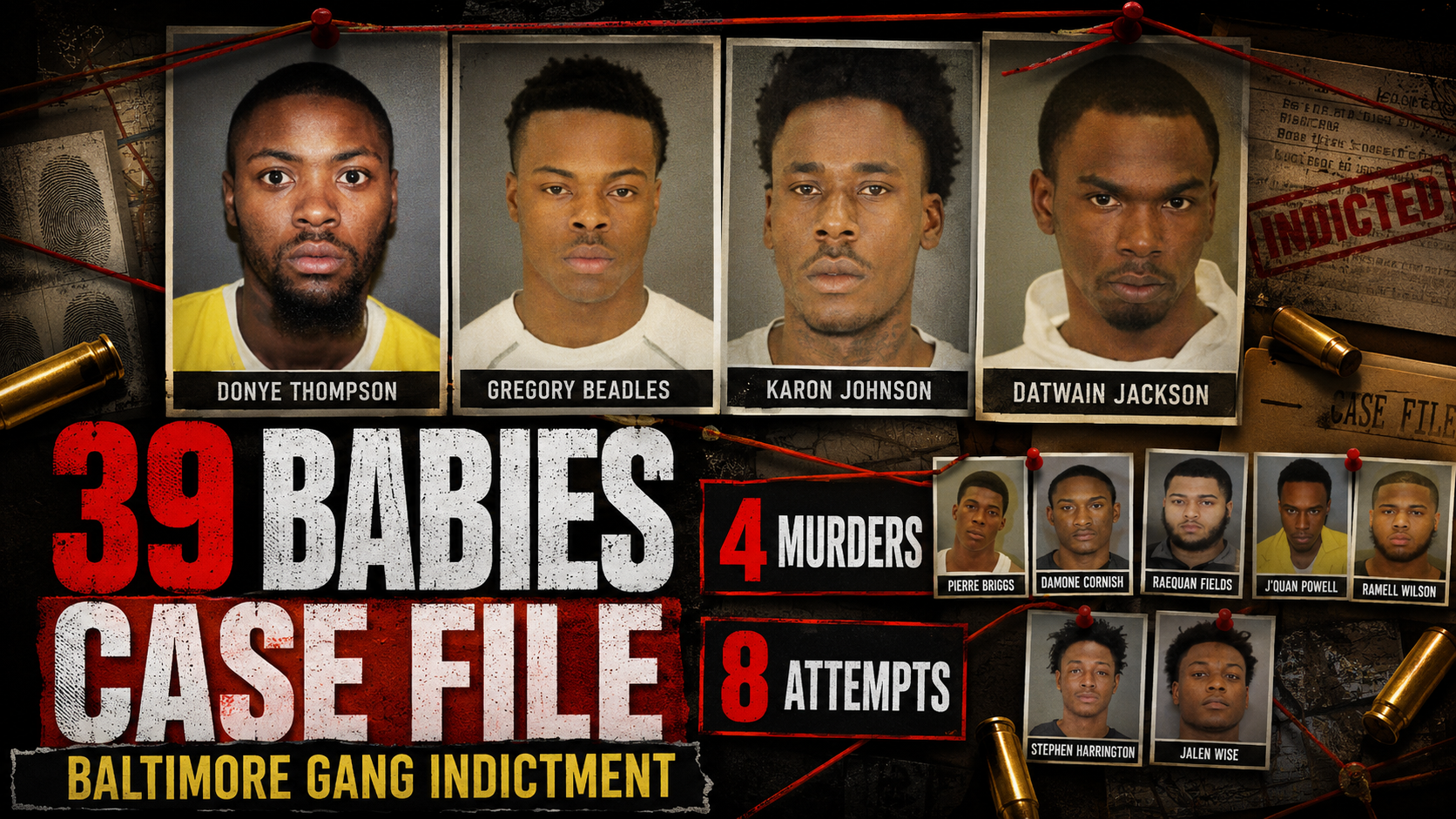
By the time the indictment was announced in August 2021, 11 alleged members had been charged. Authorities said the group was connected to four homicides, eight attempted murders, multiple retaliatory shootings, carjackings, drug possession and distribution, illegal firearms trading, and murder-for-hire discussions. WBAL reported that investigators recovered 19 firearms, ammunition, and about 109 flip-top containers of cocaine and oxycodone during the investigation.
The Zip-Code Gang
The state’s theory was that 39 Babies used geography as identity. Prosecutors said the group was named after the 21239 zip code, and reporting from the Maryland Attorney General’s Office described the organization as operating primarily around Baltimore’s Northern and Northeastern districts. That matters because this was not framed as one murder case with a few defendants. It was framed as a neighborhood-control case, where shootings, threats, weapons, drugs, and social media image were allegedly used to build reputation and punish enemies.
The “GreenTeam” name added another layer. CBS Baltimore reported that officials described 39 Babies as a gang that also presented itself like a rap group, and WJZ obtained a music video where alleged members were seen flaunting guns. That video reportedly appeared to have been shot at a Baltimore elementary school and had more than 460,000 views by the time of the indictment coverage.
That detail became one of the reasons the case stood out publicly. Prosecutors were not just saying the group committed violence in private. They were saying the group projected power in public, using guns, music videos, social media, and neighborhood identity as part of the same machine. Former Maryland Attorney General Brian Frosh said the defendants used threats and violence to control territory and retaliate against adversaries, while also flaunting guns and money in social media posts and music videos.
The Shooting That Opened The Door
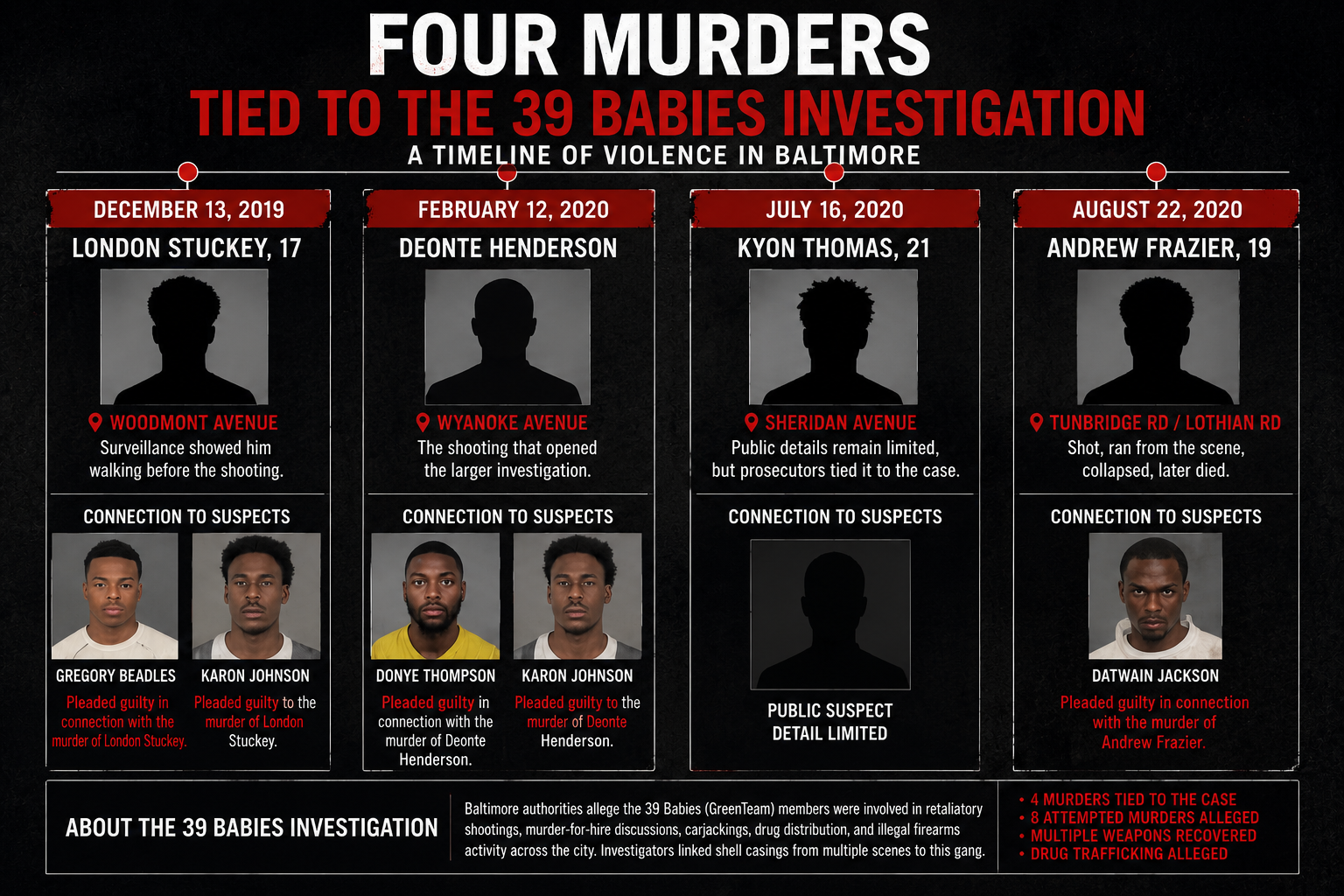
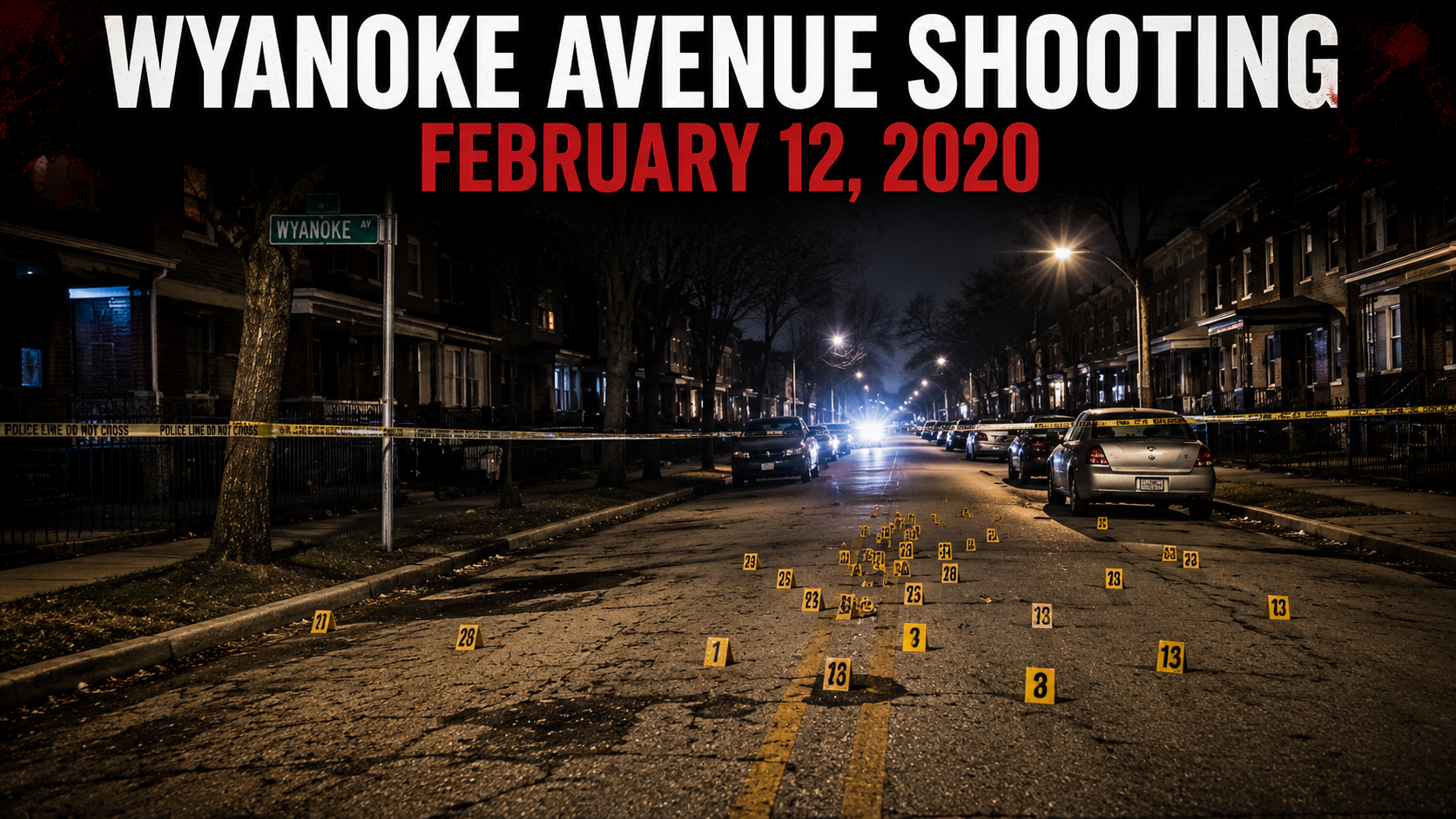
The investigation began with a deadly shooting on February 12, 2020, in the 600 block of Wyanoke Avenue. Deonte Henderson was killed, and Perry Wainwright survived an attempted murder. According to the Attorney General’s Office reporting, investigators found shell casings at the scene, then matched toolmarks from those casings to casings recovered at multiple other violent crime scenes. That ballistic connection is what allegedly allowed police and federal agents to start seeing the Wyanoke Avenue shooting not as one isolated incident, but as part of a broader pattern.
Later court reporting added the most disturbing detail from the prosecution’s version of Henderson’s murder. During Donye Thompson’s September 2024 plea hearing, Baltimore Witness reported that prosecutors said Thompson and other 39 Babies members chased Henderson and another victim, and that as Henderson lay in a front yard on Wyanoke Avenue, Thompson stood over him and fired the final shot. Thompson pleaded guilty to Henderson’s murder, participation in a criminal gang, armed carjacking, and use of a handgun in a crime. He received life suspended all but 25 years, with other sentences running concurrently.
Karon Johnson also later pleaded guilty to two first-degree murder counts tied to Deonte Henderson and London Stuckey. He was 19 at the time of the offenses and was sentenced to life incarceration, suspended all but 40 years. That plea gave prosecutors something stronger than an allegation for two of the central deaths in the 39 Babies case.
London Stuckey: The Teen Followed On Camera
The first major homicide in the public 39 Babies timeline happened on December 13, 2019. London Stuckey, 17, was killed in the 5600 block of Woodmont Avenue in Northeast Baltimore. Police later released surveillance footage showing Stuckey walking down the block with two people following behind him. WMAR reported that the video timestamp showed 12:03 p.m., and police said Stuckey was found with multiple gunshot wounds to his chest around 12:08 p.m.
That five-minute window is what makes London Stuckey’s case one of the most chilling pieces of the file. The footage did not show a long chase or a chaotic crowd. It showed the quiet seconds before a 17-year-old was killed, with two people behind him and police later asking the public to identify persons of interest. For months, the public version of the case looked like another Baltimore surveillance plea. In the larger indictment, prosecutors later placed Stuckey’s killing inside the 39 Babies timeline.
In September 2024, Gregory Beadles pleaded guilty in connection with Stuckey’s murder. Baltimore Witness reported that prosecutors said Beadles shot Stuckey multiple times on Woodmont Avenue, and Judge Barry G. Williams sentenced him to life suspended all but 30 years, with the first five years without parole. Beadles also received concurrent sentences for participating in a criminal gang and firearm use in a felony violent crime, and the judge ordered that he have no contact with Donye Thompson or members of 39 Babies.
The December 2019 Non-Fatal Shooting
The indictment was not only built around murders. One of the earlier non-fatal incidents publicly tied to the case happened on December 1, 2019, in the 1600 block of Pumphrey Avenue. Baltimore Witness reported that a 21-year-old man was wounded in his home along with two others. That incident became part of the plea proceedings involving Damone Cornish and J’Quan Powell, who both pleaded guilty to participating in gang activity, first-degree assault, and using a firearm to commit a felony violent crime.
Cornish was sentenced to 25 years, and Powell was sentenced to 15 years after binding plea agreements. According to Baltimore Witness, prosecutors said cell evidence seized by police was used to show a pattern of gang-related activity, including multiple murders, non-fatal shootings, carjackings, and murder-for-hire plots.
Raequan Fields, who had been connected to the same group of proceedings, later accepted a plea for 25 years suspended all but 10 years for first-degree assault, participation in a criminal gang, and firearm use in a felony violent crime. Baltimore Witness reported that Fields had faced multiple counts of attempted first-degree murder.
Kyon Thomas: The Thin Public Record
Kyon Thomas, 21, was killed on July 16, 2020, in the 500 block of Sheridan Avenue. WBAL and NottinghamMD both identified his killing as one of the retaliatory shootings investigators tied to 39 Babies. Publicly available details about Thomas’s case are much thinner than the London Stuckey and Deonte Henderson cases. Cham’s Baltimore homicide list also recorded Kyon Thomas as a 21-year-old shooting victim on the 500 block of Sheridan Avenue on July 16, 2020.
That lack of public detail is important. For this case file, Thomas cannot be written with fake surveillance movement, invented suspect descriptions, or a made-up motive. What can be said is that prosecutors placed his killing inside the broader 39 Babies retaliation case, and reporting identified the Sheridan Avenue homicide as one of the murders in the indictment timeline. The public record available right now does not give the same level of scene detail that exists for Stuckey, Henderson, or Frazier.
Andrew Frazier: Tunbridge Road To Lothian Road
Andrew Frazier, 19, was killed on August 22, 2020, in North Baltimore. Baltimore Witness reported that Frazier was standing in the 900 block of Tunbridge Road around 9:05 p.m. when he was allegedly shot by Datwain Jackson. After being shot, Frazier reportedly ran down the 5400 block of Lothian Road, collapsed, and later died at a hospital.
Other local reporting said Frazier was shot in the head near Tunbridge Road and Ivanhoe Avenue. Datwain Jackson was arrested in October 2021 in connection with Frazier’s death, with police identifying him as the suspect in the fatal shooting.
In the larger 39 Babies timeline, Frazier’s killing became one more point on the map. It was not presented publicly as a random shooting floating outside the case. Prosecutors grouped it with London Stuckey, Kyon Thomas, Deonte Henderson, and the attempted murders that investigators said were part of the same violent organization.
The Ballistics Trail
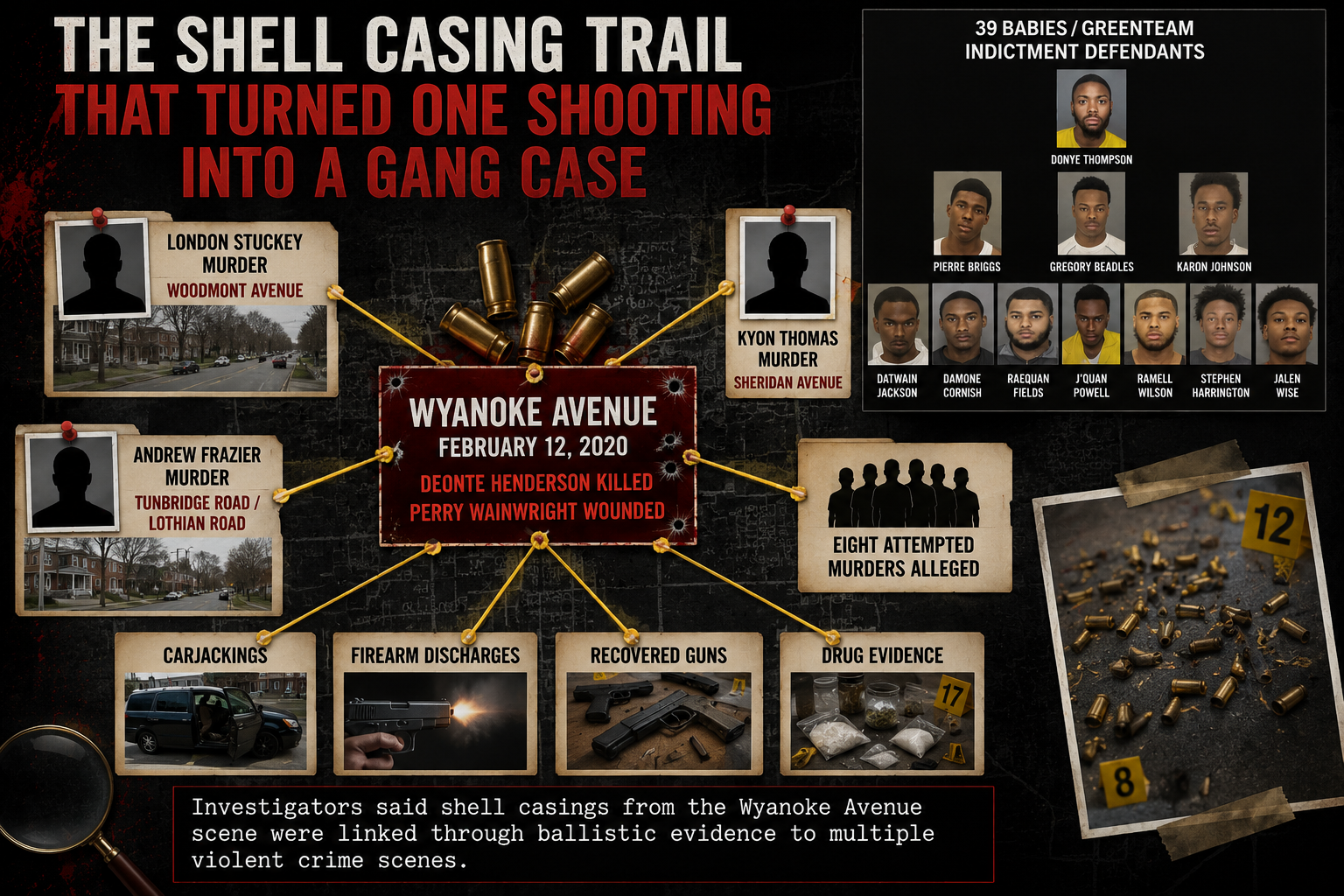
The strongest investigative spine of the 39 Babies case was not a rumor, a rap lyric, or a neighborhood story. It was ballistics. Authorities said the shell casings from the Wyanoke Avenue scene were linked through the National Integrated Ballistic Information Network to multiple incidents, including homicides, non-fatal shootings, firearm discharges, carjackings, and other violent crimes.
That is what gave investigators the ability to turn separate crime scenes into a connected map. Instead of treating each shooting as a stand-alone file, the ballistic evidence allegedly showed the same guns, or guns with matching toolmark signatures, appearing across different violent events. In a city where shootings can pile up fast and witnesses often disappear, ballistics became the quiet witness that did not change its story.
The recovery numbers also show why prosecutors framed the case as a gun pipeline case, not just a murder case. WBAL reported that authorities recovered 19 firearms, ammunition, and about 109 flip-top containers of cocaine and oxycodone. Prosecutors said members illegally possessed, obtained, sold, and traded firearms within and outside the organization.
The Indicted Members
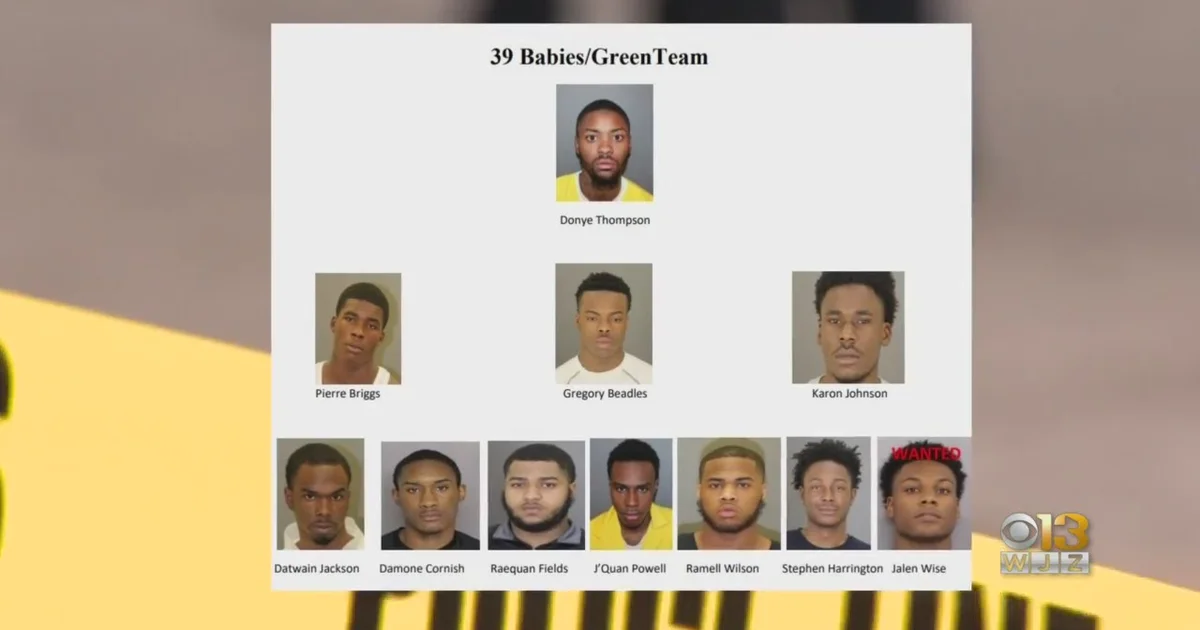
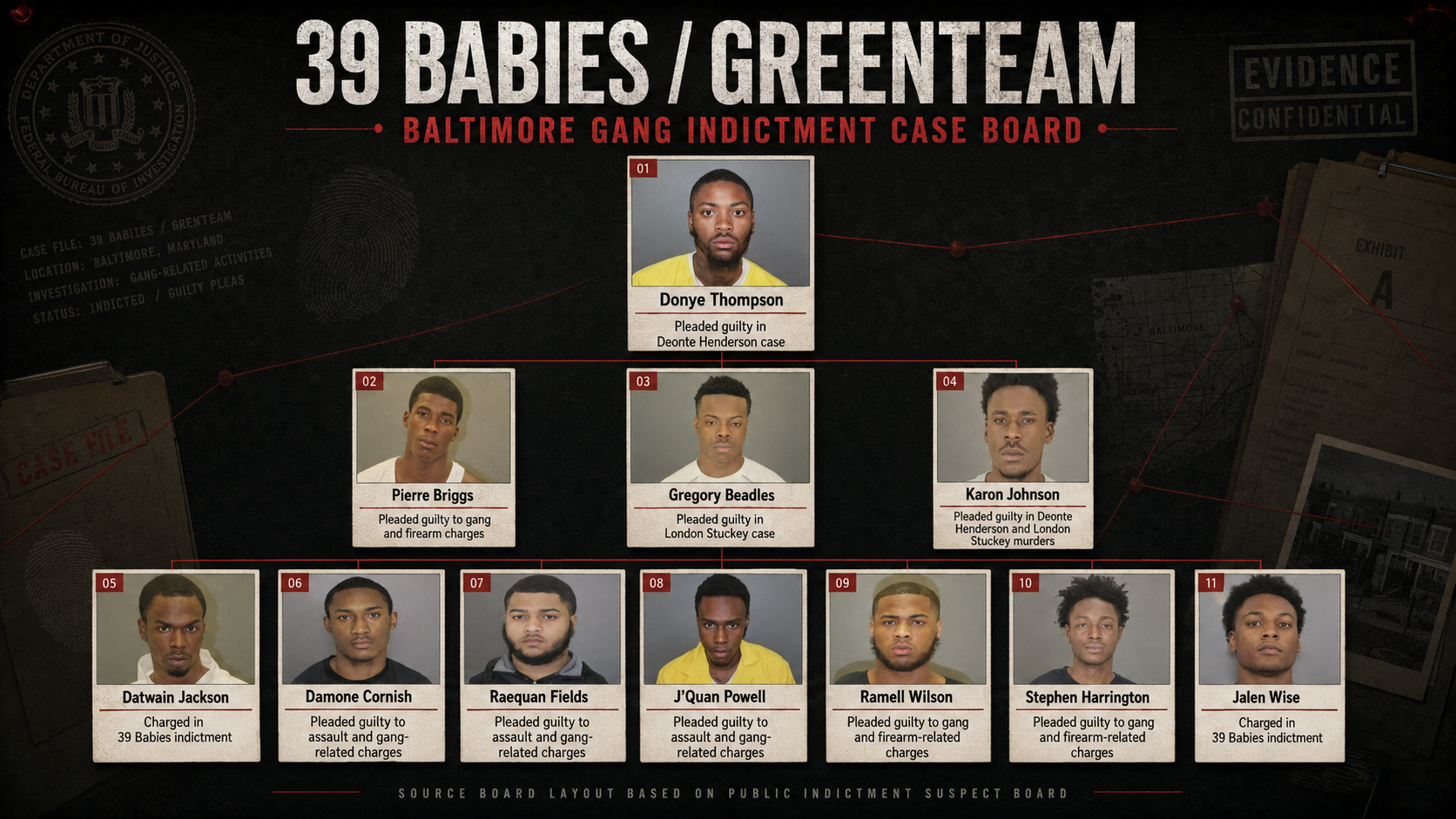
The 2021 indictment named 11 alleged members: Gregory Beadles, Pierre Briggs, Damone Cornish, Raequan Fields, Stephen Harrington, Datwain Jackson, Karon Johnson, J’Quan Powell, Donye Thompson, Ramell Wilson, and Jalen Wise. WBAL reported that Wise was the only defendant not in custody when the indictment was announced, and the ATF offered a $5,000 reward for information leading to his arrest.
The indictment was massive. Baltimore Witness reported that Karon Johnson, Gregory Beadles, and Pierre Briggs were charged with more than 70 counts tied to murder, attempted murder, reckless endangerment, gang participation, conspiracy, armed carjacking, and firearms offenses. Donye Thompson separately faced 50 charges related to violent crimes, handgun violations, carjacking, and the larger 39 Babies indictment.
Other defendants resolved portions of the case earlier. Stephen Harrington was reported as serving five years suspended all but two years for conspiracy participation in a criminal gang and illegal possession of a firearm. Ramell Wilson pleaded guilty in December 2022 to first-degree assault, participation in a criminal gang, and being a minor in possession of a firearm, receiving 25 years suspended all but 10 years, with concurrent sentences on other counts.
The Courtroom Split
One of the most important parts of this case is that the state’s theory was challenged hard in court. During opening statements in June 2023, a defense attorney called 39 Babies an “imaginary group” and argued there was no leader, no beef, and no coordinated gang activity. The defense framed the case as a collection of disconnected incidents tied together mostly by geography, not by proof of a criminal organization.
That argument matters because it shows the fault line in the case. Prosecutors saw a pattern: shared identity, shared communications, shared guns, shared territory, shared violence, and a common organization. Defense attorneys argued the state was stretching separate crimes into one gang story. One attorney also argued there was no DNA or fingerprint evidence placing Beadles at the scene, and that non-fatal victims could not identify him.
But the case did not end with only argument. Several defendants accepted plea agreements, and multiple central pieces of the timeline were later supported by guilty pleas. Karon Johnson pleaded guilty to the murders of Deonte Henderson and London Stuckey. Gregory Beadles pleaded guilty in connection with London Stuckey’s murder. Donye Thompson pleaded guilty to Deonte Henderson’s murder and other gang-related charges. Those outcomes did not prove every original allegation in the indictment, but they did give the state confirmed convictions in the heart of the case.
Official Facts Versus Allegations
The official facts are clear in several places. Eleven alleged 39 Babies or GreenTeam members were indicted in 2021. Authorities said the group was named after the 21239 zip code and was tied to multiple homicides, eight attempted murders, murder-for-hire discussions, drug distribution, carjackings, and illegal firearms activity. Law enforcement said the investigation began after Deonte Henderson was killed and Perry Wainwright was shot on Wyanoke Avenue, and that ballistic evidence linked that scene to other violent incidents.
The proven courtroom outcomes are also clear. Karon Johnson pleaded guilty to participating in a criminal organization, two counts of first-degree murder for Deonte Henderson and London Stuckey, and use of a handgun in a crime of violence. Pierre Briggs pleaded guilty to participating in a criminal organization and two counts of illegal possession of a regulated firearm by a prohibited person. Gregory Beadles pleaded guilty in connection with London Stuckey’s murder, and Donye Thompson pleaded guilty in connection with Deonte Henderson’s murder and related gang conduct.
The allegations that require careful wording are the broader claims about every shooting, every attempted murder, and every murder-for-hire discussion. Those were part of the indictment and prosecution theory, but not every allegation has the same level of publicly available detail or individual conviction record in open reporting. That is especially true for Kyon Thomas, where the public reporting identifies his killing as part of the 39 Babies case but does not provide the same detailed scene breakdown or plea-record detail currently available for Stuckey, Henderson, or Frazier.
The Retaliation Map
The retaliation map begins with December 2019. London Stuckey is seen on surveillance walking down Woodmont Avenue, with two people behind him. Minutes later, he is found shot in the chest. Prosecutors later say the killing was part of the 39 Babies pattern, and years later, Gregory Beadles and Karon Johnson both become part of the courtroom outcome connected to Stuckey’s death.
The map moves to Wyanoke Avenue in February 2020. Deonte Henderson is killed, Perry Wainwright survives, and shell casings from that scene become the thread that investigators use to pull open the broader case. Prosecutors later say Thompson and other 39 Babies members chased Henderson and another victim before Henderson was shot while down in a front yard.
By July 2020, the map reaches Sheridan Avenue, where Kyon Thomas is killed. By August 2020, it reaches Tunbridge Road and Lothian Road, where Andrew Frazier is shot, runs, collapses, and dies at a hospital. Around those killings, prosecutors also point to eight attempted murders, carjackings, non-fatal shootings, illegal guns, drug distribution, and murder-for-hire talk.
Why This Case Stands Out
The 39 Babies case stands out because it is not built around one moment. It is built around a pattern that prosecutors said stretched across months: shootings in December 2019, a killing and attempted killing in February 2020, another homicide in July 2020, another killing in August 2020, and other attempted murders around the same period. The case moved from street shootings to ballistic evidence, from music videos to courtroom pleas, from an alleged zip-code identity to long prison sentences.
It also stands out because of the age of everyone involved. London Stuckey was 17. Andrew Frazier was 19. Kyon Thomas was 21. Deonte Henderson was 22. Several defendants were also teenagers or young adults at the time of the crimes. Karon Johnson was 19 at the time of the offenses he later pleaded guilty to, and Gregory Beadles was also described in court as 19 at the time of London Stuckey’s murder.
The public-facing image was music, guns, and a zip code. The court-facing image was shell casings, phone evidence, plea agreements, victim-impact statements, and a prosecution theory that 39 Babies used violence to enforce identity and territory. That split is what makes the file bigger than a normal indictment story.
The Unanswered Questions
The first unanswered question is how much of the indictment’s full map has been publicly proven in detail. Several central murders now have guilty pleas attached to them, but the public reporting does not lay out every one of the eight attempted murders with the same level of specificity. For a premium case file, that means the attempted-killing portion should be treated as an indictment-backed allegation unless a specific plea, conviction, or court statement ties a specific defendant to a specific incident.
The second unanswered question is the full motive chain. Prosecutors called many of the shootings retaliatory and said the group used violence to punish adversaries, but the open public record does not fully explain every beef, every target, or every triggering event. The case gives the pattern, but not every private reason behind the pattern.
The third unanswered question is what happened with every named defendant after the early reporting. Several plea outcomes are publicly documented, but the public trail is not equally complete for every person named in the original indictment. Jalen Wise, for example, was reported as the only person not in custody when the indictment was announced, while Baltimore Witness later said it could not confirm his status in connection with the gang case.
Final Breakdown
The 39 Babies case is the kind of Baltimore file that looks simple from the outside and gets darker the deeper it goes. At first glance, it is a gang indictment with a strange name and a zip-code identity. Underneath that, it becomes a four-homicide investigation tied together by ballistics, phone evidence, firearms recovery, social media image, alleged retaliation, and years of courtroom movement.
The heart of the file is the contrast. A group calling itself “Babies” was accused of building a reputation through adult-level violence. A name tied to one zip code became connected to shootings across multiple Baltimore neighborhoods. A music-video image turned into a court file with murder charges, attempted murder counts, armed carjacking allegations, drug evidence, and firearms that investigators said kept resurfacing at violent crime scenes.
By the end, prosecutors did not need every allegation to remain just an allegation. Karon Johnson pleaded guilty to murdering Deonte Henderson and London Stuckey. Gregory Beadles pleaded guilty in connection with London Stuckey’s murder. Donye Thompson pleaded guilty in connection with Deonte Henderson’s murder. Other defendants accepted pleas tied to gang activity, assault, firearms, or related conduct. The indictment began as a sweeping theory, but pieces of that theory hardened into convictions and prison sentences.
That is why this case works as a premium file. It is not just “a gang was indicted.” It is a retaliation timeline, a zip-code identity case, a ballistics case, a music-video case, and a courtroom case all folded into one. The story begins with a name that sounds harmless, then ends with four young men dead, eight attempted killings alleged, 19 guns recovered, and a Baltimore crew permanently written into the city’s violent-crime record.


