
Reporting and analysis may discuss allegations and online theories. Allegations are not findings of guilt. Verify important details in the cited public record.
THE CASE FILE OVERVIEW
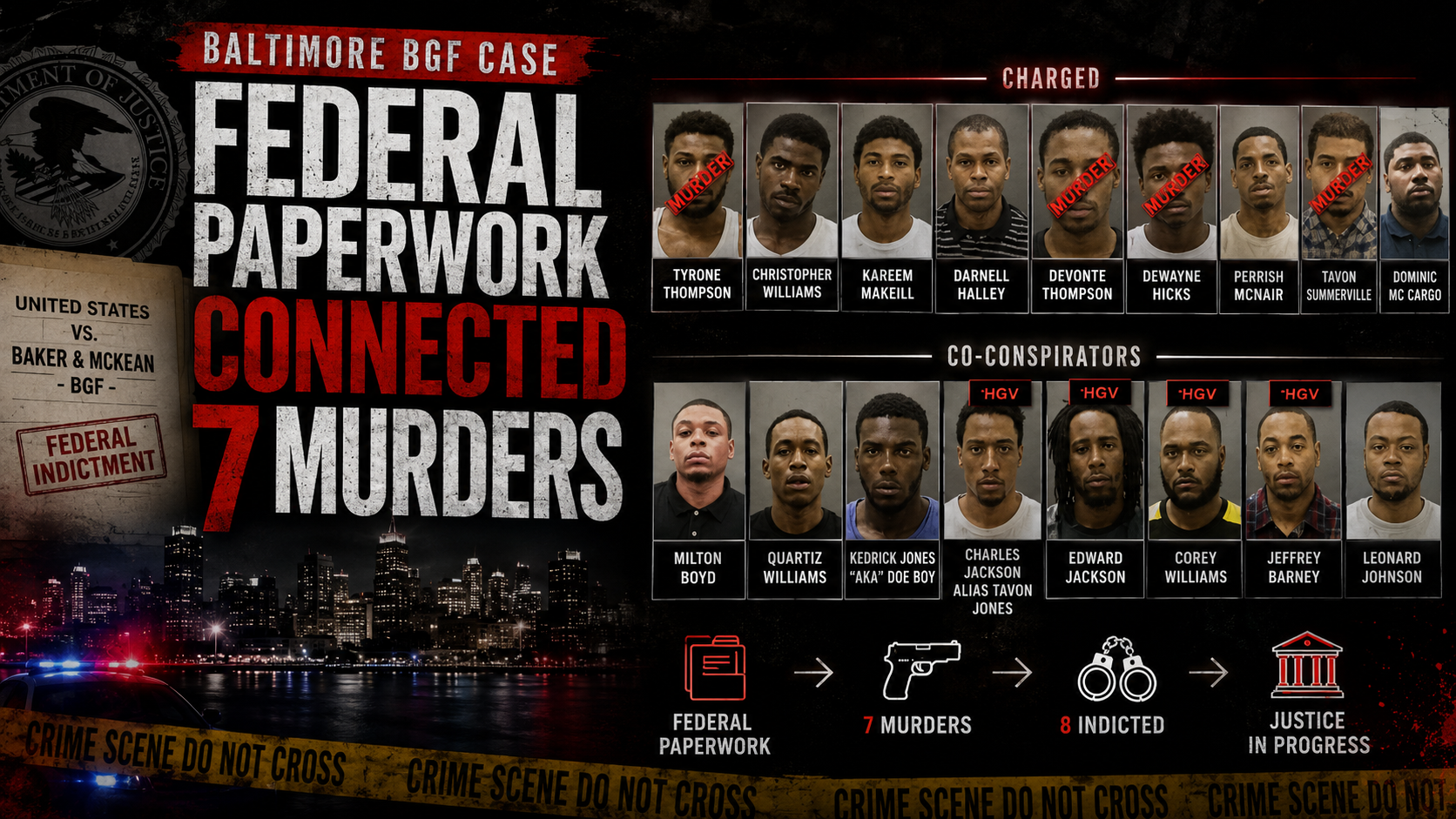
Federal prosecutors described the BGF Greenmount Avenue Regime as a violent Baltimore set of the Black Guerrilla Family that grew out of the Young Guerilla Family, or YGF. The group was tied to the 2200, 2300, and 2400 blocks of Barclay Street and Guilford Avenue, selling drugs through the Greenmount Avenue corridor while committing murders, shootings, stabbings, home invasions, and armed robberies. By 2013, prosecutors said the gang controlled a rectangular area bordered by Greenmount Avenue to the east, Guilford Avenue to the west, 25th Street to the north, and Federal Street to the south, with offshoots around Mund Park and Cokesbury Avenue. Between 2005 and 2017, federal evidence connected the gang and its members to seven murders, three non-fatal shootings, more than 10 armed robberies, and over 12 years of street-level drug dealing.
THE GREENMOUNT AVENUE REGIME
The paperwork says the group started as YGF before members took the BGF oath around mid-2007 and became the BGF Greenmount Avenue Regime. Prosecutors described it as a “bubble” or set of BGF, operating in North Baltimore with a street-level drug business built around crack cocaine, powder cocaine, heroin, ecstasy, marijuana, and oxycodone. Gerald Thomas Johnson, also known as “Geezy” and “Gzy Tha Prince,” was identified as the leader of the gang. Kenneth Jones, also known as “K-Slay” and “Slay,” was described as a primary enforcer responsible for three murders and at least one attempted murder. Marquise McCants, also known as “Digga,” was described as a member who dealt drugs, committed stabbings, robberies, and attempted murders in furtherance of BGF.
THE SEVEN MURDER PAPERWORK ANGLE
The strongest confirmed angle is that this was not just a drug conspiracy. Federal prosecutors repeatedly stated that the BGF Greenmount Avenue Regime was responsible for seven murders, three non-fatal shootings, more than 10 armed robberies, and years of drug trafficking. The violence was tied directly to witness intimidation, retaliation, drug territory protection, gang dues, and enforcing internal rules. In plain terms, the government framed the case as a racketeering organization where murder was used to keep people quiet, keep rivals away, and keep members in line.
GERALD “GEEZY” JOHNSON
Gerald Johnson was sentenced to life in federal prison after a jury convicted him of racketeering conspiracy, drug conspiracy, conspiracy to commit murder in aid of racketeering, murder in aid of racketeering, possession of ammunition by a felon, and possession with intent to distribute crack cocaine. Prosecutors said Johnson supplied members with powder cocaine, crack cocaine, heroin, ecstasy, marijuana, and oxycodone. The paperwork also says Johnson ordered multiple acts of violence, including the murders of Gregory Rochester and Moses Malone.
THE MURDER OF GREGORY “CRAIG MACK” ROCHESTER
One of the central murders in the case was Gregory Rochester, also known as “Craig Mack.” Prosecutors said Johnson authorized Rochester’s murder because Rochester was rumored to be cooperating with law enforcement and because Johnson believed Rochester had stolen drugs from the gang. On January 9, 2007, Kenneth Jones and Charles Pace, also known as “Foo,” carried out the order and murdered Rochester inside an apartment building in the 200 block of East 25th Street. A Maryland appellate opinion adds that Rochester was found dead on January 11, 2007, inside Johnson’s home and had been shot nine times, including four times in the head. Witnesses connected the killing to BGF, and ballistics evidence showed Rochester was shot with at least two guns.
THE MURDER OF MOSES MALONE
Moses Malone became the heart of the federal murder case. Malone had been robbed and shot by BGF member Norman Handy, then identified Handy in a photo array and also identified Johnson as the person who likely ordered the crime. Federal prosecutors said Johnson ordered Malone killed after learning Malone had provided information to Baltimore police. Malone had been placed into protective custody, but according to the Fourth Circuit, he was later removed from witness protection after a rules infraction and was killed shortly after. Police reportedly received a tip on the night of Malone’s death that he was in immediate danger, but they were unable to reach him in time. Prosecutors said Wesley Brown carried out Johnson’s order and murdered Malone on May 2, 2013, in the 600 block of Cokesbury Avenue.
NORMAN HANDY AND THE ROBBERY THAT LED TO A MURDER
Norman Handy, also known as “Norm” and “Lil Norm,” was sentenced to 142 months in federal prison. According to his plea agreement, Handy admitted that on March 23, 2013, he and another person robbed Moses Malone of a phone and money. During that robbery, Handy used a .38 caliber handgun and shot Malone in the foot. Malone was later scheduled to testify against Handy in state court, but before that could happen, Wesley Brown shot and killed Malone to stop him from testifying. This section is one of the strongest “cooperation fears” angles because the paperwork directly connects a robbery victim, a police identification, an upcoming court testimony, and a murder meant to silence him.
KENNETH “K-SLAY” JONES
Kenneth Jones was sentenced to life in federal prison. Federal prosecutors said Jones was responsible for three murders and at least one attempted murder as the gang’s primary enforcer. The state case against Jones also included the murder of Gregory Rochester and the attempted murder of Lamontae Smith. Witnesses described Jones as having “a lot of pull” inside BGF and said he played a major role in merging YGF into BGF. The state appellate record says Jones was convicted of first-degree murder, attempted first-degree murder, conspiracy to establish and entrench a gang through unlawful means, participating in a criminal gang, handgun offenses, and possession of a handgun by a prohibited person.
THE ATTEMPTED MURDER OF LAMONTAE “CHOP” SMITH
Lamontae Smith, also known as “Chop,” was shot near Greenmount Street on October 5, 2013. According to the state appellate record, Smith identified Kenneth Jones as the shooter from a photo array. Smith said the shooting came from an internal dispute inside BGF, with Smith and Jones on opposing sides. Smith also testified that he did not initially tell police who shot him because he believed Jones would try to kill him again. Another witness, Alexis Roberts, also known as “Big Baby,” told police that “Slay shot Chop,” though her memory failed at trial and her prior recorded statement was played for the jury.
THE ATTEMPTED MURDER OF PERRY JOHNSON
The state appellate record also describes the attempted murder of Perry Johnson. On April 11, 2011, Perry Johnson was involved in an altercation on North Avenue in Baltimore. A Baltimore police officer heard gunshots and saw Kenneth Jones running away while holding his waistband. Police found a stolen handgun and four spent casings in Jones’s pants. Perry Johnson survived gunshot wounds and later told detectives that Jones was a high-ranking BGF member, that Jones shot first, and that he believed BGF targeted him because someone had accused him and his wife of being “rats” cooperating with police.
MARQUISE “DIGGA” MCCANTS
Marquise McCants was sentenced to life in federal prison. Prosecutors said that between 2005 and 2017, the BGF Greenmount Avenue Regime was responsible for seven murders, three non-fatal shootings, more than 10 armed robberies, and over 12 years of drug dealing. McCants was described as a member who sold crack cocaine near Barclay and 24th Streets, participated in violence for BGF, and committed stabbings, robberies, and attempted murders. At his sentencing, the government also presented evidence that McCants committed an additional murder that had been unsolved at the time of trial.
THE STABBING OF A 12-YEAR-OLD RIVAL
One of the most disturbing McCants details came from May 9, 2008. Prosecutors said McCants, who was not yet 16 years old, led a group attack in the 2400 block of Greenmount Avenue against a 12-year-old member of a rival Bloods gang. The victim was stabbed. A witness identified McCants as the person who led the attack, and prosecutors said BGF members later walked back and forth in front of the witness’s home in what appeared to be an intimidation effort. The witness’s family moved out of the neighborhood shortly afterward because they feared for their lives.
THE ELKTON HOME INVASION AND PRISON STABBING
Federal prosecutors also said witnesses testified that on August 26, 2010, McCants and an unknown accomplice committed an armed home invasion and robbery of a family in Elkton, Maryland. The government also presented evidence that in August 2011, McCants assaulted and stabbed a rival Bloods member inside a prison in Hagerstown, Maryland. These details matter because they show the case was not limited to one Baltimore block. The violence followed members into homes, prisons, and different parts of Maryland.
THE 2017 GREENMOUNT AND NORTH AVENUE SHOOTING
On February 4, 2017, while McCants was a fugitive in the federal case, prosecutors said he attempted to murder a person near Greenmount and North Avenues by shooting the victim seven times in the legs and back. McCants fled to a residence in the 5600 block of Pioneer Drive, where he was arrested after a multi-hour standoff with a U.S. Marshals Task Force. Before surrendering, prosecutors said McCants disassembled the .40 caliber firearm used in the shooting and hid it behind a bathroom wall. Jail calls later captured McCants trying to direct others to dispose of the weapon, but law enforcement recovered the gun and linked it to the shooting.
JOSEPH “YO GOTTI” BONDS
Joseph Laurence Bonds, also known as “Joe” and “Yo Gotti,” was sentenced to 90 months in federal prison. Bonds admitted that he was part of the BGF Greenmount Avenue Regime and conspired with members between 2005 and 2016 to distribute crack cocaine, powder cocaine, and marijuana. His plea agreement included a major murder-related detail: on July 20, 2005, another gang member used a .32 caliber revolver belonging to Bonds to murder someone, and Bonds later took the revolver back. Bonds also admitted possessing a loaded .357 revolver on October 23, 2013, despite being prohibited from having firearms because of prior felony convictions.
MONTEL “TELLY” HARVEY
Montel Harvey, also known as “Telly,” “Telephone,” and “Big Head,” was sentenced to 21 and a half years in federal prison. Harvey admitted that he was part of the BGF Greenmount Avenue Regime and agreed with other members to commit crimes for the gang, including drug distribution, murder, robbery, witness tampering, and witness retaliation. Prosecutors said Harvey personally engaged in drug trafficking and attempted murder. On June 8, 2013, outside the Mirage nightclub in downtown Baltimore, Harvey shot a victim with a 9mm handgun while the victim was fighting BGF member Wesley Brown during a birthday gathering for Brown.
THE WITNESS INTIMIDATION THEME
The entire case is built around the fear of cooperation. Gregory Rochester was killed after being accused of cooperating and stealing drugs. Moses Malone was killed after identifying Norman Handy and giving police information. Perry Johnson said he believed BGF targeted him because he and his wife were accused of being “rats.” Lamontae Smith said he initially stayed quiet after being shot because he believed Jones would try to kill him again. A witness in the McCants stabbing case moved out of the neighborhood after BGF members allegedly walked in front of the home in an apparent intimidation move. The repeated pattern in the paperwork is not random violence. It is violence used to stop witnesses, punish suspected cooperators, and protect the gang’s drug operation.
THE FEDERAL TRIAL THAT SCARED THE JURY
The case became even more intense during trial. In the Johnson and Jones appeal, the Fourth Circuit said jurors raised multiple concerns about their personal safety. After testimony about Moses Malone’s murder and the police effort to save him, jurors worried that defendants had access to their personal information from jury selection. Later, a juror reported that associates of the defendants appeared to be taking photos of jurors in a public hallway outside the jury room. The district court removed that juror but did not initially hold the type of evidentiary hearing the appellate court said was required. The Fourth Circuit later vacated and remanded for a Remmer hearing to examine whether the incident affected jury impartiality.
THE BROADER BGF STRUCTURE
Separate federal appellate paperwork gives important background on BGF in Baltimore. The Fourth Circuit described BGF as a gang founded in California’s San Quentin State Prison in the 1960s that later established itself in Maryland’s prison system before expanding onto Baltimore streets. The gang was organized into subsets called “regimes,” with each regime led by a “bushman,” often called “Uncle” or “Unc.” The bushman collected dues, settled disputes, and enforced protocol with punishments ranging from fines to death. The FBI wiretapped the phone of citywide commander Timothy Michael Gray and dozens of other phones, documenting 40 Baltimore locations where BGF distributed heroin and cocaine.
THE WIRETAP MURDER ORDER ANGLE
The separate BGF appellate case also shows how federal investigators decoded violence in real time. On March 10, 2014, Mark Bazemore, also known as “Uncle Mark,” ordered William “Boosie” Harrington to kill Ronald Hall for allegedly lying to gang leadership. In wiretapped calls, Harrington told Bazemore he was near the target and said it would be easy. Bazemore responded, “Go ahead and do it then.” FBI Special Agent Mark James was monitoring the calls live and alerted Baltimore police that violence was about to happen in South Baltimore’s Lakeland neighborhood. Police arrived and found Hall shot in the arms and torso. Hall survived. Later jail calls captured Bazemore confirming that the order came from him.
THE REDDIT AND ONLINE ANGLE
There is not a strong Reddit paper-trail around this exact Greenmount Avenue Regime seven-murder case the way there is for many Chicago FOIA cases. The strongest community discussion angle is broader Baltimore BGF history, especially how long locals have discussed BGF’s presence in the city’s prisons and streets. A Baltimore Reddit thread about the BGF jail scandal includes users saying the corruption and BGF presence were widely known in the local criminal justice world before the federal cases made it public. For this specific seven-murder case, the best angle is not Reddit rumor. It is the federal paperwork itself: murder orders, witness intimidation, drug corners, sentencing records, appellate opinions, juror fear, and the repeated claim that the gang used violence to stop cooperation.
THE STRONGEST CASE FILE ANGLE
The strongest case file angle is that federal prosecutors did not describe the BGF Greenmount Avenue Regime as just another Baltimore drug crew. They described a neighborhood gang that grew out of YGF, took the BGF oath, controlled a defined Greenmount corridor territory, sold drugs for more than a decade, and used violence as a system. The paperwork connects seven murders, three non-fatal shootings, stabbings, robberies, witness intimidation, prison violence, home invasions, and courtroom fear into one racketeering story. The most powerful thread is cooperation fear: men accused of talking were shot, witnesses were threatened, a murder victim was killed after leaving protective custody, and even jurors became concerned about their safety during the trial.


