
Reporting and analysis may discuss allegations and online theories. Allegations are not findings of guilt. Verify important details in the cited public record.
The Case File
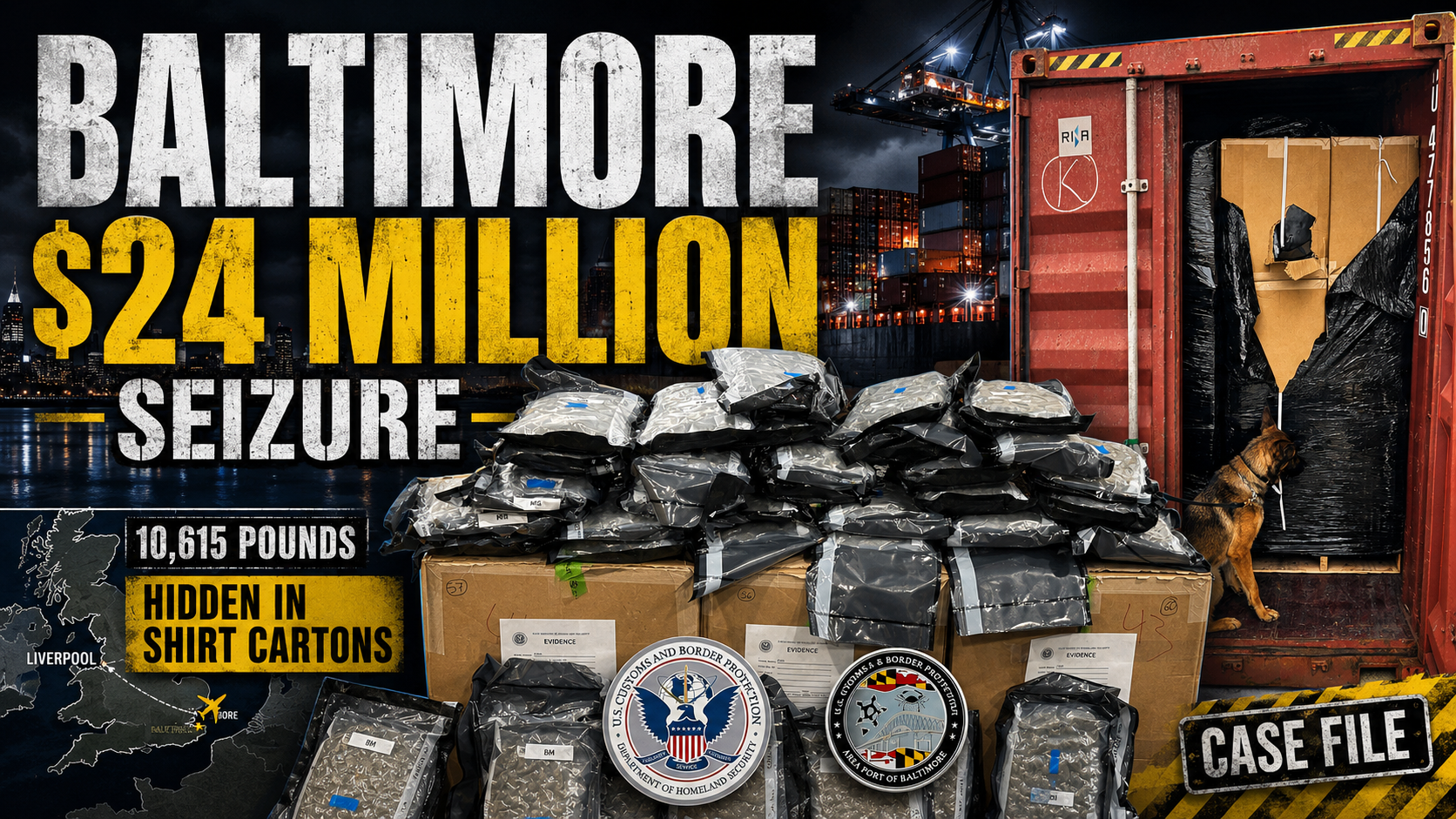
On May 29, 2026, federal customs officers in Baltimore opened a shipping container that was supposed to be carrying men’s shirts. The paperwork said the cargo was headed for Liverpool, England. The container came from Nassau County, New York. On paper, it looked like another ordinary export moving through one of America’s busiest freight gateways.
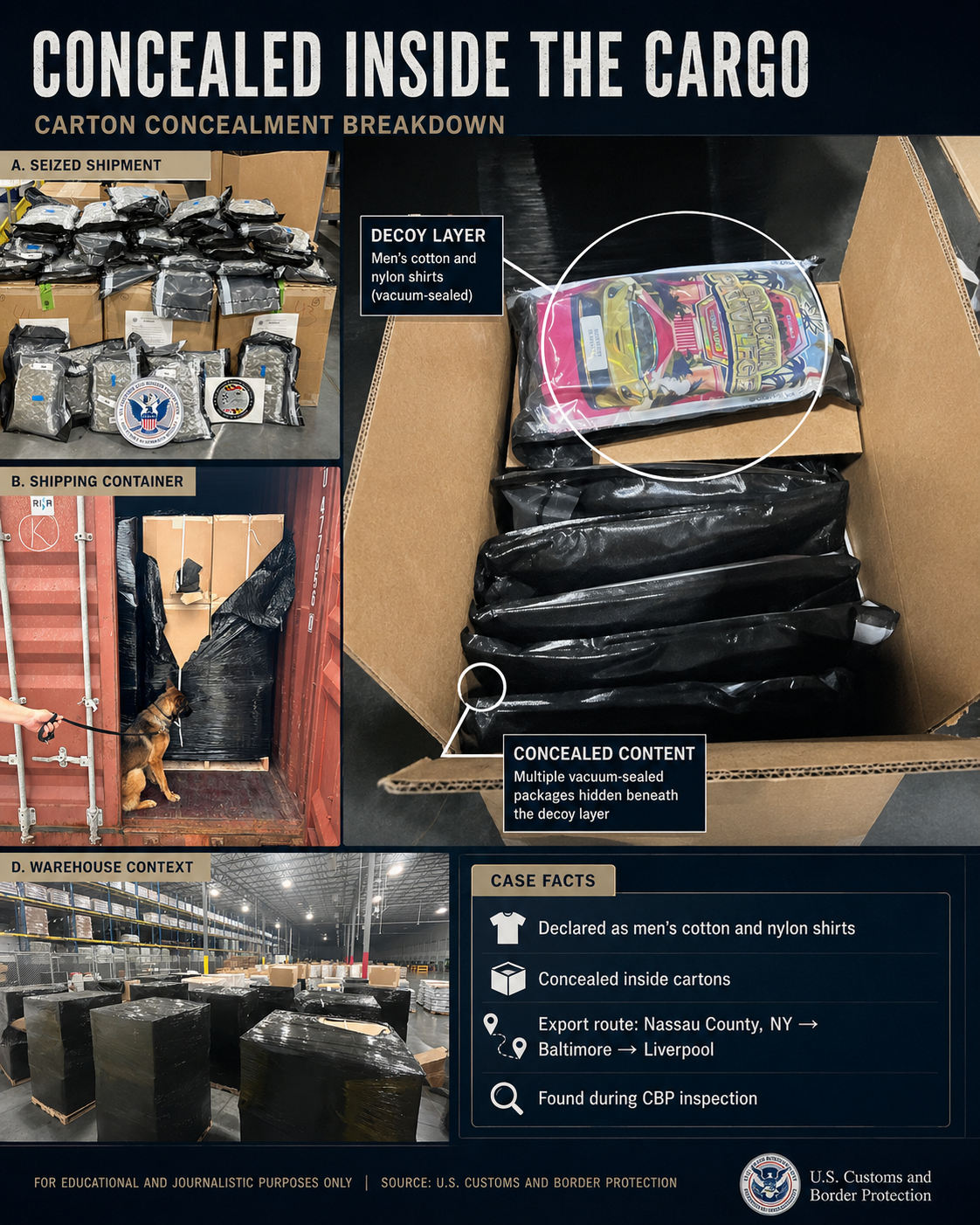
Inside, officers found something completely different.
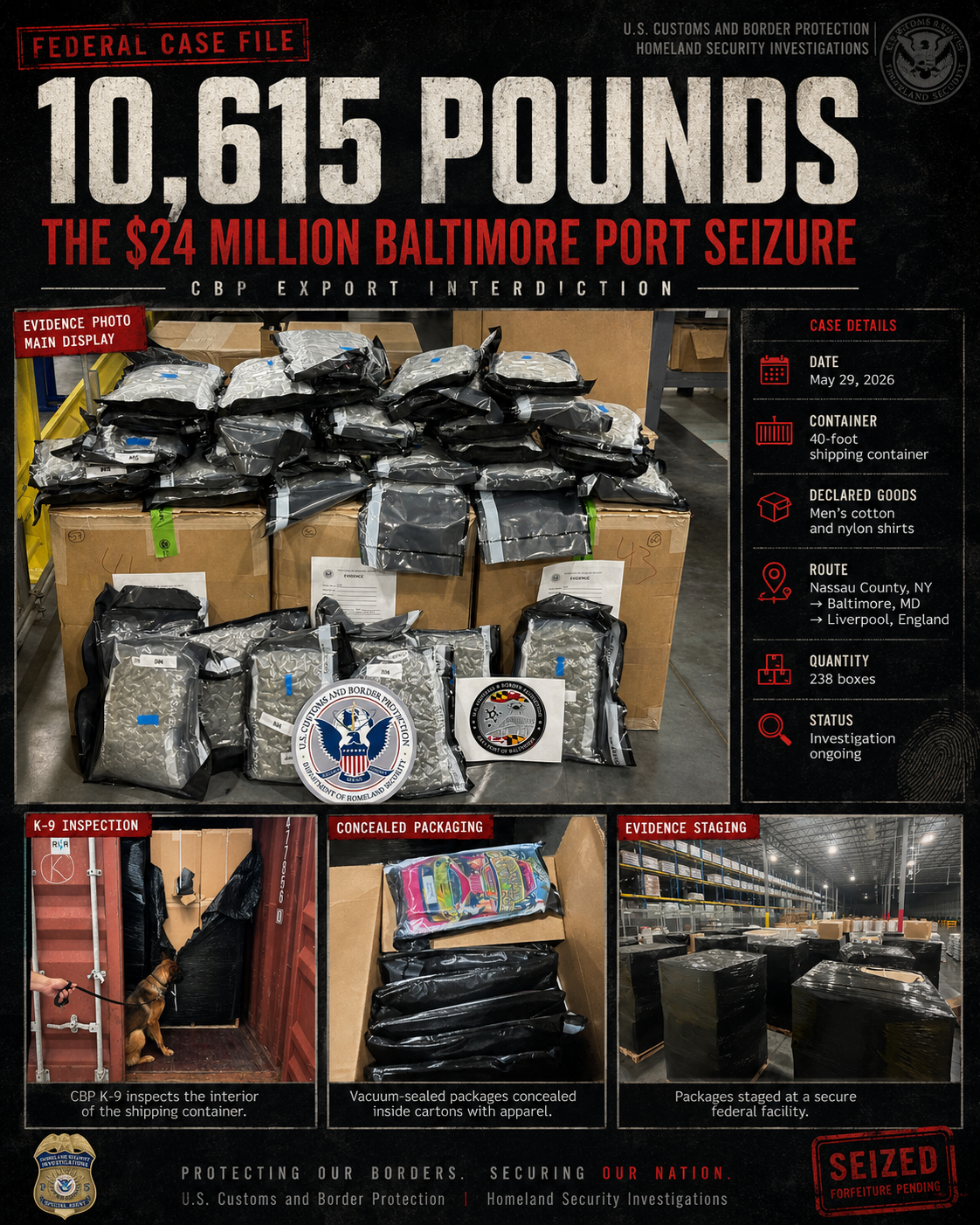
U.S. Customs and Border Protection said the container held 238 boxes packed with vacuum-sealed marijuana. The total weight was 4,815 kilograms, or about 10,615 pounds. In the United States, officials estimated the load was worth roughly $24 million. In Europe, CBP said the same marijuana could have brought back about twice that amount.
This was not a street-level drug seizure. It was not a suitcase at an airport, a trunk on a highway stop, or a warehouse stash discovered after a local raid. This was a multi-ton shipment moving inside commercial cargo, hidden behind a clothing manifest, routed through Baltimore, and pointed toward one of the United Kingdom’s major port cities.
The public record does not yet identify the shipper, receiver, warehouse, organizer, courier, trucking route, broker, or intended distribution network. No arrests had been announced as of the initial reports, and Homeland Security Investigations remained involved in the case. That is what makes the seizure bigger than the headline. The container was stopped, but the network behind it has not been publicly exposed.
The Shipment
The official facts begin with the container.
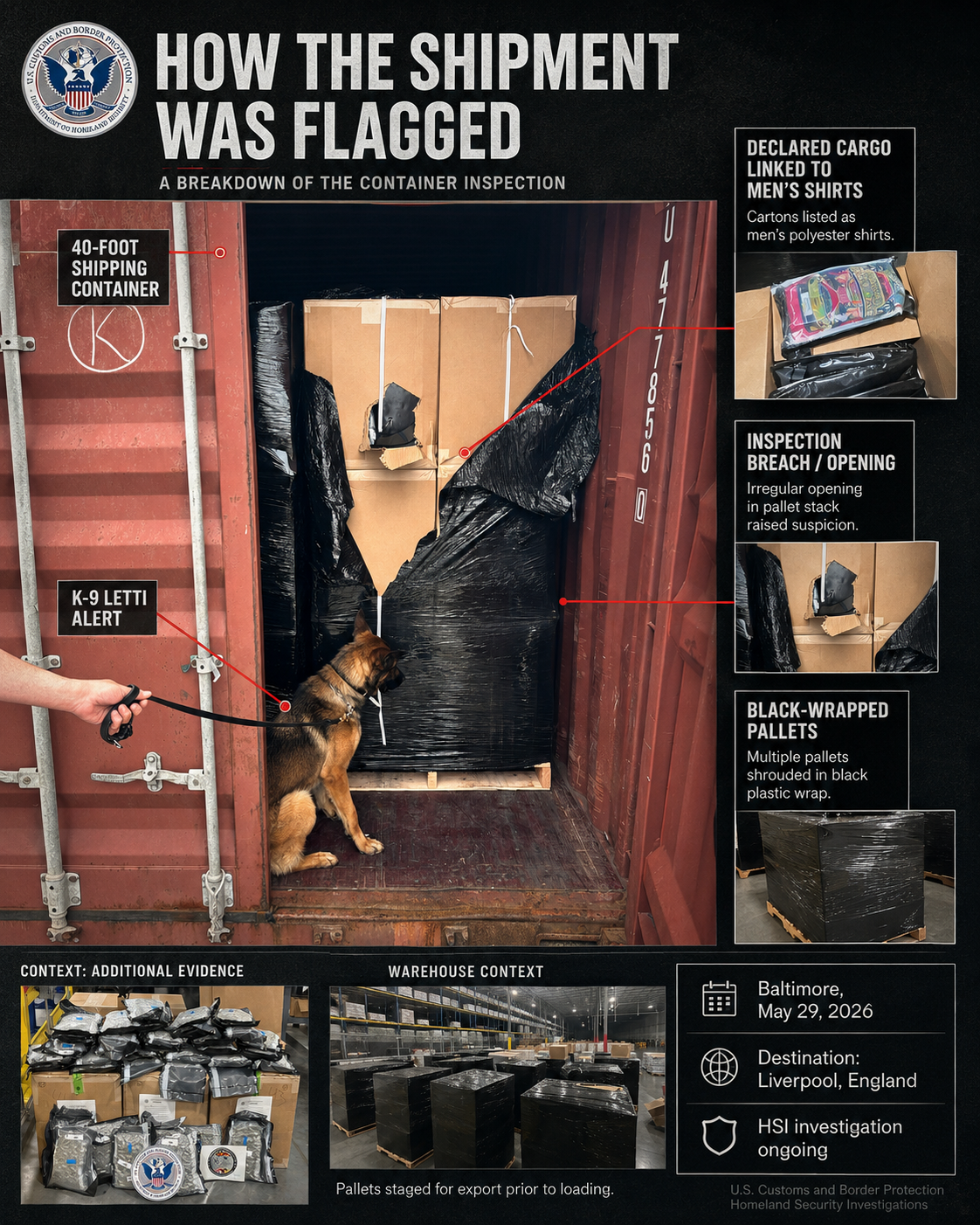
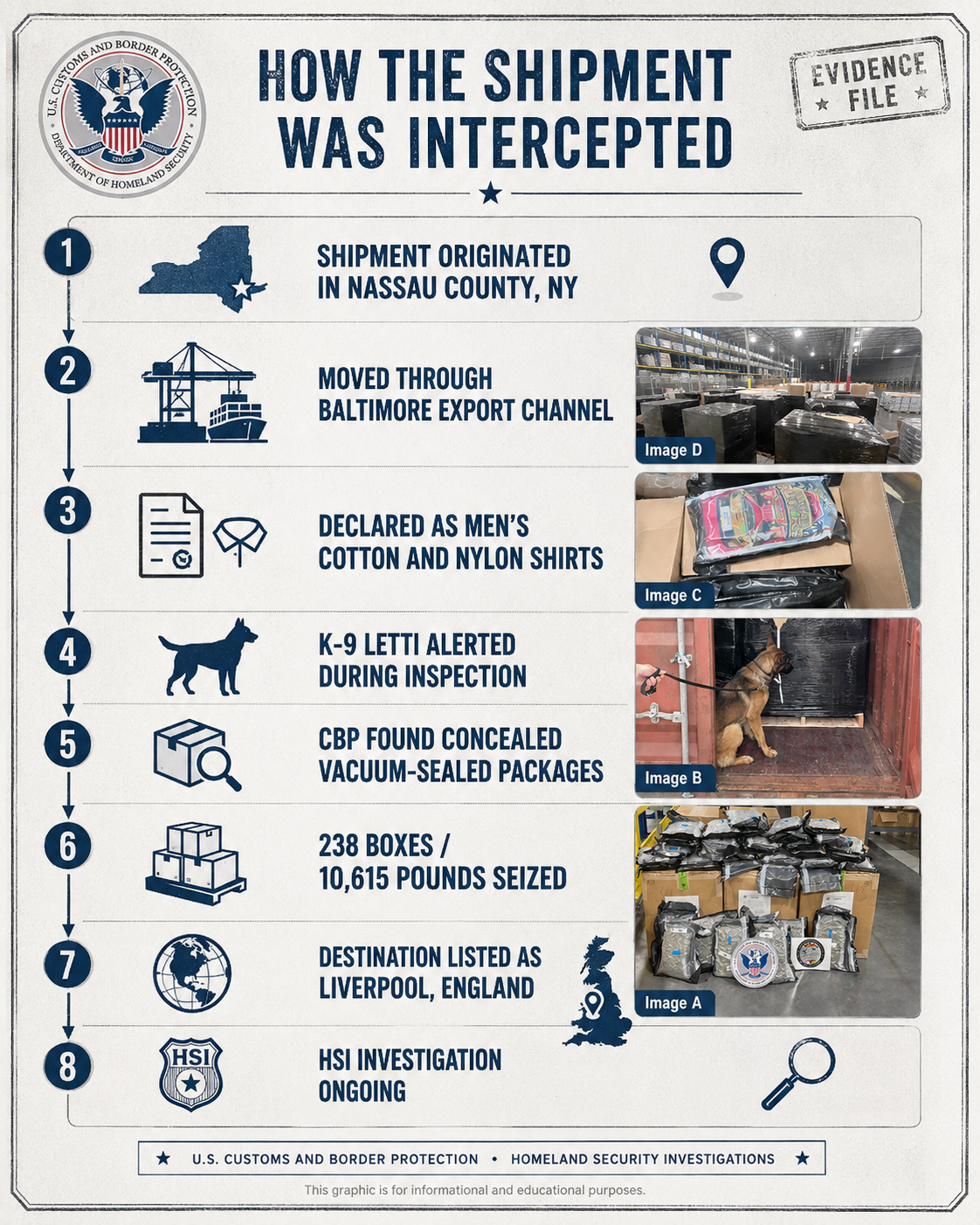
CBP officers conducted an export inspection of a 40-foot shipping container in Baltimore. The container had reportedly come from Nassau County, New York, and was manifested as men’s cotton and nylon shirts. Its destination was Liverpool, England.
The turning point came when Letti, a 2-year-old female German shepherd working as a CBP narcotics detector dog, alerted to the presence of narcotics. After that alert, officers examined the cargo and discovered 238 boxes filled with vacuum-sealed bags of marijuana.
The weight of the seizure was massive: 4,815 kilograms, approximately 10,615 pounds. The estimated U.S. street value was $24 million. CBP officials said the European resale value could have been substantially higher, with FOX45 reporting that the shipment could potentially sell for twice that amount overseas.
The concealment method was not complicated in the way people imagine from movies. The sophistication was in the system being used. A full container. A false commercial description. A legitimate port environment. A transatlantic destination. A shipment large enough that it could not be explained as personal use, passenger smuggling, or small-scale trafficking.
The container itself became the evidence.
The Clothing Manifest
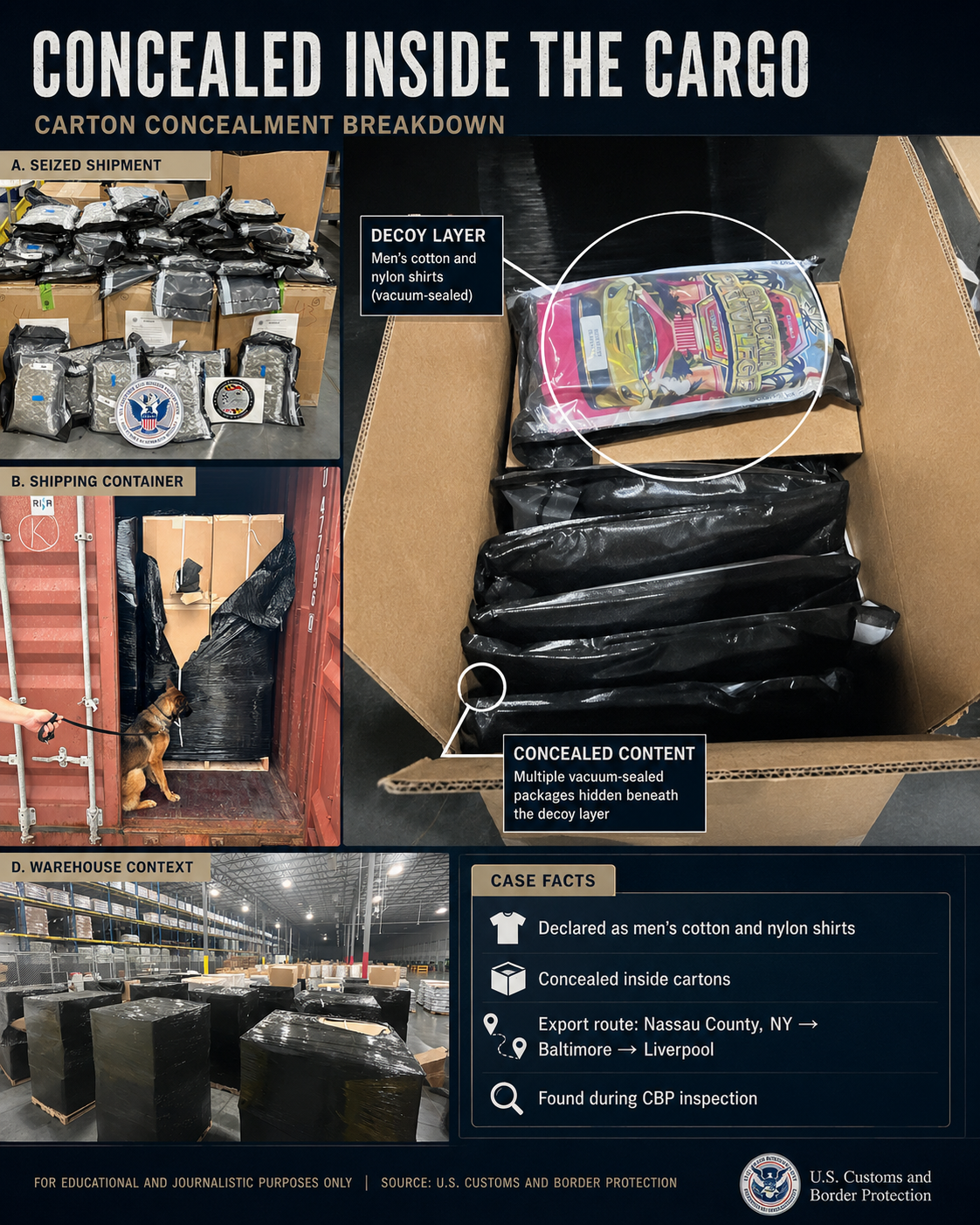
The paperwork said the shipment was men’s cotton and nylon shirts. That detail matters because the case was not built around loose packages hidden in a backpack. It was built around commercial cargo documentation.
A clothing manifest gives a container a legal identity. It tells port systems, customs officers, shipping companies, and freight handlers what the cargo is supposed to be. In this case, the declared identity did not match the cargo inside.
That does not automatically prove who created the false description or who knew what was inside. The public reports do not say whether the named exporter was real, stolen, fake, manipulated, or unknowingly used. They do not say whether the receiver in Liverpool was a legitimate business, a front, a hijacked identity, or a name placed on paperwork to keep the shipment moving.
What the official record does prove is narrower and stronger: the container was declared as clothing, but officers found more than five tons of marijuana hidden inside.
That gap between paperwork and cargo is where the investigation now lives.
Why Baltimore?
Baltimore was not a random location for this shipment to appear.
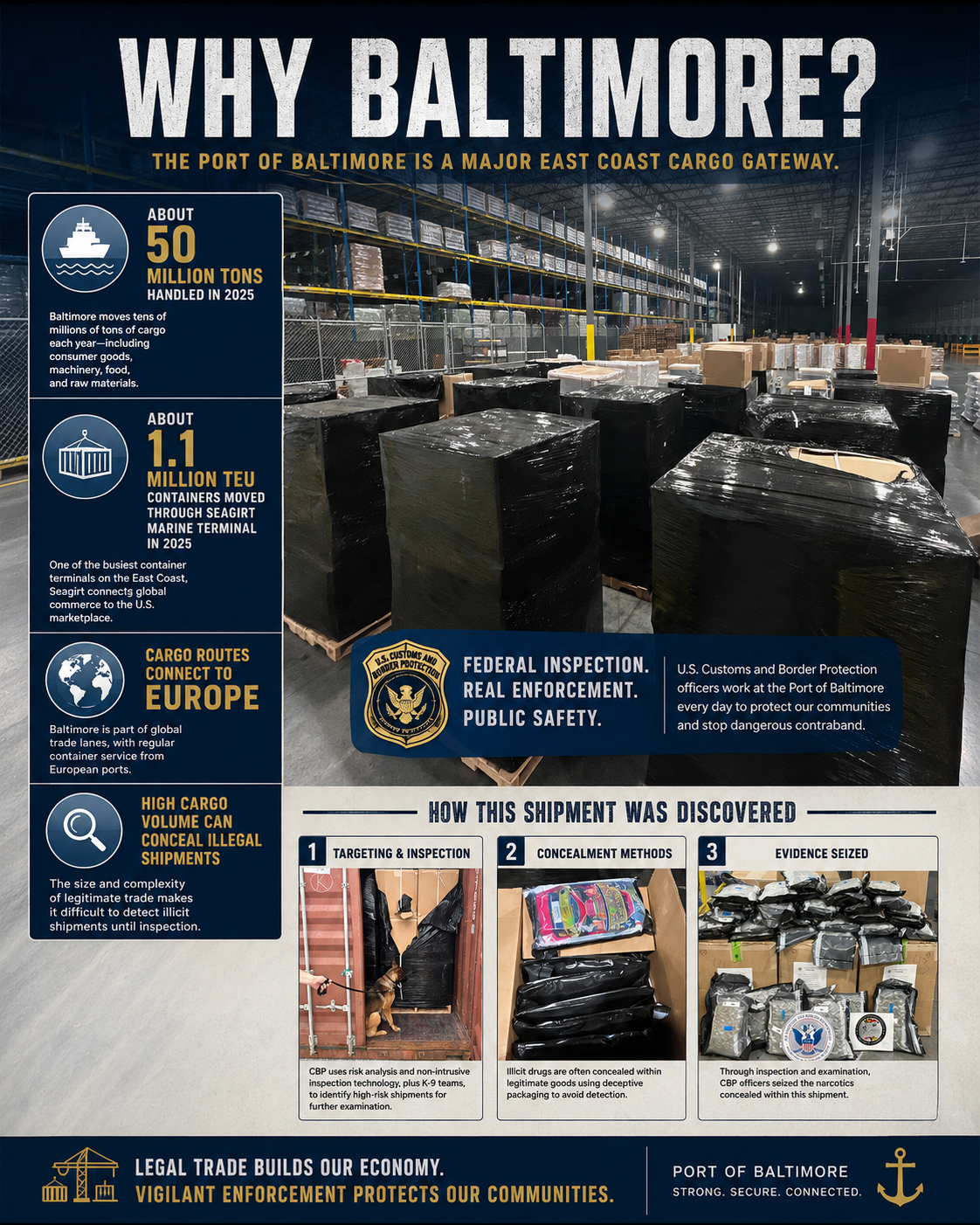
The Helen Delich Bentley Port of Baltimore is one of Maryland’s major economic engines and a major gateway for cargo moving in and out of the United States. In 2025, state officials said the port handled approximately 50 million tons of cargo at its public and private marine terminals, making it the port’s second-best year ever.
Maryland officials also said cargo moving through Baltimore reaches markets across the United States and overseas, including Europe, Africa, and Asia.
That scale is the point. Baltimore is built for movement. Containers, vehicles, machinery, forest products, bulk cargo, and international freight all pass through the system in huge volume. The same infrastructure that makes the port valuable for legal trade also creates the kind of environment criminal organizations try to exploit: high cargo volume, international routes, layered paperwork, and shipments moving through multiple hands before they reach their final destination.
In January 2026, Maryland officials announced that the port set records in 2025 for cargo vessel visits and container activity. The state said Baltimore handled 2,223 cargo vessel visits that year, a 21 percent increase over 2024, and moved 1,113,309 twenty-foot equivalent units through Seagirt Marine Terminal.
A containerized shipment can move through that kind of environment without looking unusual from the outside. Thousands of legal containers are supposed to move. The machine depends on speed, documentation, inspection targeting, and risk analysis. A single container can disappear into the noise unless something causes officers to look closer. In this case, that break came before the container reached the Atlantic.
The Baltimore-To-Europe Angle
The destination changes the meaning of the seizure.
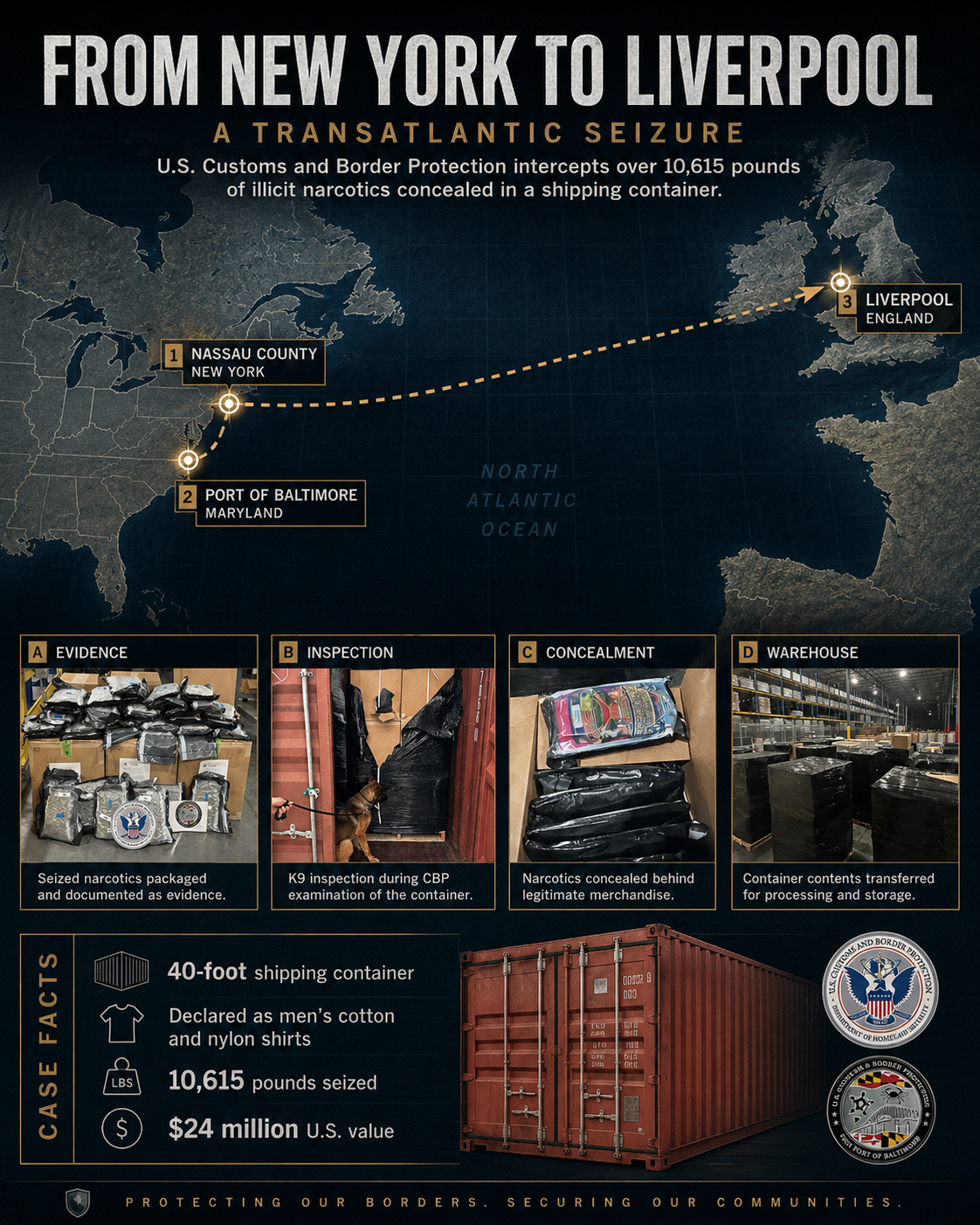
If the marijuana had been headed to another state, the case would still be serious. But Liverpool turns it into an international smuggling file. This was not just marijuana moving through Baltimore. It was marijuana allegedly moving from the United States into the European market.
CBP has been warning about this pattern. Officers have seen transnational criminal organizations trying to move marijuana into Europe through passenger baggage, express delivery, air cargo, and now a large shipping container. Officials have said high-quality marijuana can generate far higher profits overseas, with CBP reporting that European prices can reach two to three times the U.S. value in some cases.
That explains the risk.
A $24 million U.S. load becomes more tempting when the overseas resale value could be dramatically higher. The profit margin creates a reason to move product across borders, even when the shipment becomes more exposed to federal inspection, international law enforcement cooperation, and cargo tracking.
The route also shows how far removed this case may be from the street-level cannabis market. A shipment this large requires access to supply, packaging, transportation, paperwork, freight movement, and a receiving point overseas. The official record has not named the network, but the shipment itself suggests planning beyond a small crew.
The K-9 Alert
The public reports credit the discovery to Letti, the CBP narcotics detector dog.
That detail gives the seizure a clean turning point. Before the alert, the container was a shipment of clothing on paper. After the alert, it became a suspected narcotics load. Once officers opened and inspected the boxes, the scale of the shipment became impossible to minimize.
The public record does not say why this specific container was selected for inspection before the K-9 alert. It does not reveal whether CBP acted on risk indicators, intelligence, random inspection, paperwork issues, routing concerns, or standard export screening.
That missing piece is important. A major seizure often raises the same question: did officers find the shipment because of routine inspection, because the paperwork looked wrong, because intelligence pointed to the container, or because the dog alert changed the entire direction of the inspection?
For now, only one part is confirmed: Letti alerted, officers searched, and the container was found to contain 238 boxes of vacuum-sealed marijuana.
The Money
The $24 million estimate is the number that makes this case travel.
A shipment weighing 10,615 pounds is already large enough to stand on its own. But the value gives readers the scale of the alleged operation. At $24 million in the United States, the cargo was already a massive financial hit. If the European resale estimate is correct, the loss could represent far more than a domestic seizure.
This is why the case cannot be treated like a simple drug bust. A shipment at this level does not only represent marijuana. It represents front-end supply costs, packaging labor, storage, freight movement, port access, international logistics, and expected profit on the other side.
CBP’s public comments framed the seizure around transnational criminal organizations being drawn to European marijuana profits. That does not mean CBP has publicly identified the organization behind this specific container. It means the agency is placing the seizure inside a larger trend: U.S.-sourced marijuana being pushed toward foreign markets where the markup can be much higher.
The load was stopped before that profit could be realized.
The Pattern Before Baltimore
This Baltimore container did not appear in isolation.
Just months earlier, CBP officers at BWI Thurgood Marshall Airport intercepted four London-bound marijuana smuggling attempts totaling 247 pounds. CBS Baltimore reported that officers found 116 pounds on February 6, 2026, in luggage tied to two Baltimore travelers; 73 pounds on March 11 in luggage tied to a Los Angeles couple; 29 pounds on March 16 in luggage tied to a United Kingdom woman; and 29 pounds on March 19 in luggage tied to a Baltimore man.
Those airport seizures were smaller, but they showed the same destination pressure: marijuana moving from the United States toward London.
The financial logic was the same too. CBP said those combined BWI loads had an estimated U.S. street value of about $675,000, with high-quality marijuana potentially worth two to three times more in Europe.
In January 2026, Philadelphia CBP officers intercepted 481 pounds of marijuana in a shipment headed to the United Kingdom. CBP said the clothing shipment came from Decatur, Georgia, and was bound for an address in Oxford, England.
In April 2025, CBP officers in Baltimore seized more than 200 pounds of marijuana in air cargo headed to Belgium. The shipment was disguised as men’s overalls, and CBP described it as another example of marijuana being exported toward higher-profit overseas markets.
Those earlier cases matter because they show the Baltimore container was not just a one-off headline. The region had already seen smaller Europe-bound marijuana loads through airports, air cargo, and commercial shipments. The May 29 container took the same trend and stretched it to a different scale.
The International Context
The European side of the story was moving at the same time.
On June 19, 2026, the U.K. Home Office announced that Border Force had seized about 12 tonnes of cannabis at Southampton Port from two shipping containers sent from Canada. Officials said the drugs were packed into 1,200 boxes, valued the seizure at an estimated £139 million in criminal revenue, and described it as Border Force’s largest cannabis seizure ever.
That case was separate from the Baltimore seizure. The public record does not connect the two shipments, and they should not be treated as the same network unless investigators later prove a connection.
But the timing and structure are impossible to ignore. In May 2026, U.K. officers intercepted a record cannabis shipment from Canada. Weeks later, CBP publicly announced a five-ton marijuana seizure in Baltimore bound for Liverpool. Both cases involved North America-to-U.K. cannabis movement through commercial shipping containers.
The pattern is bigger than one port.
North American cannabis markets have created supply. European demand has created profit. Ports have become pressure points where legitimate global trade and illegal export attempts collide.
Official Facts
The confirmed public facts are clear.
The seizure happened in Baltimore on May 29, 2026. CBP officers inspected a 40-foot shipping container that had reportedly come from Nassau County, New York. The container was manifested as men’s cotton and nylon shirts and was destined for Liverpool, England. A narcotics detector dog named Letti alerted to the presence of narcotics. Officers found 238 boxes packed with vacuum-sealed marijuana bags. The total weight was 4,815 kilograms, or about 10,615 pounds. The estimated U.S. street value was about $24 million. Officials said the load could have been worth significantly more in Europe.
No arrests were announced in the initial reporting. Homeland Security Investigations special agents were continuing the investigation.
CBP has described the seizure as part of a broader trend involving marijuana being moved from the United States toward Europe, where overseas prices can make the same product far more profitable.
Those facts are enough to establish the core case. Everything beyond that has to be handled carefully.
What Has Not Been Revealed
The public record still leaves major parts of the file sealed.
Investigators have not publicly identified who packed the boxes. They have not named the shipper in Nassau County. They have not named the intended receiver in Liverpool. They have not explained whether the clothing manifest was created by a real business, a fake business, a compromised company, or a third party. They have not said where the marijuana was grown, where it was stored before shipment, or how it reached the container.
The record also does not reveal whether the container had been under surveillance before the inspection. It does not say whether federal agents were already tracking the shipment, whether the inspection began because of risk analysis, or whether the K-9 alert was the first decisive break.
No public charging documents have been released tying named people to the container. No indictment has identified a trafficking organization. No criminal complaint has laid out phone records, warehouse records, freight broker emails, vehicle movements, or financial transfers.
That absence does not weaken the seizure. It defines the current state of the investigation.
The drugs are confirmed. The network is not publicly exposed.
Official Record Versus Assumptions
It would be easy to overstate this case.
The shipment came from Nassau County, New York, but that does not prove the marijuana was grown in New York. The container was headed to Liverpool, but that does not prove Liverpool was the final street-level distribution point. The manifest described clothing, but that does not prove the listed company knowingly participated. The shipment moved through Baltimore, but that does not mean the organization was based in Baltimore.
The official facts show a route. They do not yet reveal ownership.
That distinction matters because a case file like this has to separate what the government has confirmed from what the size of the load suggests. The container suggests organization, money, logistics, and overseas demand. The official record confirms the seizure, the weight, the destination, the concealment, and the ongoing investigation.
Until arrests or court filings appear, the rest remains unanswered.
The Bigger Meaning
The Baltimore seizure is important because it shows a drug market changing shape.
For decades, marijuana smuggling stories were often framed around drugs entering the United States. This case points in the opposite direction: marijuana leaving the United States for Europe. The product was not coming into Baltimore. It was allegedly moving through Baltimore on its way out.
That shift matters. In parts of the U.S., marijuana markets have become saturated, legal cannabis has changed pricing, and high-quality American product can carry a premium overseas. Criminal organizations do not need the old border story if the profit is now across the Atlantic.
Baltimore becomes part of that story because it is a real port city with real international cargo reach. The port’s legitimate strength is what makes the case possible. Containers are supposed to move through Baltimore. Ships are supposed to leave for foreign markets. Cargo is supposed to be described through manifests and bills of lading. The alleged smuggling attempt tried to hide inside that normal movement.
One alert broke it open.
The Final Breakdown
The May 29 seizure in Baltimore was not just a big marijuana bust. It was a snapshot of an international trafficking route at the moment it failed.
A 40-foot container came from Nassau County, New York. The paperwork said men’s shirts. The destination was Liverpool. A CBP dog alerted. Officers opened the shipment and found 238 boxes of vacuum-sealed marijuana weighing more than five tons. The U.S. value was estimated at $24 million, with European resale potentially far higher.
The container never reached England.
What remains unknown is the part investigators are still chasing: who controlled the load, who arranged the shipment, who expected to receive it, and how many people touched the cargo before it reached Baltimore.
For now, the case ends with a stopped container, a missing network, and one confirmed fact sitting at the center of the file: 10,615 pounds of marijuana were hidden behind a clothing manifest and nearly moved through Baltimore toward Europe.


