
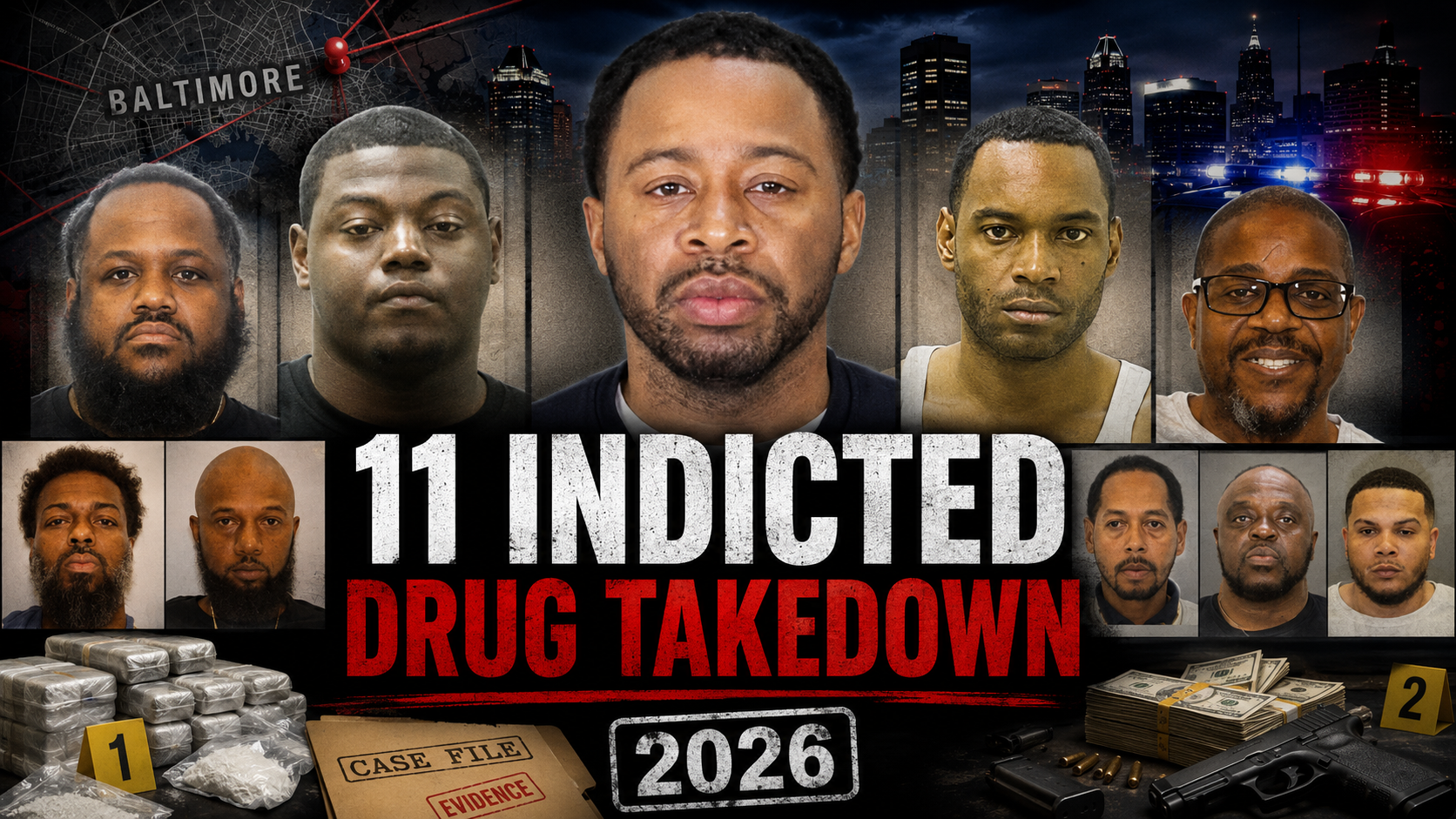
Reporting and analysis may discuss allegations and online theories. Allegations are not findings of guilt. Verify important details in the cited public record.
The Case File
This case begins with what Baltimore prosecutors described as a coordinated takedown of two alleged open-air drug markets operating in the city, one centered on the 1800 block of North Collington Avenue and another tied to the 2600 block of Greenmount Avenue. On January 15, 2026, Baltimore City State’s Attorney Ivan Bates stood with federal and local law enforcement officials to announce that 11 defendants had been indicted on multiple firearm and drug trafficking charges. The case was not presented as a simple street-level narcotics arrest. Prosecutors framed it as a multi-agency investigation involving the FBI Baltimore Safe Streets Task Force, the DEA, Baltimore Police, and the Baltimore City State’s Attorney’s Office, with wiretaps, search warrants, alleged wholesale suppliers, suspected street sellers, stash locations, firearms, ammunition, cocaine, fentanyl mixture, and more than $55,000 in seized cash.
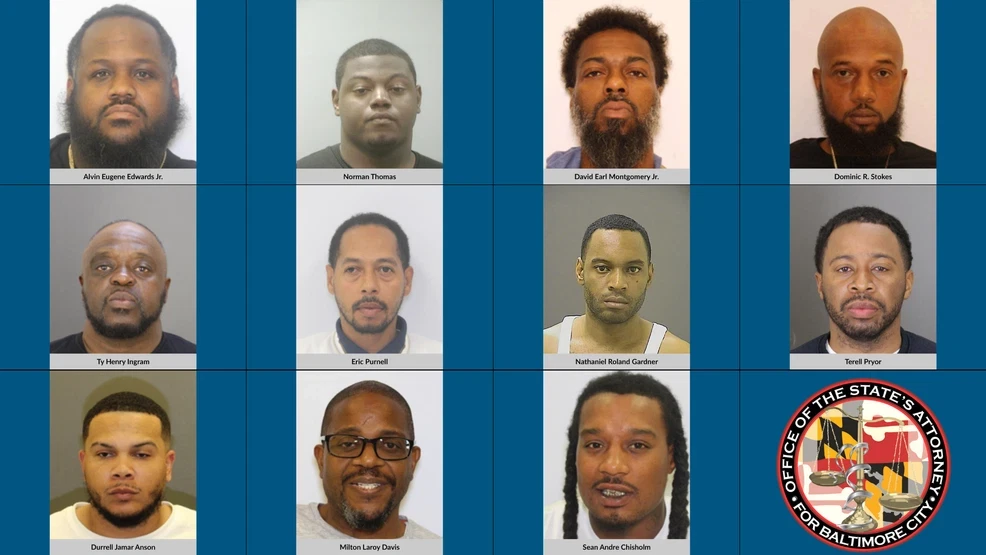
The defendants named publicly in the case are Terell Pryor, Alvin Eugene Edwards Jr., Norman Thomas, David Earl Montgomery Jr., Dominic R. Stokes, Ty Henry Ingram, Eric Purnell, Nathaniel Roland Gardner, Durrell Jamar Anson, Milton Laroy Davis, and Sean Andre Chisolm. The public records and news reports describe them as charged defendants, not convicted offenders, and the State’s Attorney’s Office specifically stated that anyone charged by indictment is presumed innocent unless and until proven guilty at trial. That distinction matters in this case because the official story is built around allegations from investigators, intercepted communications, search warrant results, and charging documents, not a final verdict.
The Investigation
According to the Baltimore City State’s Attorney’s Office, the investigation began in early 2025 when the FBI Baltimore Safe Streets Task Force, working with the DEA and Baltimore Police Department, launched a probe into alleged drug activity on the 1800 block of North Collington Avenue. That block became the first anchor point of the case. Investigators identified Terell Pryor as someone they believed was selling bulk quantities of cocaine to people connected to the alleged organization, and prosecutors later described him as a volume supplier whose narcotics were allegedly broken down for street-level sale.
The case widened after investigators received court authorization to wiretap two of Pryor’s phones. Prosecutors said those intercepted calls appeared to show Pryor traveling and meeting with different people for volume narcotics sales. From there, the investigation allegedly uncovered a distribution pattern involving multiple defendants, with some accused of buying from Pryor and others accused of working with him to obtain larger amounts of cocaine before dividing it for their own customers.
The Alleged North Collington Avenue Network
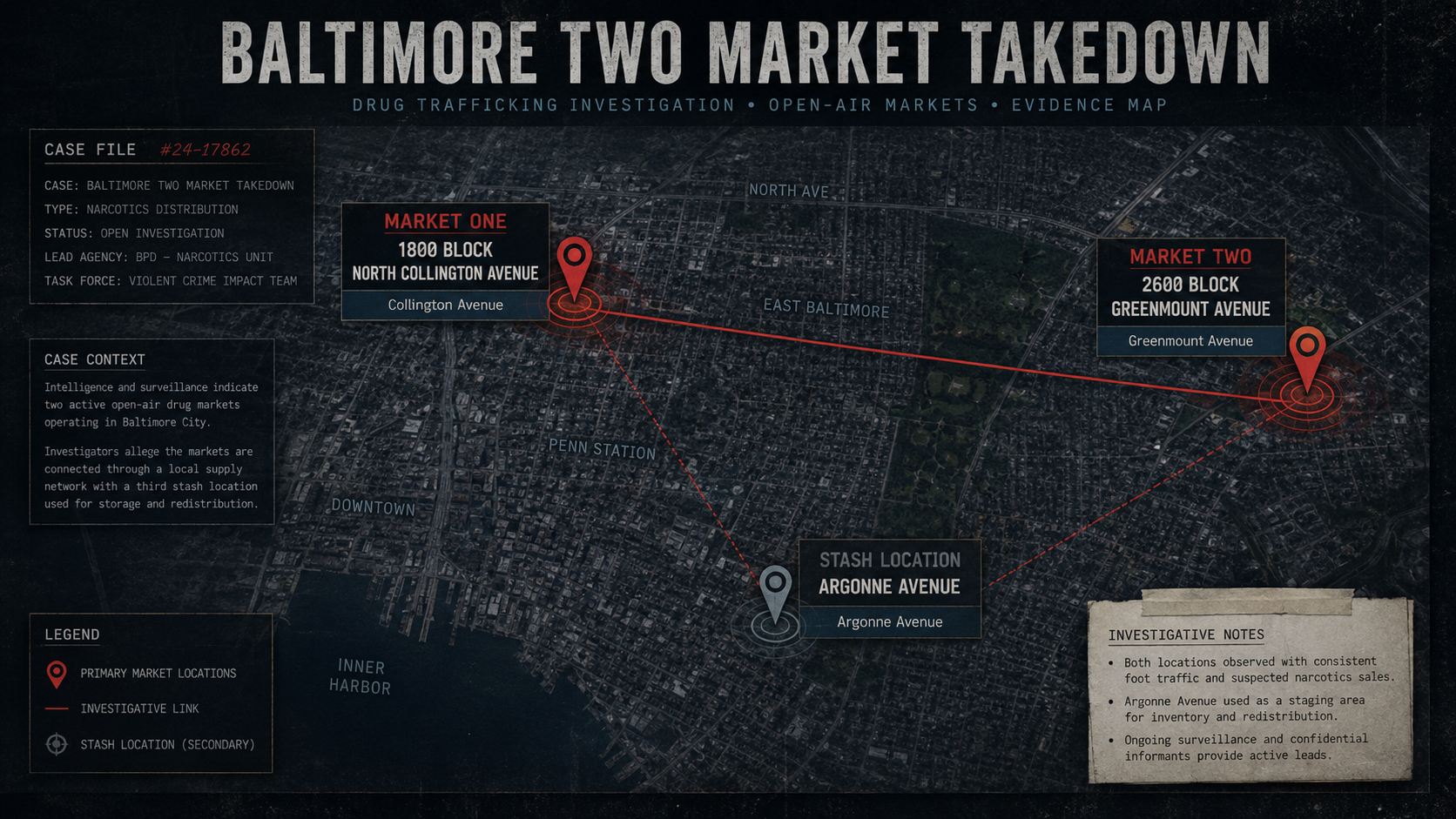
The first alleged market in the case was tied to the 1800 block of North Collington Avenue, an area prosecutors described as an open-air drug market. Investigators claimed Pryor regularly conducted narcotics sales to Alvin Edwards, Dominic Stokes, Durrell Anson, and Milton Davis. The official release also stated that Pryor was regularly meeting with Norman Thomas and Nathaniel Gardner so the three could obtain large volumes of cocaine together and divide those narcotics among themselves for distribution to their own customers.
That detail gives the file its first major structure. Prosecutors were not only describing hand-to-hand activity. They were describing an alleged supply chain, where bulk cocaine allegedly moved from higher-volume transactions into smaller street-level sales. In the state’s version of the case, Pryor functioned as one of the central figures because investigators believed he was connected to both the direct sales side and the larger procurement side involving Thomas and Gardner.
The Greenmount Avenue Expansion
After investigators received court authorization to wiretap phones connected to Norman Thomas and Nathaniel Gardner, the case allegedly opened into a second location. Prosecutors said the intercepted communications showed Thomas and Gardner were operating another drug trafficking organization on the 2600 block of Greenmount Avenue with help from David Montgomery Jr. That second location is what made the case bigger than one block, because investigators now believed the same investigation had exposed two separate street markets connected through alleged suppliers, buyers, and middle-layer distributors.
WBAL reported that officials described the Collington Avenue and Greenmount Avenue locations as less than two miles apart, with the first tied to South Clifton Park and the second connected to the Harwood neighborhood. That geography matters because it shows how the case was framed publicly: not as one isolated narcotics address, but as two active neighborhood markets operating close enough to form a compact corridor of alleged drug activity.
The Alleged Wholesale Layer
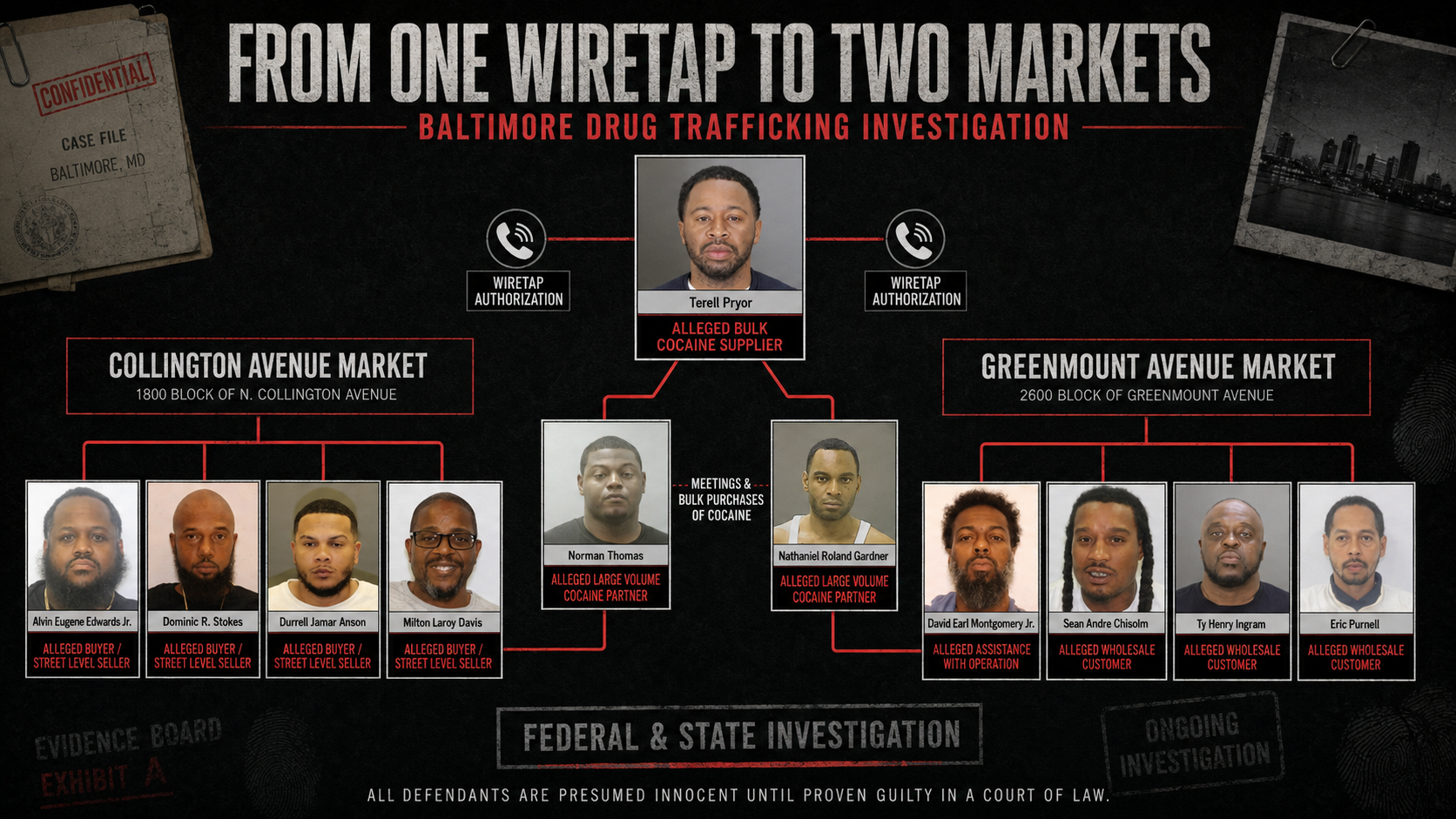
The Thomas and Gardner wiretaps became one of the most important pieces of the official narrative. Prosecutors said those communications showed Thomas and Gardner acting as wholesale cocaine suppliers to Sean Chisolm, Ty Ingram, and Eric Purnell. In the case file, this creates a second tier beneath the alleged Pryor supply line, where Thomas and Gardner are described as both buyers with Pryor and alleged suppliers to others connected to the Greenmount Avenue operation.
The public release does not lay out every recorded call, every transaction, or the full indictment count by count, but it does give enough to show the state’s theory. Pryor was allegedly tied to bulk cocaine movement around North Collington Avenue. Thomas and Gardner were allegedly tied to both Pryor and the Greenmount Avenue operation. Montgomery was named as helping with the Greenmount Avenue drug trafficking organization, while Chisolm, Ingram, and Purnell were described as alleged wholesale cocaine customers of Thomas and Gardner.
The Search Warrants
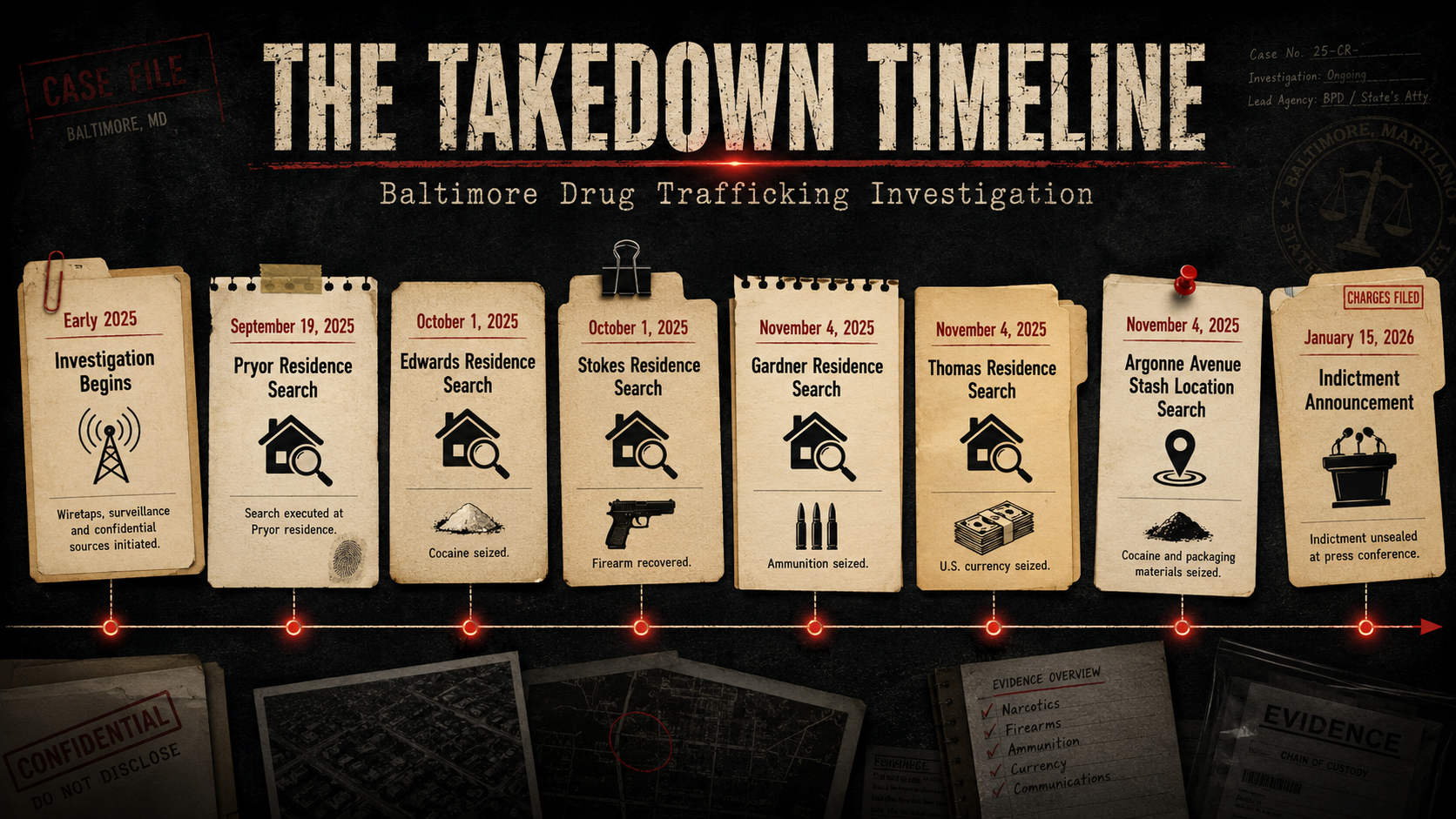
The case turned from intercepted calls into physical evidence through multiple search and seizure warrants. Prosecutors said those warrants led to the recovery of nearly nine kilograms of narcotics and more than $55,000 in cash. The search results are one of the strongest parts of the case file because they provide specific dates, residences, weapons, ammunition, narcotics, cash amounts, and packaging-related evidence that prosecutors used to support the takedown announcement.
At Terell Pryor’s residence on September 19, 2025, authorities said they recovered a loaded Glock 43X 9mm handgun, approximately five kilograms of cocaine, and $5,946 in U.S. currency. That seizure is the largest single cocaine amount listed publicly in the case, and it lines up with how prosecutors described Pryor as an alleged volume quantity supplier.
At Alvin Edwards’s residence on October 1, 2025, investigators reported finding a black Ruger LCP .380 firearm with no serial number, a Smith & Wesson Bodyguard .380, approximately 34.8 grams of a fentanyl mixture, approximately 20.11 grams of cocaine, four scales, packaging material, and approximately $1,880 in cash. That part of the seizure is important because it included narcotics, two firearms, scales, and packaging material, which prosecutors presented as evidence tied to distribution activity.
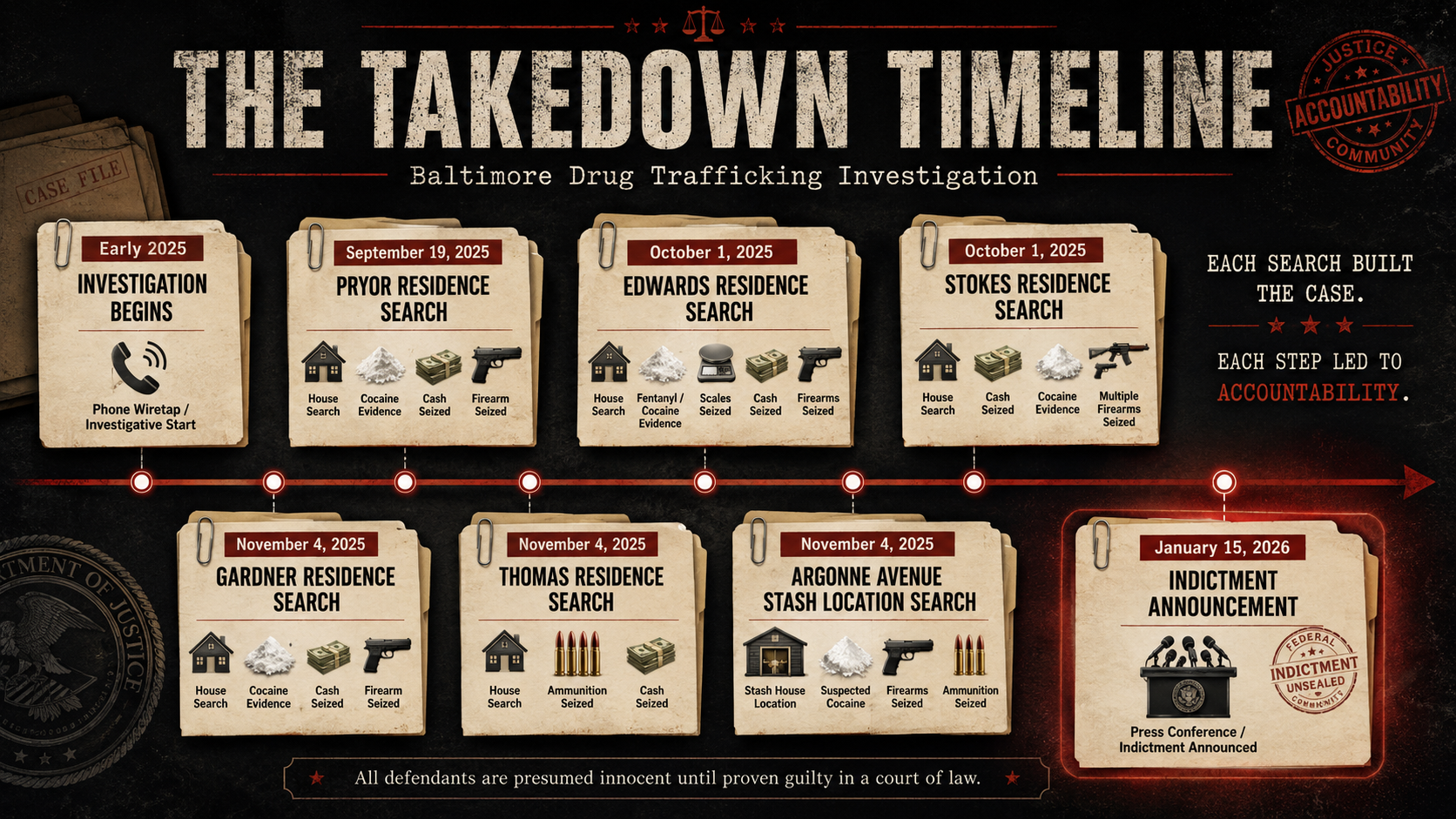
At Dominic Stokes’s residence on October 1, 2025, authorities said they recovered a Taurus 9mm model 709 with a loaded magazine, a Glock 43 9mm with a loaded magazine, a P80 frame 9mm with no serial number, a Desert Eagle 1911G with two loaded magazines, approximately six grams of cocaine, and approximately $25,000 in cash. This was the largest cash amount publicly tied to any single residence in the seizure list, and it also included multiple firearms, including a weapon with a P80 frame and no serial number.
At Nathaniel Gardner’s residence on November 4, 2025, investigators said they recovered one handgun containing a .40 caliber Glock 27 slide and a P80 frame, a loaded Glock magazine, more than three kilograms of cocaine, and $10,893 in cash. That seizure is one of the clearest reasons Gardner became a major figure in the case, because the cocaine amount was second only to what prosecutors reported from Pryor’s residence.
At Norman Thomas’s residence on November 4, 2025, authorities said they recovered 40 rounds of 9mm ammunition and $11,628 in U.S. currency. The public release does not list cocaine or a firearm from Thomas’s residence, but the ammunition and cash were still included in the official seizure summary connected to the broader investigation.
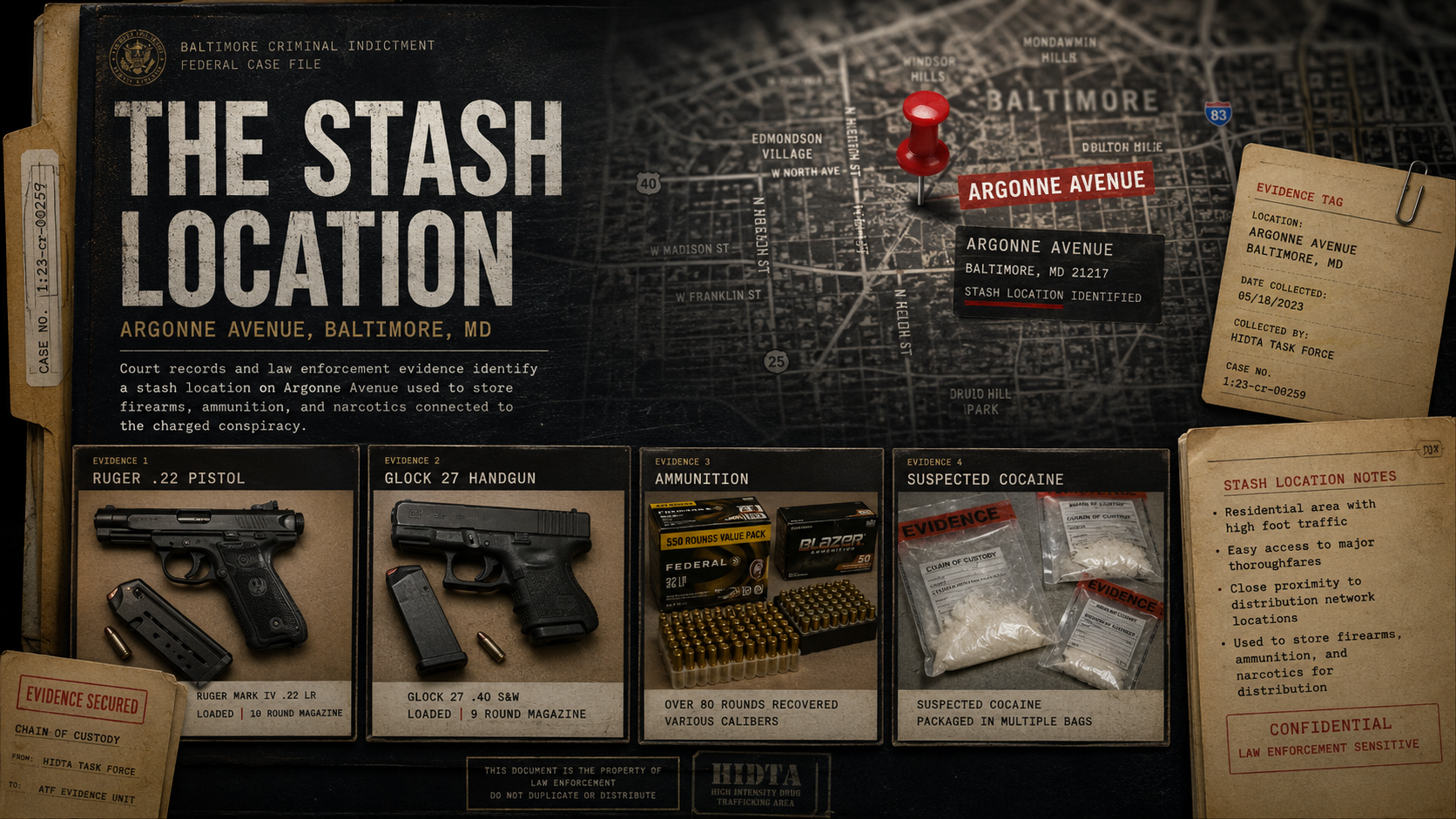
At a stash location on Argonne Avenue on November 4, 2025, investigators reported recovering a loaded Ruger .22 pistol, a Glock 27 handgun, more than 80 rounds of varying ammunition, and approximately 40 grams of suspected cocaine. The Argonne Avenue location adds another important layer because it was not presented as a residence in the public summary, but as a stash location connected to the wider investigation.
The Firearms And Ammunition
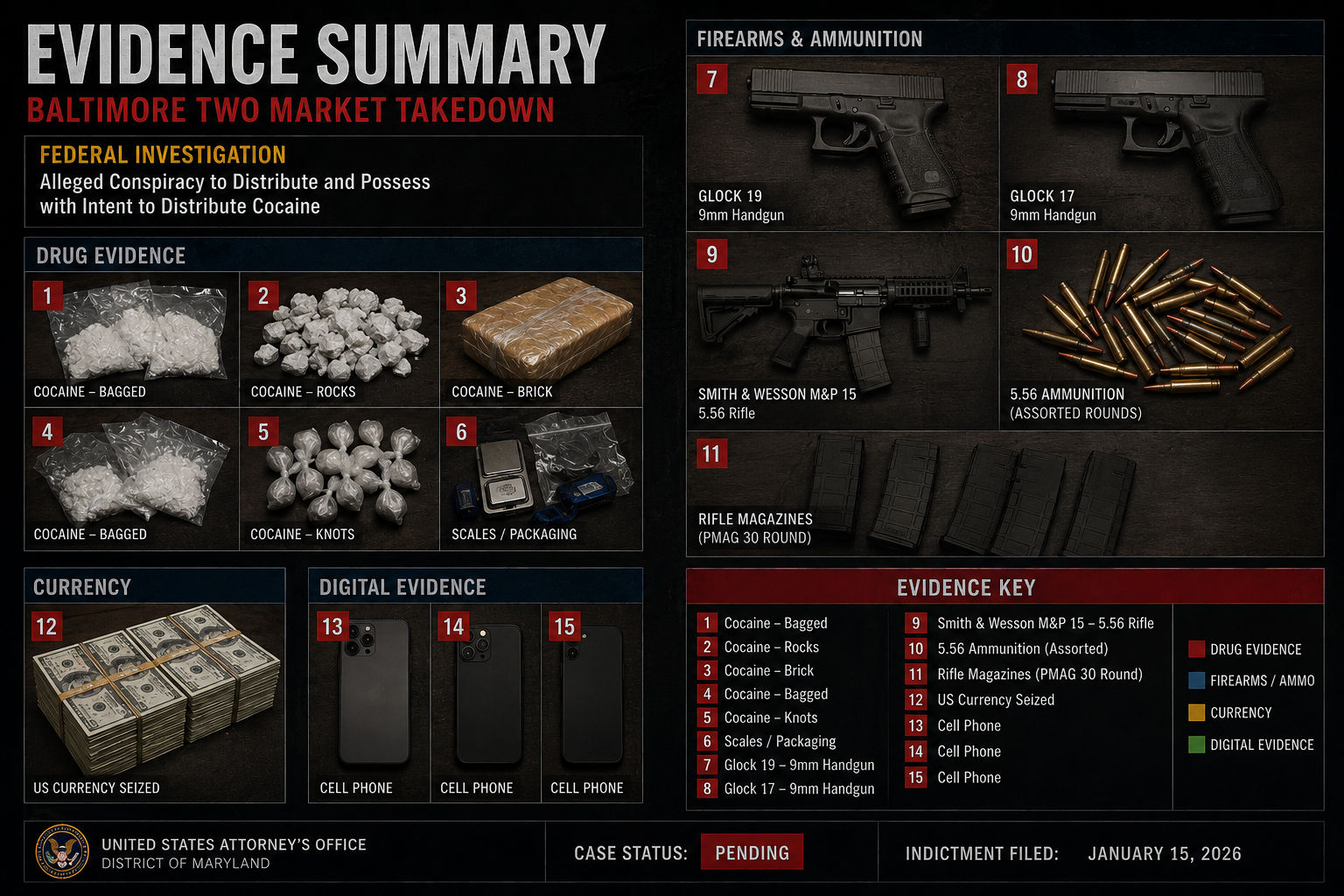
The firearm side of this case is not a minor detail. The evidence list includes a loaded Glock 43X 9mm, a Ruger LCP .380 with no serial number, a Smith & Wesson Bodyguard .380, a Taurus 9mm model 709, a Glock 43 9mm, a P80 frame 9mm with no serial number, a Desert Eagle 1911G, a handgun with a Glock 27 slide and P80 frame, a loaded Ruger .22 pistol, a Glock 27 handgun, 40 rounds of 9mm ammunition, and more than 80 rounds of mixed ammunition from the Argonne Avenue stash location. Prosecutors charged defendants with offenses that included firearm drug trafficking and possession of a regulated firearm after a felony conviction.
WBAL also reported that the seized guns would be analyzed to determine whether they were connected to violent crimes. That does not mean the firearms have already been publicly linked to specific shootings, and the case file should not claim that unless official testing results become available. What can be said is that law enforcement publicly treated the firearms as part of a larger violence-reduction effort connected to alleged drug trafficking activity in Baltimore neighborhoods.
The Charges
The defendants were charged with multiple offenses, including firearm drug trafficking, possession of a regulated firearm after a felony conviction, possession with intent to distribute cocaine, possession of CDS proceeds, and participating in a criminal organization. The public charging summary does not provide every count for every defendant in the sources currently available, so the cleanest way to present the case is to describe the overall categories of charges while making clear that the full indictment sheet would be needed for a count-by-count defendant breakdown.
The official record also makes this case slightly different from a purely federal indictment. Federal partners were involved, including the FBI, DEA, and the U.S. Attorney for the District of Maryland, but the public announcement came through the Baltimore City State’s Attorney’s Office and described the defendants as indicted on firearm and drug trafficking charges connected to Baltimore City operations. Until a separate DOJ indictment or federal docket is located, the case should be framed as a Baltimore City indictment supported by federal and local investigative partners.
The Official Facts Versus What Is Not Proven
The official facts are that prosecutors announced an 11-defendant indictment, identified two alleged open-air drug markets, described court-authorized wiretaps, named specific defendants, and listed multiple seizures from residences and a stash location. The strongest documented claims involve the two alleged markets, the alleged supply roles, the wiretap authorizations, and the physical evidence recovered during search warrants. Those details come from the State’s Attorney’s Office, FOX45, WBAL, and CBS Baltimore.
What is not proven publicly is just as important. The available reports do not provide the full wiretap transcripts, the complete indictment document, each defendant’s count-by-count charges, lab-tested narcotics confirmations for every seized item, ballistic testing outcomes, or any final conviction results. The public release also does not name a specific gang or prove that any seized firearm was used in a particular shooting. Any deeper claim about gang affiliation, specific violent incidents, or hidden motives would need to be backed by court filings, police records, or later verified reporting before it can be written as fact.
Why This Case Matters
This case matters because it gives a clear look at how Baltimore officials are targeting alleged open-air drug markets in 2026. The public story is not built around one arrest or one traffic stop. It is built around a months-long investigation that allegedly started on North Collington Avenue, expanded through wiretaps, moved into Greenmount Avenue, and ended with search warrants across multiple locations. By the end of the public announcement, the case had become a two-market takedown involving alleged suppliers, alleged street-level sellers, more than $55,000 in cash, nearly nine kilograms of narcotics, multiple loaded firearms, ammunition, and weapons with no serial numbers or P80-style frames.
The stronger angle for a premium case file is the structure. Investigators say one alleged market led them to a central supplier, the supplier’s wiretaps led them to more defendants, and the second round of wiretaps exposed another alleged operation less than two miles away. That gives the case a clean investigative chain: Collington Avenue, Pryor’s phones, Thomas and Gardner, Greenmount Avenue, Montgomery’s alleged help, Chisolm, Ingram and Purnell as alleged wholesale customers, then search warrants that produced firearms, narcotics, cash, and ammunition.
Unanswered Questions
The biggest unanswered question is what the full indictment says beyond the public summary. The press release and news reports give the broad structure, but the actual charging document would show the precise counts, the defendants tied to each charge, possible overt acts, case numbers, court dates, and any additional facts prosecutors did not include in the public announcement. Without that indictment sheet, the case file can explain the takedown, the alleged structure, and the seized evidence, but it cannot fairly assign every count or allegation to every individual beyond what prosecutors publicly stated.
Another unanswered question involves the firearms. WBAL reported that the seized guns would be analyzed for possible links to violent crimes, but the available public reporting does not confirm whether any gun was later matched to a shooting. That thread gives the case an important investigative cliffhanger, because if ballistic testing later connects any of those weapons to open violence cases, this indictment could become more than a drug-market takedown. For now, the responsible conclusion is that the firearms were seized during the investigation and testing was expected, not that any weapon has already been publicly tied to a specific act of violence.
Final Breakdown
The Collington Avenue and Greenmount Avenue indictment is a premium case because it has a clear investigative spine, specific defendants, named locations, a wiretap trail, alleged supply roles, multiple search warrants, and a detailed seizure list. Prosecutors say the case began with one alleged open-air market, expanded into another, and exposed what they described as a drug trafficking organization moving bulk cocaine through Baltimore neighborhoods. The state’s public theory centers on Terell Pryor as an alleged volume supplier, Norman Thomas and Nathaniel Gardner as alleged large-volume cocaine distributors tied to a second market, and other defendants as alleged buyers, sellers, or participants within the broader structure.
At this stage, the case should be presented as an indictment file, not a conviction file. The strongest verified material is the official announcement, the named defendants, the two alleged market locations, the wiretap authorizations, the search warrant seizures, and the publicly listed charges. The deeper story is still developing through court records, possible firearm testing, and whatever the full indictment reveals once the actual charging paperwork is pulled. For now, the case stands as one of Baltimore’s cleaner multi-agency takedown files: two markets, 11 defendants, nearly nine kilograms of narcotics, loaded firearms, ammunition, cash, and a wiretap trail that prosecutors say connected the blocks together.


