
Reporting and analysis may discuss allegations and online theories. Allegations are not findings of guilt. Verify important details in the cited public record.
THE CASE FILE
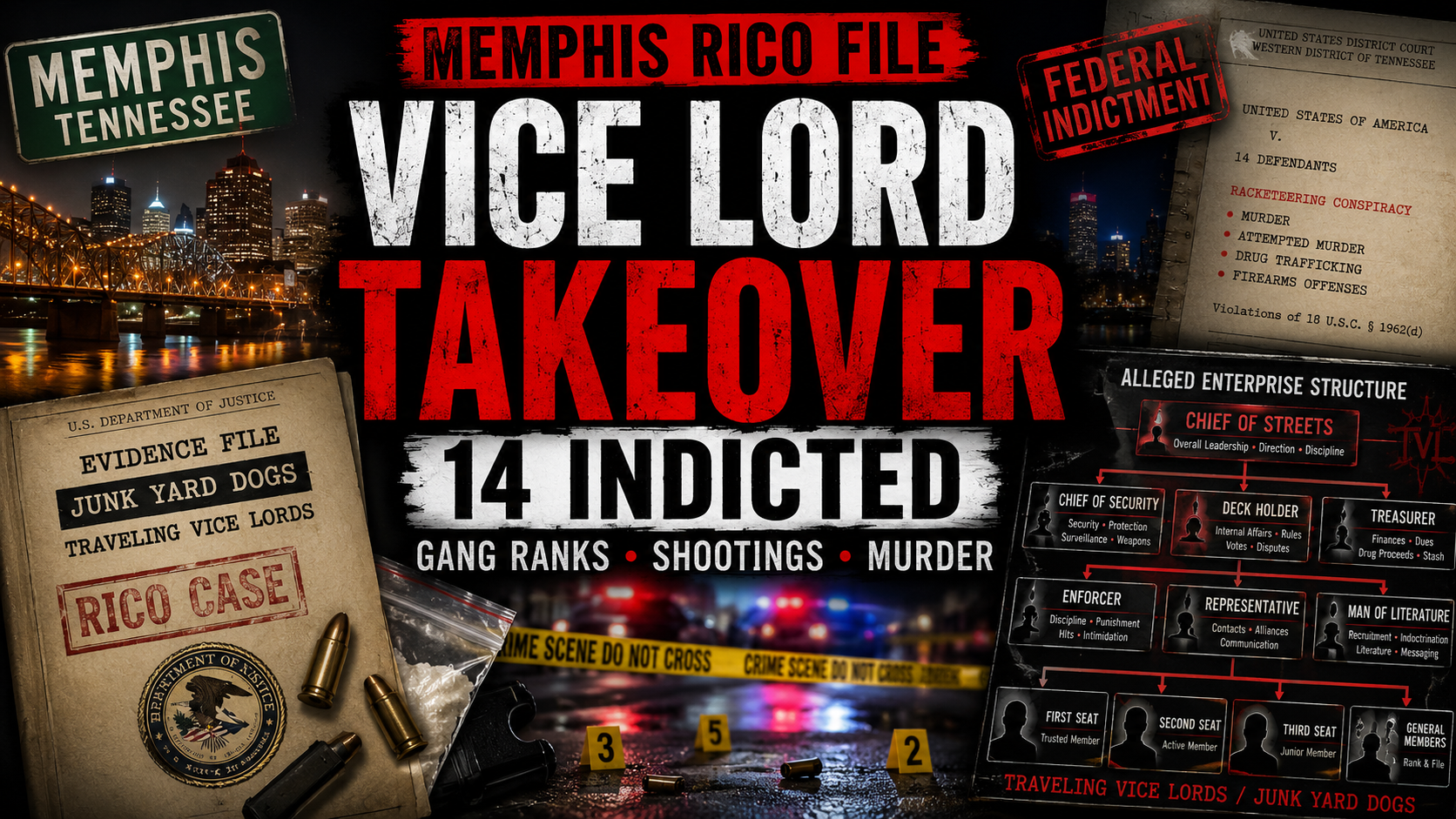
When federal prosecutors unsealed the Traveling Vice Lords and Junk Yard Dogs indictment, the case immediately stood apart from the average Memphis gang roundup because the government was not simply describing shootings or drug sales. Prosecutors were describing an alleged criminal enterprise with hierarchy, leadership roles, internal discipline, rank structures, enforcement systems, and organized retaliation operating inside one of the most violent periods Memphis had seen in years.
According to the Department of Justice, fourteen alleged members and associates were charged in a racketeering conspiracy involving murder, attempted murder, narcotics trafficking, and firearms offenses tied to the Traveling Vice Lords and Junk Yard Dogs structure operating in West Tennessee. Federal prosecutors alleged the organization functioned under the larger Almighty Vice Lord Nation while maintaining its own internal leadership and enforcement systems inside Memphis-area streets. (justice.gov)
What made the indictment different was the level of organizational detail. Prosecutors described titles, leadership responsibilities, security roles, literature positions, and disciplinary structures that resembled a criminal government more than a random neighborhood crew. The indictment attempted to show that the organization allegedly operated with continuity, rules, rank progression, and long-term criminal objectives rather than isolated violence.
This was not written like a normal street case.
It was written like an enterprise dismantling operation.
MEMPHIS DURING THE VIOLENCE WAVE
The indictment arrived during a period when Memphis was already experiencing an explosion in retaliatory shootings, carjackings, homicide spikes, interstate narcotics trafficking, and rapidly evolving gang structures. Entire neighborhoods across North Memphis, South Memphis, Frayser, Orange Mound, Hickory Hill, and Westwood were already dealing with recurring violence tied to local feuds, hybrid gang alliances, and social media conflicts escalating into shootings.
By this time, Memphis had become one of the most closely watched cities in Tennessee for violent crime trends. Police and federal authorities were increasingly concerned about organized groups operating inside the city with deeper structures than traditional neighborhood crews. Law enforcement agencies had also become focused on organizations connected to national prison and street gang systems, especially groups tied to Vice Lord and Gangster Disciple structures that stretched beyond Tennessee.
Federal investigators increasingly believed some gangs were evolving into organized criminal enterprises capable of coordinating narcotics trafficking, retaliation shootings, firearms movement, recruitment operations, and internal discipline systems simultaneously.
That broader atmosphere is important because prosecutors attempted to place the Junk Yard Dogs directly inside that environment.
The government’s position was that the alleged organization was operating as part of a much larger criminal ecosystem developing inside Memphis during this period.
THE ALLEGED HIERARCHY
One of the most unusual parts of the indictment was how deeply prosecutors broke down the internal rank structure allegedly operating inside the organization.
According to federal court documents, members allegedly held formal positions connected to authority, discipline, recruitment, finances, security, and organizational enforcement.
Prosecutors described titles including:
• Chief of the Streets
• Chief of Security
• Treasurer
• Deck Holder
• Representative
• Enforcer
• First Seat
• Man of Literature
• Five Star Universal Elite
• Three Star Universal Elite
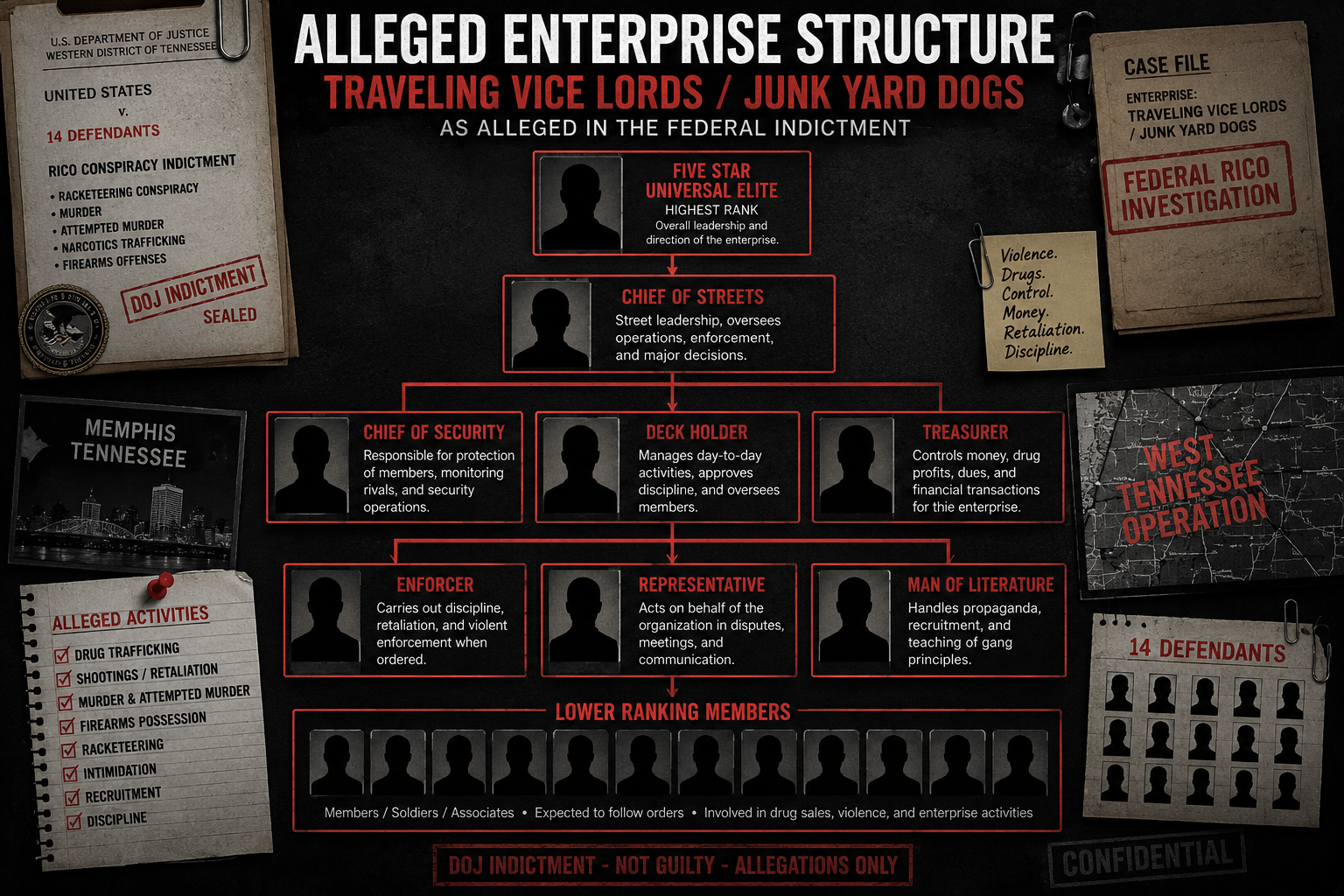
Federal prosecutors claimed these positions were not symbolic. The indictment alleged higher-ranking members supervised lower-ranking members, enforced internal rules, handled disputes, approved retaliation, managed organizational discipline, and maintained the structure of the enterprise itself.
The indictment identified Tomarcus “TC” Baskerville as an alleged Five Star Universal Elite and Chief of the Streets. Prosecutors alleged his role involved leadership authority tied to recruitment, discipline, organizational management, and enforcement operations inside the alleged enterprise.
The DOJ also referenced internal literature, organizational teachings, meetings, and rank-related communication that prosecutors argued showed continuity and structure inside the organization. Investigators attempted to prove the enterprise functioned with leadership systems and operational stability instead of random acts of violence by unrelated individuals.
That structure became one of the strongest pillars of the federal racketeering case.
THE JUNK YARD DOGS STRUCTURE
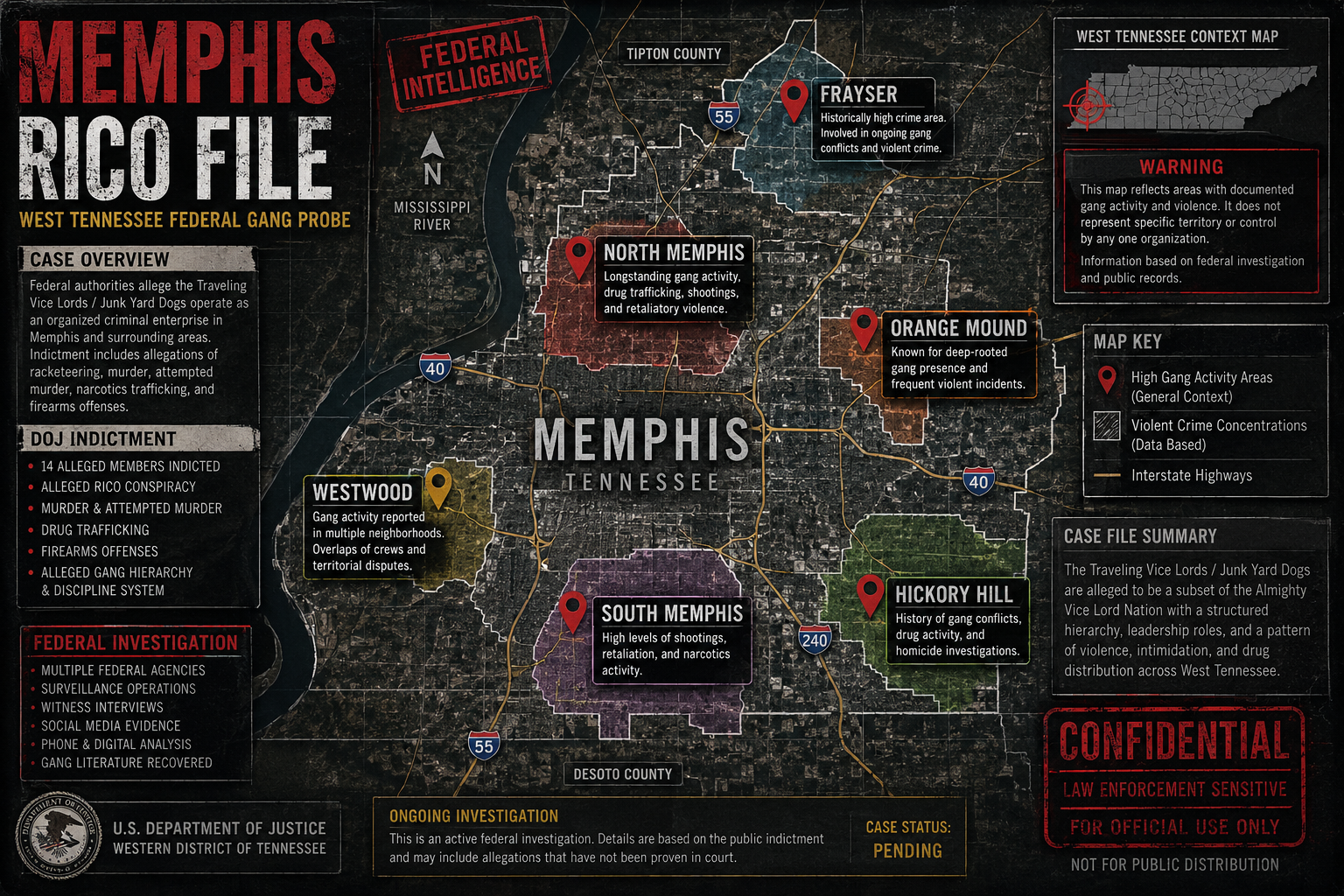
According to prosecutors, the Junk Yard Dogs operated as a Traveling Vice Lord subset with its own identity, leadership, and internal expectations for members. Federal authorities alleged members were expected to benefit the organization through narcotics trafficking, loyalty enforcement, retaliation, and protection of the gang’s reputation.
The indictment repeatedly described the organization as a coordinated enterprise rather than a loose street affiliation.
Federal prosecutors alleged members acted collectively to maintain influence and respond to rival activity. Court records also suggested the organization allegedly relied on violence and intimidation to strengthen authority and maintain discipline.
The “Chief of Security” and “Enforcer” roles became particularly notable because prosecutors claimed those positions were directly tied to maintaining control and organizational protection.
According to the government, the organization allegedly relied on both fear and hierarchy to maintain operational stability.
THE SHOOTINGS AND RETALIATION
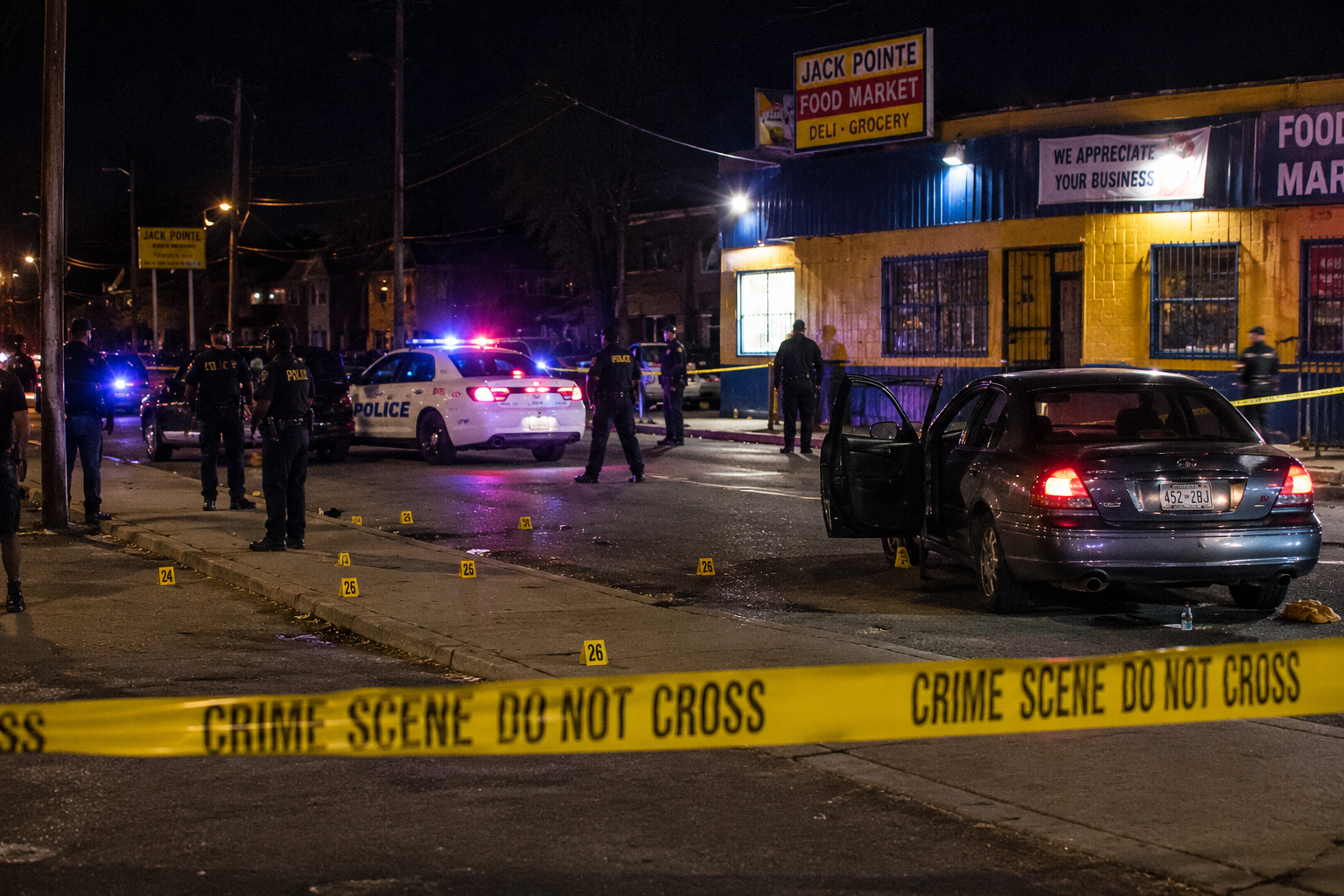
Violence sat at the center of the federal racketeering theory.
According to prosecutors, the organization was connected to retaliatory shootings, attempted murders, firearms offenses, and homicide allegations tied to gang rivalries and organizational enforcement. The indictment accused members of possessing firearms during gang-related activity and participating in acts of violence connected to the alleged enterprise.
Federal authorities repeatedly emphasized retaliation.
Investigators argued the violence was not random street chaos but allegedly connected to maintaining status, enforcing loyalty, protecting territory, and responding to disrespect from rivals. Prosecutors attempted to show that shootings allegedly functioned as part of the organization’s broader operations rather than isolated emotional disputes.
This distinction mattered because the government was building a RICO conspiracy case instead of simply prosecuting individual shootings one by one.
Federal prosecutors wanted the court to view the violence as organizational behavior.
THE DRUG TRAFFICKING ALLEGATIONS
According to the indictment, narcotics trafficking played a major role inside the enterprise.
Federal prosecutors alleged members distributed controlled substances throughout parts of West Tennessee while using profits to benefit the organization and maintain operations. Investigators claimed members worked together in drug trafficking activity connected directly to the enterprise structure itself.
The government also alleged firearms were possessed and used during narcotics operations tied to the organization.
This combination of drugs, firearms, retaliation, and rank-based structure became one of the most important elements of the case because prosecutors attempted to present the organization as a fully functioning criminal enterprise generating money while enforcing power through violence.
THE FEDERAL INVESTIGATION
The investigation itself reportedly involved multiple agencies and developed into a broader long-term federal operation focused on proving the existence of an organized criminal enterprise.
According to court records and DOJ statements, investigators used surveillance operations, witness testimony, social media evidence, gang literature, intercepted communications, and firearms evidence during the investigation. Federal prosecutors also examined online activity allegedly connected to members of the organization.
Like many modern gang investigations, social media reportedly became an important part of the federal case. Investigators allegedly used photographs, communications, online affiliations, and public activity to establish relationships between defendants, identify rank structures, and support claims involving organizational identity.
The government attempted to build continuity between shootings, narcotics activity, firearms possession, leadership positions, and communication between members in order to support the racketeering conspiracy itself.
Instead of proving one isolated crime, prosecutors attempted to prove an entire organizational ecosystem.
THE MEMPHIS GANG TRANSFORMATION
Part of what made this indictment important locally was what it represented about the changing gang landscape inside Memphis.
For years, many Memphis crews were viewed publicly as mostly neighborhood-based groups with shifting alliances and local disputes. But by the time of this indictment, federal authorities increasingly believed some organizations were evolving into more structured enterprises connected to prison systems, national gang affiliations, and interstate criminal activity.
The Traveling Vice Lords indictment reflected that shift.
Federal prosecutors were no longer describing random neighborhood conflicts alone. They were describing an alleged organization with rank systems, leadership authority, organized retaliation, financial objectives, and internal governance structures.
At the same time, Memphis was experiencing historic levels of violence. Retaliatory shootings often happened rapidly, social media disputes escalated into real-world killings, and younger recruits were increasingly pulled into gang environments shaped by both local conflicts and larger national gang systems.
The government’s theory suggested the Junk Yard Dogs operated directly inside that transformation.
THE OFFICIAL FACTS VS THE STREET REPUTATION
Officially, the DOJ focused on the indictment, the alleged racketeering structure, and the criminal acts prosecutors tied directly to the organization.
Online discussions quickly expanded far beyond the official allegations.
Some discussions exaggerated the organization’s size and influence, while others compared the hierarchy described in the indictment to organized crime structures or old-school Chicago gang governments. The titles themselves became one of the most discussed parts of the case because many people were shocked by how formal the alleged structure appeared inside federal documents.
Still, the confirmed allegations remained limited to what prosecutors specifically charged in court.
The indictment accused the defendants of participating in an organized racketeering conspiracy involving violence, firearms offenses, narcotics trafficking, and retaliatory activity connected to the Traveling Vice Lords and Junk Yard Dogs structure.
Anything beyond those allegations entered speculation territory.
THE FINAL BREAKDOWN
What made this indictment stand out was not simply the violence because Memphis has seen violent gang prosecutions before.
What made this case different was the structure federal prosecutors claimed existed underneath the violence. The DOJ attempted to present the Traveling Vice Lords and Junk Yard Dogs as an organized enterprise operating with hierarchy, discipline systems, leadership positions, rank progression, narcotics operations, retaliatory violence, and internal enforcement mechanisms tied together under one organization.
The indictment painted a picture of a group allegedly functioning with rules, authority systems, financial objectives, and coordinated criminal activity instead of isolated street crimes committed independently.
That is why the case immediately drew attention across Memphis.
The federal government was not simply alleging gang violence.
Prosecutors were alleging an entire organizational framework behind it.