

Reporting and analysis may discuss allegations and online theories. Allegations are not findings of guilt. Verify important details in the cited public record.
The Case File
The Bermuda Run bust did not begin as a simple traffic stop, a street-corner arrest, or a single firearm recovery. It began with Memphis Police already focused on a residence in the 2100 block of Bermuda Run on February 18, 2026, when officers from the Multi-Agency Gang Unit and the Fugitive Unit moved in during an investigation that ended with six people in custody. MPD’s public case number for the release is 2602025387ME.

What makes the file stand out is the way several layers opened at once. MPD says the people inside were known or confirmed gang members. One defendant was allegedly out on bond for attempted second-degree murder. Another had active federal weapon-related warrants. Inside the home, police reported marijuana, pills, rifles, handguns, a scale, cash, and a vehicle with a fraudulent VIN. The official record does not name the gang, does not identify who owned the residence, and does not explain the full intelligence that brought investigators to Bermuda Run, but the pieces that were released point to a larger enforcement target than one isolated drug seizure.

The Bermuda Run Operation
According to Memphis Police, officers with the Multi-Agency Gang Unit and Fugitive Unit were conducting an investigation at the residence when the arrests happened. The public release does not describe the beginning of the investigation, but it does make one detail clear: this was not a situation where police discovered the group by accident. The unit involved, the address, the suspects, and the warrant all point to a pre-planned enforcement action.

As officers surrounded the residence, MPD says they were alerted that one or more occupants were attempting to escape through the attic. That detail turns the file from a normal search-warrant story into something more urgent. Before police even describe the drugs, guns, or charges, the official version places the suspects inside a home with officers outside and at least one person allegedly trying to move upward through the structure rather than leave through a door.
Officers entered the residence and located six people inside. MPD described them as confirmed gang members and said all six were taken into custody. While securing the home, police reported seeing marijuana and a handgun in plain view in the living room. That plain-view observation became the first visible layer of the case before the search warrant revealed the rest of the evidence.
The Search Warrant

After the residence was secured, the Multi-Agency Gang Unit executed a search warrant. MPD says officers recovered two rifles, two handguns, nearly eight pounds of marijuana, Alprazolam pills, a digital scale, and a large amount of cash. Local reporting from Action News 5 repeated the same core evidence list and identified the search as a raid at a Bermuda Run home.
The evidence list is compact, but it carries multiple meanings. The four firearms created the weapons layer. The nearly eight pounds of marijuana created the possession-with-intent layer. The Alprazolam pills created the prescription-drug layer. The digital scale and cash added the distribution context police used to frame the search as more than personal-use possession. What the public release does not include is also important: no firearm serial numbers, no exact cash total, no owner of the guns, no fingerprint results, no lab testing details, and no statement explaining which item was allegedly connected to which defendant.
The Nissan Murano
The vehicle detail is one of the most important parts of the file because it sits slightly outside the house search. During the investigation, MPD says officers located a Nissan Murano at the residence. One of the detained individuals allegedly had keys to the vehicle, and police found that the vehicle had a fraudulent VIN. The Murano was towed for further investigation.
That does not mean the public record proves the vehicle was stolen, used in a crime, or tied to any other incident. The release does not go that far. What it does prove is that investigators found a vehicle at the scene with a VIN issue serious enough to remove it from the location and continue investigating. In a case already involving guns, drugs, warrants, and alleged gang affiliations, the fraudulent VIN creates a separate investigative thread that could matter later if court records or follow-up charges reveal more.
The Six Names Charged

MPD listed six defendants in the Bermuda Run case. The charges are allegations at this stage, not convictions.
Robert Young, 30, was charged with possession of a controlled substance with intent to manufacture, deliver, or sell marijuana; possession of a legend drug without a prescription; possession of drug paraphernalia; and possession of a firearm during the commission of a dangerous felony.
Decorian Young, 31, was charged with possession of a controlled substance with intent to manufacture, deliver, or sell marijuana; possession of a legend drug without a prescription; possession of drug paraphernalia; and possession of a firearm during the commission of a dangerous felony.
Antonio Benton, 29, was charged with possession of a controlled substance with intent to manufacture, deliver, or sell marijuana; possession of a legend drug without a prescription; possession of drug paraphernalia; and possession of a firearm during the commission of a dangerous felony.
Mardarius Lee, 30, was charged with possession of a controlled substance with intent to manufacture, deliver, or sell marijuana; possession of a legend drug without a prescription; possession of drug paraphernalia; possession of a firearm during the commission of a dangerous felony; and convicted felon in possession of a handgun. MPD also stated that Lee had active federal warrants for weapon-related charges.
Kordae Johnson, 19, was charged with possession of a controlled substance with intent to manufacture, deliver, or sell marijuana; possession of a legend drug without a prescription; possession of drug paraphernalia; and possession of a firearm during the commission of a dangerous felony.
Quentin Burnside, 25, was charged with possession of a controlled substance with intent to manufacture, deliver, or sell marijuana; possession of a legend drug without a prescription; possession of drug paraphernalia; and possession of a firearm during the commission of a dangerous felony. MPD also said Burnside had outstanding warrants for attempted second-degree murder, seven counts of reckless endangerment with a deadly weapon, and employment of a firearm during the commission of a dangerous felony.
The Burnside Layer

Quentin Burnside is the name that gives the Bermuda Run file its most serious violent-crime connection. MPD says Burnside was out on bond for attempted second-degree murder at the time of his arrest. Police also identified him as an MPD Aggravated Assault Prolific Offender and claimed he had been linked to multiple violent crimes throughout Memphis.
The U.S. Marshals Service also singled out Burnside in its Memphis Safe Task Force update. According to the Marshals, Burnside was arrested in the 2100 block of Bermuda Run for possessing a firearm during the commission or attempted commission of a dangerous felony, possession with intent to distribute, possession of a prescription drug without a prescription, and possession of drug paraphernalia. The Marshals said officers recovered marijuana and Alprazolam.
That matters because Burnside’s arrest is documented in both the Memphis Police release and the U.S. Marshals task force update. MPD gives the local case details and the outstanding warrant list. The Marshals place the arrest inside a broader one-day enforcement sweep across Memphis. Together, the two releases show that Bermuda Run was not just being treated as a neighborhood drug search. It was folded into a larger violent-crime enforcement push.
The Federal Warrant Thread

Mardarius Lee adds another serious layer to the case. MPD says Lee was charged as a convicted felon in possession of a handgun and also had active federal warrants for weapon-related charges. The public release does not identify the federal case number, the issuing court, the exact warrant offense, or whether the federal matter was connected to the Bermuda Run search.

That limitation matters. The file can say Lee had active federal weapon-related warrants because MPD said it. It cannot claim those warrants came from this same investigation, involved the same firearms, or connected to the same group unless a federal complaint, indictment, or docket confirms it. Right now, the official record gives the federal-warrant fact, but not the federal-warrant story.
The Memphis Safe Task Force Context
The Bermuda Run arrests landed inside a much larger enforcement wave. On February 19, 2026, the U.S. Marshals Service said the Memphis Safe Task Force had executed 49 criminal arrests, including one juvenile, and recovered 12 illegal firearms on Wednesday. Burnside was one of the highlighted arrests from that operation.

The Marshals described the Memphis Safe Task Force as a multi-agency initiative that began in September 2025 and included federal, state, and local law enforcement, along with the Tennessee National Guard. The task force said its focus was arresting violent offenders, clearing warrants, seizing firearms, and locating missing children. By the time of the February 2026 update, the task force reported 6,269 arrests, including 35 for homicide, 686 for controlled substances, 550 for firearms violations, and 1,023 illegal firearms seized.
That context changes how the Bermuda Run case reads. The house search was one address, but it was also part of a citywide enforcement machine built around fugitives, guns, warrants, drugs, and violent-crime targets. Burnside’s name appeared in that task force update because the arrest fit the type of case the operation was designed to highlight.
Official Facts Versus Unconfirmed Claims
The official record confirms the date, the 2100 block of Bermuda Run, the units involved, the six arrests, the evidence recovered, the Nissan Murano with a fraudulent VIN, and the charge list released by MPD. It also confirms that the U.S. Marshals placed Quentin Burnside’s arrest inside the Memphis Safe Task Force’s wider February 2026 enforcement update.
The official record does not name the specific gang or set. It does not explain who lived at the residence. It does not say who allegedly tried to escape through the attic. It does not say who owned the guns. It does not identify which defendant allegedly possessed which specific weapon. It does not provide the exact amount of cash. It does not give the VIN history of the Nissan Murano. It does not include body-camera footage, surveillance footage, an affidavit, or a full probable-cause statement.
That missing information is the difference between a strong arrest file and a fully reconstructed investigation. The public release gives enough to build the outline, but the deeper file would require court records, affidavits, warrant returns, jail records, and any federal docket tied to Lee’s alleged weapon warrants.
The Evidence Breakdown
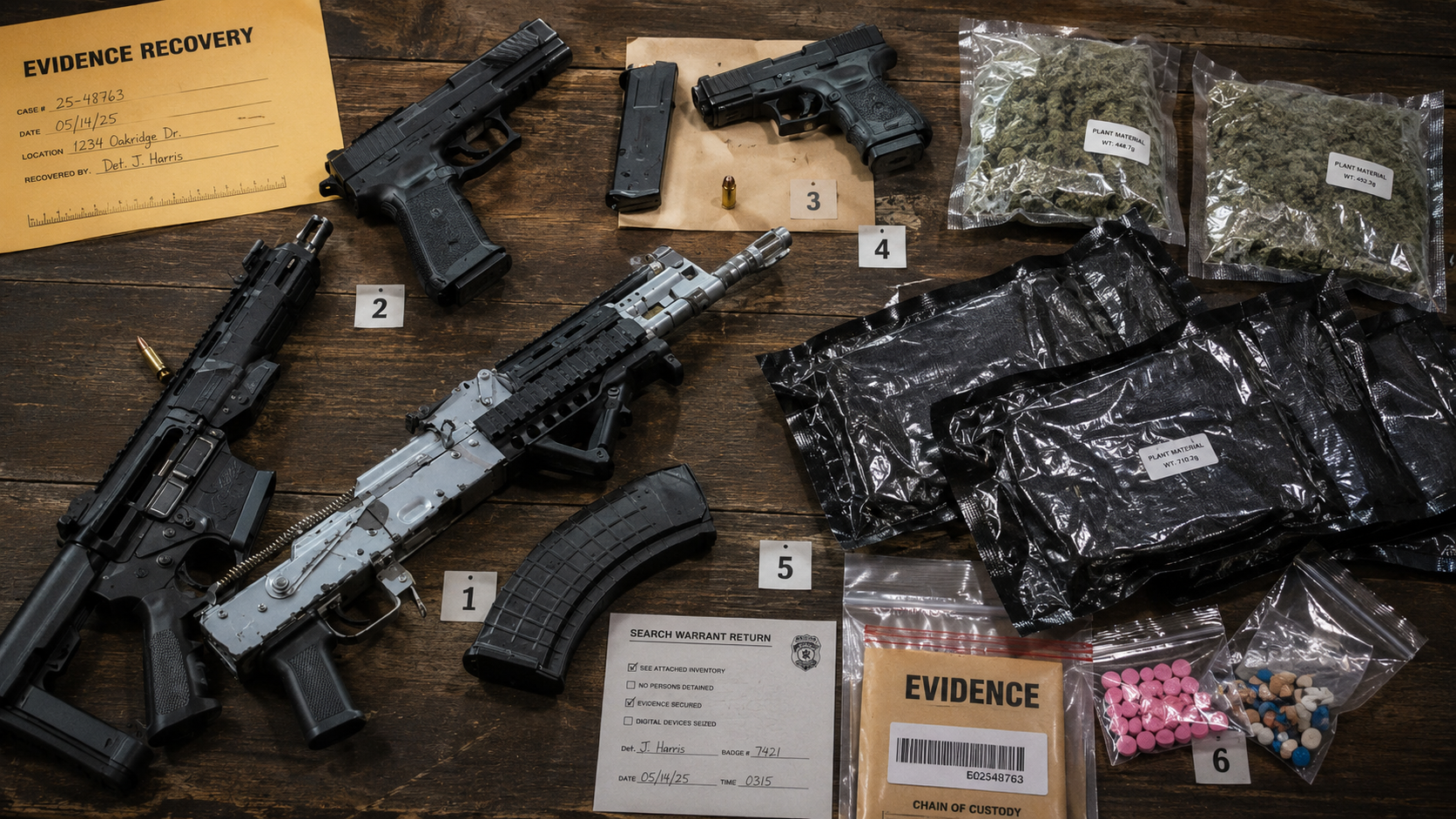
The weapons recovery sits at the center of the case because every defendant listed by MPD was charged with possession of a firearm during the commission of a dangerous felony. Police reported four firearms in total: two rifles and two handguns.
The narcotics evidence drives the possession-with-intent charges. MPD reported nearly eight pounds of marijuana, Alprazolam pills, and a digital scale. Those items were not described as separate discoveries from separate rooms in the public release, so the case file cannot assign them to bedrooms, vehicles, individuals, or containers without additional documents.
The cash is mentioned but not quantified. MPD called it a large amount of cash, while Action News 5 repeated the same description. Without an exact figure, the cash can be described as part of the seizure, but it should not be turned into a specific money claim.
The fraudulent VIN vehicle is the final evidence thread. It does not sit neatly inside the drug-and-gun charges, but it signals that investigators had a reason to preserve the vehicle for further review. At this stage, that part of the file remains open-ended because MPD did not release the result of the vehicle investigation.
The Unanswered Questions
The biggest unanswered question is what brought investigators to the Bermuda Run residence in the first place. MPD says officers were conducting an investigation, but the release does not say whether the target was a fugitive, a gang investigation, a narcotics complaint, a firearm investigation, surveillance intelligence, or a warrant connected to one of the six men.
The second unanswered question is the attic. MPD says officers were alerted that one or more occupants were attempting to escape through the attic, but the release does not identify who allegedly made that attempt or how officers were alerted. That detail is powerful, but incomplete.
The third unanswered question is ownership. The guns, drugs, pills, scale, cash, and vehicle are all listed as recovered evidence, but the public release does not assign every item to an individual defendant. In a house with six people inside, that distinction can become important later if defense arguments challenge possession, knowledge, or control.
The fourth unanswered question is the gang identification. MPD called the defendants known or confirmed gang members, but did not name a specific organization or explain the evidence used to classify them that way. That means the case can accurately use MPD’s wording, but it cannot build a specific gang-war theory from the release alone.
Final Breakdown
The Bermuda Run bust is built around one address, six arrests, four guns, nearly eight pounds of marijuana, Alprazolam pills, a digital scale, cash, and a Nissan Murano with a fraudulent VIN. The case becomes heavier because of the people attached to it: Quentin Burnside, who MPD says was out on bond for attempted second-degree murder and wanted on additional violent felony warrants, and Mardarius Lee, who MPD says had active federal weapon-related warrants.
The official record does not reveal the entire investigation. It gives the entry point, the seizure, the names, and the charges. What remains hidden is the intelligence behind the raid, the ownership of the evidence, the gang identity, the full story behind the fraudulent VIN vehicle, and the cases sitting behind Burnside’s and Lee’s outstanding warrants.
For now, the public file shows a Memphis enforcement operation that started at a Bermuda Run residence and quickly widened into a firearms, narcotics, fugitive, and task force case — one house search folded into a much larger push to take guns, wanted suspects, and alleged gang-linked offenders off the street.